























Now that basic and higher rate taxpayers will have to pay an additional 2% on dividend income, what is the best way for business owners to take profits tax efficiently? David Downie, Technical Manager at Aberdeen Adviser, crunches some numbers.

Business owners are having to reassess how they take profits from their company in light of changes to both NI and dividends.
Taking profits in the form of dividends rather than salary has been the default position for many small businesses.
From April basic and higher rate taxpayers will pay an additional 2% on dividend income. This follows on the back of changes to NI which have seen an increase to the rate paid by employers and threshold at which they pay NI almost halved.
While employer NI has been on the rise there has been a 4% cut to employee NI reducing the liability for those taking salary rather than dividends.
And of course, pension funding is an alternative to taking dividends or salary. There has always been a strong argument of extracting profits in this way where clients have a need to save for retirement.
This is principally because dividends are paid after corporation tax, whereas an employer pension payment is an allowable deduction from profits before corporation tax.
The amount that can be contributed on behalf of an individual this year is potentially up to £240,000 as the annual allowance has now been £60,000 for the current year and each of the previous three carry forward years.
Provided a company has the profits to justify a contribution, corporation tax relief will normally be allowed.
Taking profits tax efficiently
Business owners will look to benefit from their hard-earned profits in the most tax efficient way. When paying themselves for day-to-day living, the choice will usually be between salary/bonus or dividend.
Dividends are paid after corporation tax and the dividend rates are less than the income tax rates on salaries, although this gap is closing following this year’s rise in basic and higher dividend rates by 2%.
Factors to consider
When reviewing the most tax efficient way of extracting profits there are a number of tax rates and allowances that can affect outcomes. The main ones include:
- National Insurance (NI) rates and thresholds for both employers and employees
- Corporation tax rates
- Income tax rates and bands
- Dividend tax rates and allowances
- Tax reliefs on pension contributions and limits on how much can be paid in
There is clearly an ongoing need to review how profits are taken as all of these factors can change. Owners should not just pick a strategy and stick to it. In the last three years alone we have seen:
- Employer NI rise to from 13.8% to 15%
- The threshold for employer NI drop from £9,100 to £5,000
- Employee NI rate drop from 12% to 8%
- Dividend rates for basic and higher rate taxpayers increase by 2% to 10.75% and 35.75% respectively
This is on top of recent reductions in the dividend allowance which has fallen from £5,000 to just £500 since its introduction in 2016.
In reality, many business owners may pay themselves a mixture of both salary and dividend. But what about profits in excess of their living needs?
One option may be to leave the net amount after corporation tax in the company as working capital or to fund the development of the business, potentially increasing share values.
Alternatively, an employer pension contribution combines the key advantages of both salary and dividends. They are an allowable deduction against corporation tax, as with salary or bonus, but without the employer/employee NI liability, like dividends.
Building up retirement savings by taking profits as a pension contribution also diversifies risk for owners who will not have to rely solely on the fortunes of their company to see them through their retirement.
And for those who do need access to maintain normal living standards, a modern flexible pension will allow directors over 55 (57 from April 2028) to access it as easily as salary or dividends.
With 25% of the pension pot normally available tax free, it can be very tax efficient – especially if the income from the balance can be taken within the basic rate. But remember that taking drawdown income will trigger the MPAA, potentially restricting future saving options.
Crunching the numbers
The table below compares the net benefit ultimately derived from £10,000 of gross profits to a higher rate taxpaying shareholding director in the 2026/27 tax year.
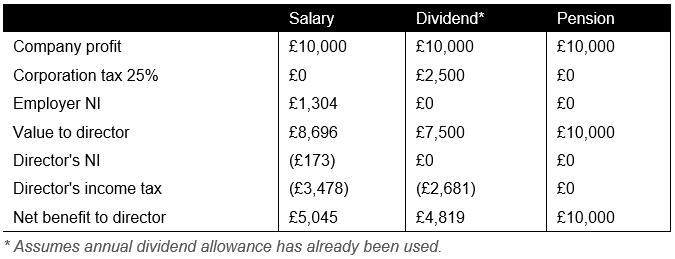
*Assumes annual dividend allowance has already been used.
Although there is not much between the net value to a director between the salary and dividend routes, it may come as a surprise to some as the headline rates on dividends are still less than the main income tax rates.
Clearly the dividend route may not always be the most efficient route. The outcome may change slightly in favour of the dividends if the dividend allowance is available or if some or all the dividend falls into the basic rate band.
But if the director doesn’t need this living income, taking profit in the form of an employer pension contribution will approximately double what they would receive by taking a salary, bonus or dividend.
When the client takes money from their pension during their lifetime to support their retirement, the figures still compare favourably.
If the £10,000 fund is taken when the director is a basic rate taxpayer, net spendable income will be £8,500** (or £7,000** if taken as a higher rate taxpayer).
For the figures in this example, that is respectively 68% and 39% more than the salary option, and 76% and 45% more than the dividend option.
** Assumes pension income includes 25% tax free cash. Growth has been ignored.
Pension considerations
From 6 April 2027, unused pension funds will be included in a client’s estate for IHT.
For deaths before the age of 75 there could also be a charge on the value above lump sum and death benefit allowance (LSDBA) if unused pensions are used to provide a lump sum to a beneficiary.
This can simply be avoided if the right nominations are made, allowing a beneficiary to take their benefits under drawdown. There will be no income tax on such payments.
For deaths after age 75, there is no LSDBA charge to consider, but there is the prospect of an IHT charge on the total value of unused funds, and an income tax charge on the beneficiary when they make withdrawals from the remainder.
Holistically, this may change which assets are used to meet retirement needs. For example, an individual may choose to draw from their pension pot instead of their ISA savings, particularly if the taxable part of the pension income can be covered by the personal allowance.
It should be noted, however, that any unused pension will not be subject to IHT if left to a surviving spouse or civil partner.
The pension could therefore be providing an income for many years, significantly reducing the unused pot ultimately exposed to an IHT charge.
Tapered Annual Allowance
Since the abolition of the Lifetime Allowance, there is no longer a tax-advantaged cap on the size of pension funds, but the amounts that can be paid in are still limited.
Many high earning business owners with ‘adjusted income’ in excess of £260,000 could see their annual allowance (AA) tapered down, potentially to just £10,000. Adjusted income broadly includes earnings, employer contributions and other income.
However, reducing what they take in salary or dividends and paying themselves a larger employer pension contribution instead could mean they retain their full £60,000 AA. This is because employer contributions do not count towards ‘threshold income’.
Summary
Frequent changes to tax and NI demand that profit extraction should be reviewed on a regular basis.
Extracting profits over and above what’s needed for day-to-day living via an employer pension contribution remains the best way of providing for an income in retirement for most people.
It could also be key to retaining certain income related allowances such as the pension annual allowance and the personal allowance.
Moving wealth out of the company and into a pension can also diversify risk for business owners when planning for retirement.
Main image: calculator, tax, towfiqu-barbhuiya-JhevWHCbVyw-unsplash