




















AS we head towards April 2027, Julia Peake – Technical Manager at Nucleus, uses a case study to illustrate the potential impact of the changes to IHT on pensions and highlights some of the planning considerations.

From 6 April 2027, most unused pension funds will be included in the value of a deceased person’s estate for inheritance tax (IHT) purposes subject to some exclusions.
For paraplanners, the implications extend beyond calculating an additional tax liability. Beneficiary nominations, the use of available nil-rate bands and the surviving spouse’s position all need to be considered together.
The following is a case study looking at a particular client set of circumstances and we know this could be very different to some of the clients you deal with.
Married couple with one child first and second death (all allowances, asset values and tax rates to remain constant)
Ben, 75, and Lisa, 70, are married and have a daughter, Tracy, aged 43. Ben dies shortly after his 75th birthday and has the following assets:
- £600,000 main residence total value (£300,000 each)
- £50,000 cash
- £70,000 ISA
- £80,000 personal effects
- £1.2m pension.
- Total £1,700,000
The beneficiaries:
- Lisa inherits Ben’s share of the house under joint survivorship, and all non-pension assets as per his Will. There is a spousal exemption and so no RNRB is used. She also inherits 60% of the pension
- Tracy inherits 40% of pension.
- Lisa is a basic rate taxpayer, and Tracy is a higher rate taxpayer
Ben has made no non-exempt gifts in the previous seven years before his death.
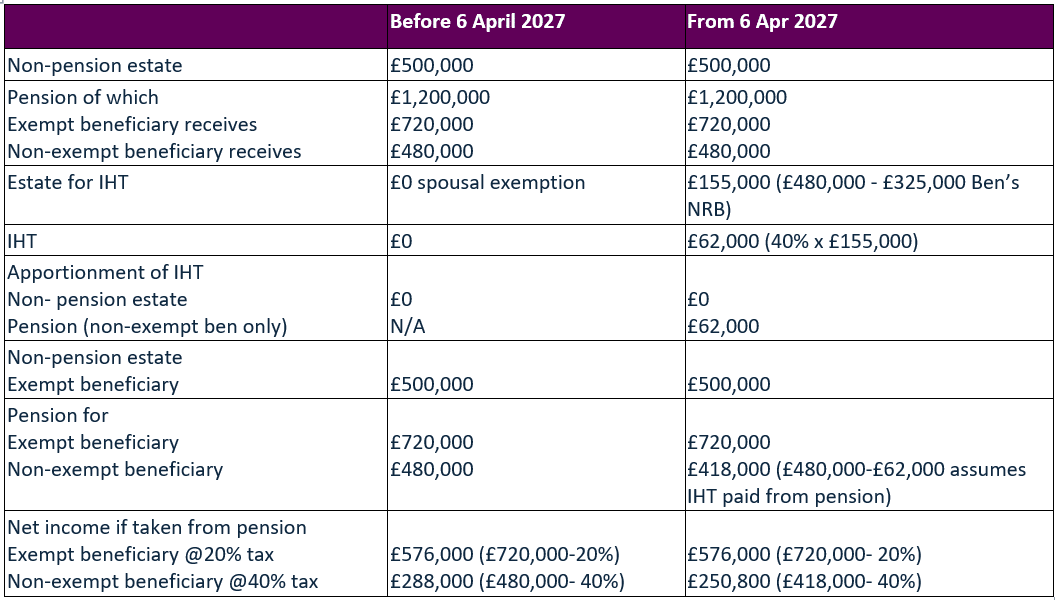
The below table shows the position of Ben’s estate pre and post the rule changes.
Lisa dies six years later aged 76 leaving all assets to the daughter Tracy. The assets are valued as:
- £600,000 main residence
- £50,000 cash
- £70,000 ISA
- £80,000 personal effects
- £720,000 pension. Lisa opted for beneficiary drawdown upon Ben’s death and the pension remained untouched.
She has not made any non-exempt gifts in the seven years prior to her death and Tracy is still a higher rate taxpayer.
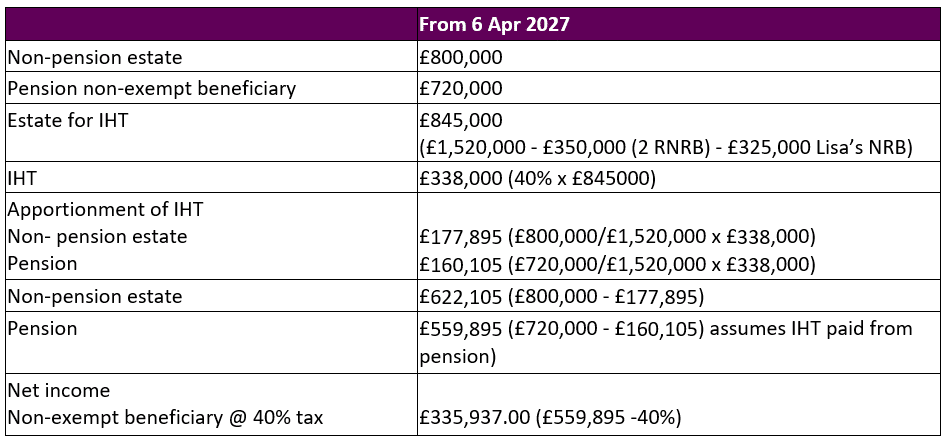
Lisa’s legal personal representatives (LPRs) can claim the transferable unused 100% of Ben’s RNRB as was not used when he died as well as Lisa’s NRB and RNRB. The position for Tracy post April 2027 is as follows:
These changes reinforce the importance of reviewing pension expressions of wishes alongside wills, property ownership and retirement income needs. The review should consider the consequences for both the immediate beneficiaries and those on the death of the surviving spouse.
There could also be an opportunity for some lifetime planning to potentially reduce the estate values by making lifetime gifts either to individuals or to trust. An example of this would be Lisa gradually withdrawing her part of the inherited pension from Ben at basic rate and making lifetime gifts to her daughter who is a higher rate taxpayer.
Keeping an up to date gifting record, whether these are exempt, potentially exempt or chargeable will assist with the estate management during lifetime and on death.
Another option might be to change the tenancy of the property and have this as tenants in common leaving Ben’s share of the property to his daughter on his death. This may lead to issues if there is a breakdown in the family relationship plus the costs and time for the legal advice and administrative work which would go alongside this.
An immediate post-death interest trust could be explored where Ben’s share is held in trust for Tracy and allows Lisa to remain in the property until her death. Both RNRB could still potentially be used with this type of trust, but legal advice should be sought.
It is the responsibility of the personal representatives dealing with the estate to report and pay any IHT due including on most pensions after April 2027. Ensuring the paperwork, records, forms required and processes are understood will be essential when they are fulfilling their duties.
If the family were Scottish taxpayers, Lisa would be an intermediate income taxpayer. Due to the Scottish legal system when it comes to succession and legal rights claim on net moveable property, in this case Tracy discharges her rights on Ben’s death as everything would come to her on Lisa’s death anyway. Therefore the position non-pension estates on first and second death would be the same as above but for the pension, on Ben’s death:

And on Lisa’s death:

This demonstrates the impact these changes can have on the amount the beneficiaries could receive depending on the different circumstances. This is where working with financial professionals can really add value and help ensure the client’s intended beneficiaries receive their wealth.
We are in process of building more case studies and support materials for our pension and IHT microsite in the coming months and once this is launched, we will let you know.
Main image: case study, joanna-kosinska-1_CMoFsPfso-unsplash