
























Recent market volatility has highlighted the relative resilience of UK equities, while market leadership continues to broaden beyond large caps. Portfolio manager Jonathan Winton explains why attractive valuations and the potential for positive change in overlooked businesses continue to create opportunities for contrarian investors.

Recent market volatility has once again highlighted the relative resilience of UK equities amid heightened geopolitical uncertainty, elevated commodity prices and higher for longer interest rates.
The UK market’s significant exposure to energy, financials and defensive sectors has provided support, while its relatively limited exposure to technology offers diversification from increasingly concentrated global equity markets.
UK equities have continued to deliver strong returns, with the market broadly keeping pace with global equities over the past five years.
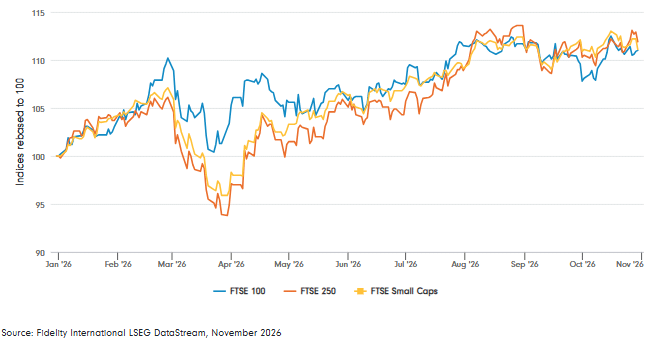
While much of this performance was initially driven by large-cap companies, market leadership has broadened in 2026, with small and mid caps performing broadly in line with their larger counterparts.
This is an encouraging development for stock pickers, particularly following a prolonged period of underperformance among smaller companies.
UK market leadership has broadened over YTD
Despite this recovery, UK equities remain attractively valued relative to global peers and their own history. The UK market trades at around 12 times forward earnings, compared with a longer-term average of approximately 14 times.
The discount is even more pronounced further down the market capitalisation spectrum, where smaller companies continue to trade well below historical valuations.
With investor sentiment showing signs of improvement and corporate activity remaining strong, we believe this creates a supportive backdrop for identifying undervalued businesses with the potential for positive change.
Identifying positive change
Our investment approach focuses on identifying unloved companies where we believe the market has become overly pessimistic about their prospects.
We look for businesses with limited downside risk and identifiable catalysts for positive change, whether through operational improvements, management initiatives or a recovery in underlying demand.
This approach has led us to increase exposure to economically sensitive areas, including recruitment, industrials and commercial property, where valuations have been depressed by prolonged weakness in end markets.
At the same time, we have reduced positions in companies where strong performance has brought valuations closer to our assessment of fair value.
Evolving sector exposure
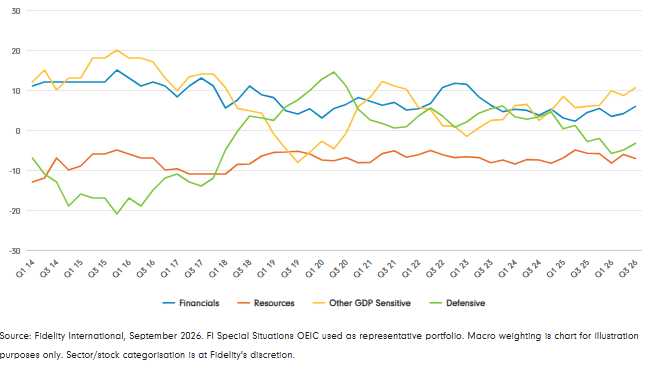
Recruitment companies provide a good example. We have built positions in Hays, SThree and PageGroup following several years of declining recruitment activity and weak investor sentiment.
Concerns about artificial intelligence disrupting traditional recruitment models have added to the pressure on valuations.
However, we believe much of the industry’s weakness is cyclical rather than structural. Net fee declines have recently stabilised, although a sustained recovery in hiring activity has yet to emerge.
These companies also have opportunities to reduce costs and improve productivity through AI adoption. While their shares have recovered in recent months, we believe the potential for further earnings improvement remains underappreciated.
Banks continue to represent a significant allocation, accounting for approximately 17% of the portfolio. We hold several banking positions, such as domestic lenders NatWest and Lloyds Banking Group, Irish bank AIB, alongside Standard Chartered, which provides greater exposure to emerging markets.
These businesses have benefited from operational improvements, stronger balance sheets and a more supportive interest rate environment. Despite their strong performance, we believe valuations remain attractive relative to their ability to generate sustainable returns on equity.
Our sell discipline is equally important. We recently exited defence company Babcock after its operational turnaround and improved industry outlook became increasingly reflected in its valuation.
Similarly, we have exited National Grid and reduced exposure to companies such as Reckitt following strong share price performance, recycling capital into businesses offering more attractive potential returns.
Opportunities across the market
We continue to find opportunities across the market capitalisation spectrum, although small and mid caps remain particularly attractive. Around 55% to 60% of the portfolio is invested in what we classify as mid-cap opportunities, reflecting our belief that this relatively under-researched area offers considerable scope for stock selection.
Within industrials, companies such as RS Group have begun to benefit from improving conditions in European industrial markets. Commercial property also offers selective opportunities, including Derwent London, where valuations reflect considerable pessimism about the sector.
We are more cautious on UK housebuilders, having reduced our position given pressure from higher mortgage rates and rising building costs. However, we see opportunities among businesses supplying the housing industry, including Travis Perkins, Norcros, Breedon and Grafton, where depressed trading conditions offer recovery potential over time.
While these businesses have been affected by weak new build volumes, many also have exposure to the more resilient repair, maintenance and improvement (RMI) market, alongside a degree of pricing power that can help offset cost inflation.
Norcros for instance is a small-cap supplier of bathroom products, with strong relationships across retailers, trade customers and housebuilders. Although growth remains subdued, the company has historically expanded its product range through bolt-on acquisitions and currently trades at just eight times estimated 2027 earnings.
Travis Perkins, meanwhile, is undergoing an extensive turnaround under a new CEO. While the near-term outlook remains uncertain, we believe volumes and margins are depressed and have scope to recover over the medium to long term. The company’s property ownership also provides a degree of downside protection.
Beyond domestic cyclicals, Glencore illustrates how our approach can identify opportunities in larger companies. We initially invested because we believed the market was undervaluing its exposure to copper, where long-term demand from electrification looks attractive relative to supply growth.
More recently, its coal exposure has benefited from higher energy prices, while its commodity marketing business provides an additional source of earnings during periods of market volatility.
Outsourcing company Serco is another example of identifying opportunities in businesses undergoing positive change.
Serco has been in the portfolio for several years, and it has progressively increased its exposure to US markets and defence contracts, which now account for a substantial proportion of earnings.
We believe this evolution in its business mix, alongside the potential for margin improvement, is not yet fully recognised in its valuation.
Attractive valuations support long-term opportunities
Looking ahead, we remain positive on the opportunities available in UK equities. Despite improved market performance, valuations remain reasonable in absolute terms and attractive relative to other regions.
Continued corporate share buybacks, dividend distributions and merger and acquisition activity also provide support for the market.
Importantly, the portfolio itself continues to trade at a meaningful discount to the broader UK market.
Based on our analysts’ estimates, portfolio holdings trade at approximately 10 times 2027 earnings, compared with around 12.5 times for the FTSE All Share Index, while offering the potential for improving profitability and returns on capital.
While there are risks to the outlook, we believe the combination of attractive starting valuations, company-specific recovery potential and disciplined stock selection provides a supportive foundation for returns over a three-to-five-year investment horizon.
Our focus remains on identifying companies where the market has yet to recognise positive change, while recycling capital as investment cases mature.
With considerable valuation dispersion across UK equities, we continue to see a broad range of opportunities to apply this approach.
This article was originally published by Fidelity International here: UK equities: finding value beyond market volatility
Past performance is not a reliable guide to future returns. You may not get back the amount originally invested, and tax rules can change over time. The writer’s views are their own at the date of publishing and do not constitute financial advice.
This information should not be relied upon by retail clients or investment professionals. Reference to any particular investment does not constitute a recommendation to buy or sell the investment.
Main image: background blue,codioful-formerly-gradienta-bKESVqfxass-unsplash