





















Recent weeks have seen significant moves in financial markets, impacting government bonds in particular. How has this altered Schroders’ views?
In the past month we have seen a Fed hike, significant moves in government bond markets, renewed concerns around Eurozone sovereign debt and some volatility in global semiconductor equities. The situation in politics and markets remains fluid.
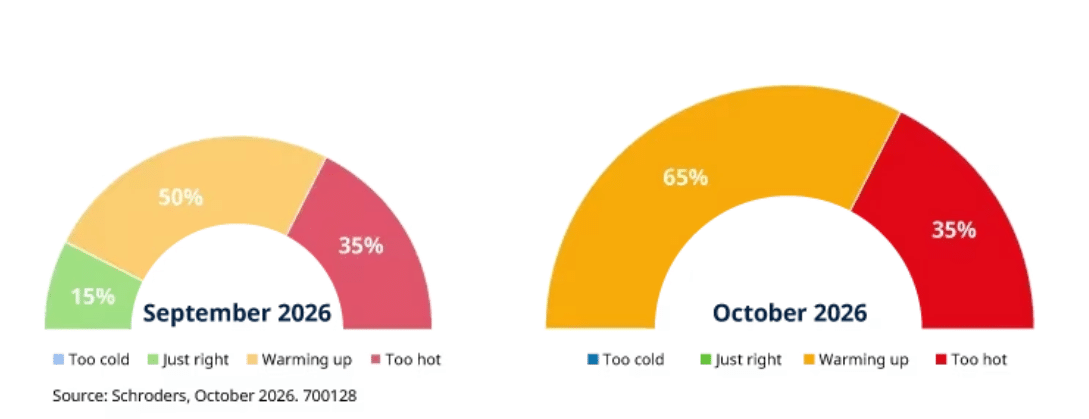
As always, we start with our scenario probabilities, where we have more firmly made ‘warming up’ our central scenario, with ‘too hot’ – involving three or more additional hikes from the Fed – remaining the main tail risk.
We reduce the probability of no hikes (‘just right’) or cuts (‘too cold’) to zero: something drastic would have to change for these to be realised given our growth, inflation and labour market outlook. The market continues to put a much higher probability on our ‘too hot’ scenario.
Our scenarios – reflecting a warmer backdrop
We have written previously that tightening from the Fed is merited,but is likely to be an ‘adjustment cycle’. Inflation remains too high, and recent CPI data reaffirmed that, but the scale of the problem remains moderate, with underlying inflation measures around 2.2-3%.
While core inflation is likely to remain sticky over the next few months, there are grounds for hope that the first half of 2027 will see an improvement as the impact of tariffs and other temporary pressures softens.
In the short term, sticky services inflation will keep the Fed hiking, but an improving outlook into 2027 would help limit the scale of the eventual cycle.
On growth, we remain constructive on the US. Consumption remains solid, and heavy investment in tech hardware and AI infrastructure is a significant boost.
We expect the current wobbles in AI-related equities to be a blip, with investment plans remaining strong. A meaningful weakening would pose a risk to the wider economy, but for now remains a tail risk rather than our base case.
We therefore remain neutral on US government bonds. A Fed hiking cycle is well discounted, and yields that have moved above 5% on ten-year Treasuries provide attractive income, but the catalysts for significant outperformance remain missing given good growth, above-target inflation and a Fed that has only just started hiking.
Our preferred destinations remain Canada and Europe. In Canada, domestic conditions remain benign: core inflation is more at risk of undershooting target than overshooting, while the labour market has softened.
The Bank of Canada has taken a more hawkish tone, but significant further tightening is already priced.
The Eurozone faces different circumstances. The ECB remains in its hiking cycle as high energy prices feed into inflation. But there are signs of stress in sovereign bond markets and clearer signs that monetary tightening is biting.
We expect at least one further hike in December, but believe the ECB is unlikely to deliver as much as the market currently discounts.
In asset allocation, we turn neutral on European corporate credit across investment grade and high yield. We have long viewed fundamentals as sound but valuations as expensive.
Recent widening in credit spreads has made the sector more attractive. We remain cautious on US credit, where valuations have adjusted less. We also upgrade emerging market local-currency bonds, seeing opportunities in countries such as Mexico.
Finally, we downgrade core Eurozone ex-Germany government bonds to neutral as the political turmoil in France rumbles on, but upgrade the periphery given recent repricing.
We still see individual opportunities, remaining wary of Belgium (which has similar fundamental fragilities to France but remains more expensive) while retaining a more positive disposition to Greece, given its improving fiscal trajectory. Hungary remains a top pick, with recent budget and euro-adoption announcements reinforcing that conviction.
Past performance is not a reliable guide to future returns. You may not get back the amount originally invested, and tax rules can change over time. The writer’s views are their own at the date of publishing and do not constitute financial advice.
This information should not be relied upon by retail clients or investment professionals. Reference to any particular investment does not constitute a recommendation to buy or sell the investment.
Main image: investment funds, dark blue, norbert-kowalczyk-BasVH2YQ1RA-unsplash