






















Americans go to the polls suspicious of the AI boom that’s sent stocks to all-time highs and driving their economy. Rathbone Greenbank Global Sustainability Fund Manager David Harrison ponders the disconnect between the numbers and the vibes.

The US economy is a great paradox at the moment. Americans usually feel happy and optimistic when GDP is doing well: “It’s the economy, stupid,” remember? Yet, with growth holding up well and unemployment low, they are miserable and restive.
Prices are the problem, according to US punters: ‘inflation’ has been far and away the nation’s top problem highlighted by voters for four years in a row. And this at a time when inflation – while noticeably higher than target – hasn’t been terribly high. In fact, complaints about inflation have got worse even as inflation improved (see chart).
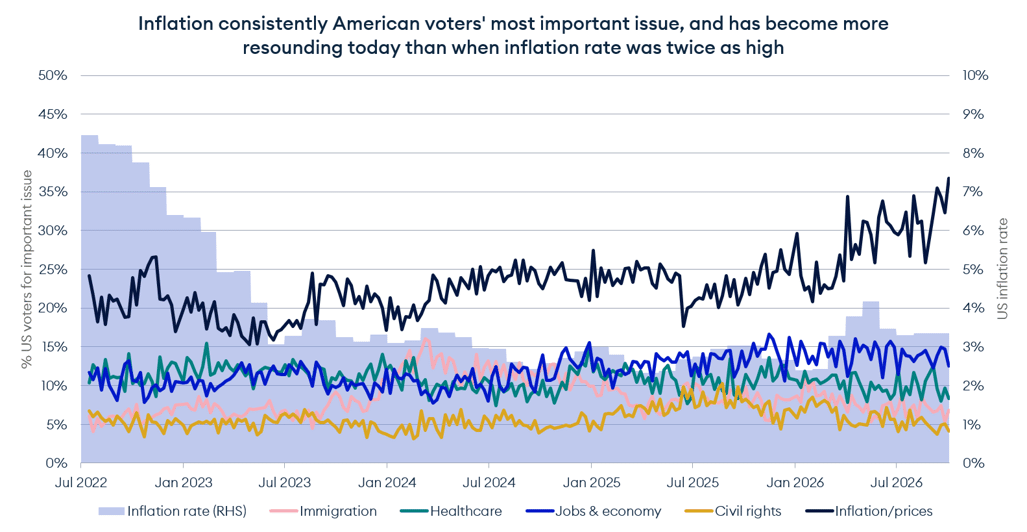
Source: FactSet, Economist/YouGov Poll percentage of registered US voters asking ‘Which of these is the most important to you?’; latest poll consisted of 1,381 respondents between 2 and 5 October 2026; inflation is CPI annual change; data 1 July 2022 to 30 September 2026
The question is: how much of this angst over inflation is down to vibes? And how much is a legitimate grievance, as experienced by Americans, yet unrecorded by stats agencies that still rely on armies of shelf checkers and telephone surveys?
As AI-fuelled algorithms personalise everything from Instagram feeds to the music we hear and the news we see, are they also personalising the prices people pay?
Consumer watchdogs in the US report growing use of ‘surveillance pricing’ since 2021 (helped by the rapid progress of AI models) – both online and in stores, that pushes up the actual prices Americans are paying in the real world.
Some companies are using personal data and shopping histories to sell the same products to different people at different prices – even at the same stores on the same day.
It only takes someone noticing this once before they see the potential for it everywhere and become suspicious that they are always being ripped off, even if they aren’t.
Meanwhile, the conflict in the Persian Gulf has driven oil prices higher and fed a growing acceptance that interest rates are likely to rise rather than fall. That’s led to a shift in markets.
US 10-year government bond yields are much higher than they were just a few months ago, pushing mortgage costs higher. Some argue that hyperscalers’ record debt issuance could be having an effect as well.
And the hyperscalers’ insatiable appetite for chips has pushed the prices of consumer electronics sharply higher as well.
Are the mid-terms a referendum on inflation, AI or both?
Putting that together: higher mortgage rates, higher petrol prices, higher groceries, higher gadget costs, it starts to make sense why Americans might say that they think inflation is actually much higher than the CPI stats say.
And why they distrust the data showing the economy doing well: they may feel like it’s extraction from their pocket, rather than genuinely positive.
Against this backdrop, on 3 November, Americans vote on all 435 seats in the House of Representatives and 35 of the 100 Senate seats. Democrats are favourites to win the House, and some measures put them ahead for control of the Senate as well.
CBS polling suggests the Democrats’ edge comes from unhappiness with prices and from Republican voters who are less likely to turn out (again, because of unhappiness with the path of prices). Ask an American how the economy’s doing and, these days, they’ll tell you what groceries cost.
Much of the administration’s agenda runs through executive action, so it’s unclear how that will fare against a Democratic-controlled Senate. We don’t expect the election to change the US economic or political direction much, however.
The feeling if the American public seems to be that AI is very powerful, but not really being used in their interest. Of course, it’s impossible to know where the truth lies. But this gap between the public sentiment and the economic data (growth, profitability and inflation) is worth watching.
Public unease can turn into regulation, and the midterms could amplify it. For now though, household spending continues, and our AI exposure sits mainly with the ‘picks and shovels’ suppliers: chips, networking and power infrastructure.
We think they’re paid for building the infrastructure, whatever voters end up thinking of it.
Main image: AI, conny-schneider-xuTJZ7uD7PI-unsplash