























Against a volatile market backdrop, income can offer a valuable source of total return while providing portfolio resilience for investors. Here, Fidelity International address five common misconceptions about income – and discuss how an active approach can deliver for income-seeking investors across equities, credit and multi-asset.
Misconception 1: Income strategies provide limited protection in volatile markets
Quality bonds and dividend-paying equities can offer meaningful downside protection during periods of market stress. Within equities, dividend returns have never been negative, even during periods of sharp market declines like the global financial crisis of 2008 and the COVID-19 pandemic. In fact, dividends have been reliable contributors to global stock total returns year after year.
Dividends are a resilient contributor to total returns
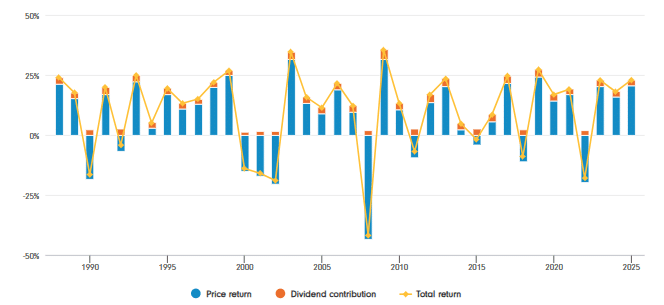
Past performance does not predict future returns.
Source: Fidelity International, LSEG Datastream. Based on annual returns data for MSCI ACWI (USD) from 1988 to 2025. For illustrative purposes only.
Companies that sustain and grow dividends tend to be well-run with strong balance sheets, predictable cash flows and disciplined capital allocation. This resilience reflects both the financial strength required to sustain dividend increases and the stability of the underlying business models.
It provides a natural buffer against market turbulence while helping to reduce any decline in total returns. Dividend-growers are therefore able to weather volatility better than the broader market over the long term.
Dividend stocks tend to be less volatile
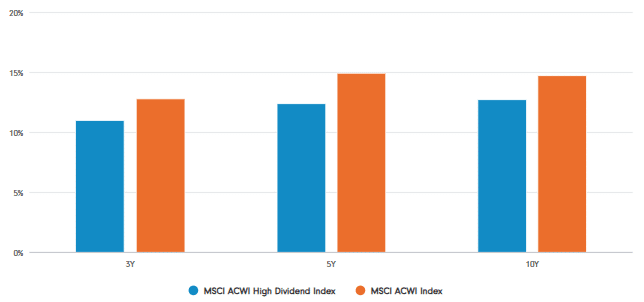
Source: Morningstar. As of 30 April 2026. Past performance is not a reliable indicator of future results. Investors should note that it may not be possible to invest directly into an index. Investors should note that the views expressed may no longer be current and may have already been acted upon by Fidelity.
Within fixed income, a high-quality, short-duration strategy can help investors limit exposure to interest rate volatility and credit risk, especially in times of policy uncertainty, while offering an attractive yield.
“This helps to dampen mark-to-market volatility and lower the risk of capital losses during periods of rising or unstable yields,” says James Durance, portfolio manager of our global short-duration income strategy.
“In contrast, longer-dated bonds tend to experience more pronounced price movements as markets reprice policy expectations, leading to greater potential drawdowns.”
Meanwhile, a global multi-asset approach can also offer diversified income sources, providing a valuable ballast for portfolios during periods of heightened uncertainty.
“Steady income from bonds and dividends can provide much-needed certainty in volatile markets, offsetting capital fluctuations and dampening portfolio volatility,” explains global multi-asset income portfolio manager, Becky Qin.
Misconception 2: Income strategies tend to be less resilient during periods of rising inflation
A portfolio of companies that deliver high and resilient income streams can potentially protect against inflation by growing income and capital over time. Over the last 20 years, for example, US dividend growth has outpaced inflation growth.
Within global equity income strategies, investors can also benefit from the use of covered call options to further boost the income stream while providing the opportunity for long-term capital growth.
For fixed income investors, duration positioning, sector allocation, and security selection become increasingly important as interest rates adjust to changing inflation expectations.
By actively managing these levers, fixed income strategies can seek to balance yield generation with capital preservation across different phases of the inflation cycle. Short-duration bonds, for example, offer attractive yields while being less sensitive to changes in interest rates – which tend to increase in inflationary environments.
Additionally, taking a diversified approach to income generation, by looking across multiple regions and sub asset classes within credit, can also help to dampen the impact of inflation in portfolios, ensuring that no single region or asset class has a dominant effect on returns.
Misconception 3: Income investing limits investors to government bonds and blue chip equities
Valuation differentials and evolving macro dynamics have uncovered new opportunities for income-seeking investors across regions, sectors, and asset classes. In particular, Asia stands out as an increasing source of both equity and fixed income opportunities for investors seeking geographical diversification.
Within fixed income, the Asian investment-grade universe offers a compelling yield relative to US and European peers, supported by improving market depth and strengthening credit quality.
Asian investment grade bonds offer attractive duration-adjusted yield compared to peers
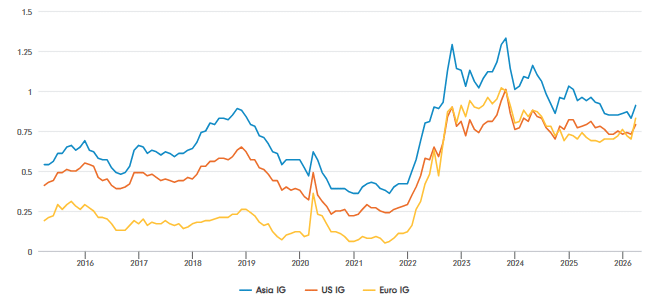
Past performance does not predict future returns.
Source: Fidelity International, ICE BofAML Bond Indices: ADIG for Asia IG, ACCG for China IG, ER00 for Europe IG, C0A0 for US IG, as at 31 March 2026. Yield reflects effective yield. Effective yield is the yield of a bond which has its coupons reinvested after payment has been received by the bondholder. It is the total yield an investor receives in relation to the coupon (nominal yield) of a bond. It takes into account the power of compounding on investment returns, while coupon (nominal yield) does not.
Within equities, dividend policies in the region have evolved in recent years, alongside changing regulations and shareholder expectations. “In today’s environment, income is no longer simply a source of yield, it has become an important source of resilience,” says Jochen Breuer, portfolio manager for several of our Asian equity income strategies.
“Across Asia, we are seeing a growing universe of high-quality companies with strong balance sheets, disciplined capital allocation and the ability to grow dividends sustainably through the cycle, which we believe can support more durable long-term returns in volatile markets.”
Global equity income portfolio manager, Daniel Roberts, says income sources outside the US have also become more attractive due to the relative valuation premium of US sectors.
“In addition, many of the largest US technology companies pay little or no dividend, which reduces our willingness to consider them as potential investments. Instead, we focus on stock selection within a portfolio that is well differentiated from the index to drive performance,” he adds.
Taken together, these features highlight the value of a flexible, global approach to income investing, which can capture opportunities beyond traditional markets and enhance portfolio diversification.
Misconception 4: Income investing is only for conservative investors
While income investing is attractive for those seeking capital preservation, it can play a role in providing total returns for all types of investors. Notably, within the US, dividend-growers have outpaced the broader S&P 500 index across market cycles.
This means that versatile equity income strategies can play a positive role in different market conditions and across the investment lifecycle. For investors seeking long-term growth, reinvested income can enhance compounding, while for those in the decumulation stage, high-quality dividends can provide the stability they need to weather market cycles.
The same applies across credit markets. The contribution to returns from coupon income helps to both dampen capital volatility and deliver a more stable return profile during periods of market turbulence.
Misconception 5: Income strategies are only suited to a ‘set-and-forget’ approach
Income strategies can differ significantly in their approaches, portfolio composition, risk exposures and return drivers, with significant implications for performance. Unlike passive index investing, an active, research-based approach can be more selective and agile when pursuing opportunities in fast-changing markets, helping to improve investor outcomes.
Furthermore, with income-focused strategies available across equities, credit and multi-asset, investors have greater options to identify approaches aligned closely to their objectives, requirements and risk tolerance.
“Historically, periods of higher volatility have provided attractive entry points into new ideas,” says Roberts. “In such cases, a selective approach backed by bottom-up research is key to identifying opportunities.” In a less predictable macro environment, active risk management also comes to the fore, says Qin.
“That’s why we dedicate part of our multi-asset portfolio for hedging assets and manage the sizing and structure of it actively, while also taking advantage of periods of market volatility to add to high-conviction positions at more attractive valuations.”
An active approach to income
In changing markets, income plays an increasingly important role in portfolios across asset classes. However, not all income strategies are alike.
The ability to access opportunities across the investment universe – combined with the flexibility to adapt as conditions evolve – can be a key differentiator in shaping both returns and downside resilience.
An active approach, underpinned by rigorous research and disciplined risk management, becomes critical in navigating uncertainty and achieving more consistent long-term investment outcomes.
Main image: investing, income, kamil-894I850Hyl0-unsplash