























Exclusions are back in focus, but flexible, risk-based management and engagement can better navigate transition risks, says Andy Howard, Global Head of Sustainable Investment at Schroders.

The investment industry’s focus on exclusions as a cornerstone of climate strategies has moved back into focus, with the release of the Science Based Target initiative’s new Financial Institutions Net-Zero (FINZ) standard, which effectively requires signatories to exclude the majority of the oil and gas sector from the portfolios they manage[1].
Reaching a net zero economy globally will require a significant reduction in the use of fossil fuels, which accounts for three-quarters of global emissions.
However, the transition to net zero is proving uneven. While we expect to reach that destination in time, we have a responsibility to manage portfolios in the world as it is, not as we might wish it to be.
Changing policy priorities, expanding data centre demand, geopolitical tensions and energy supply shocks present challenges to the transition away from fossil fuels.
Against this backdrop, the case for rigid, prescriptive exclusion frameworks becomes harder to sustain – and the case for flexible, risk-based active management becomes stronger.
We are convinced that climate change represents a significant source of investment risk and opportunity. We are equally convinced that managing portfolios to reflect those risks will require thoughtful analysis and engagement, not blunt rules alone.
In 2022 we introduced – and continue to apply – exclusions to companies generating more than 20% of their revenue from thermal coal mining across Schroders-managed funds[2].
However, we have consistently resisted pressure to adopt more extensive exclusions. Coal mining relies on assets with very long lives and no clear path to transition, whereas oil and gas fields are typically shorter-life assets with less political commitment to phase down their use. A differentiated approach is therefore essential.
Our assessment is that the wider asset management industry has moved back towards our long-held position.
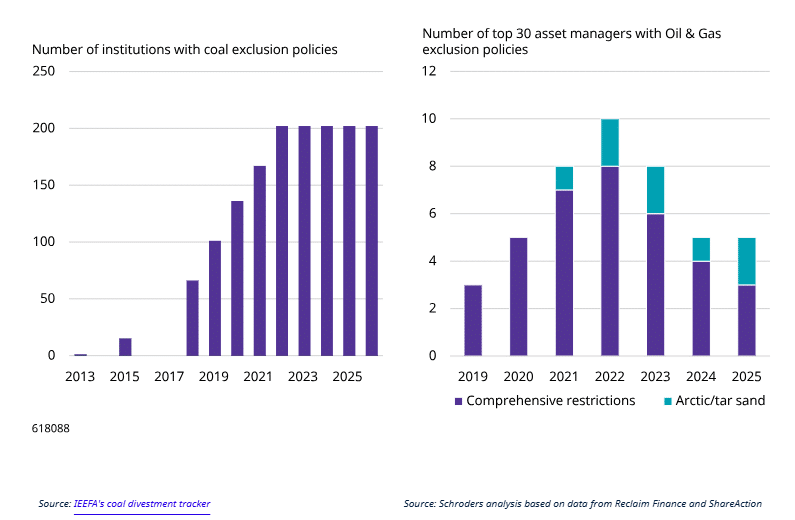
While coal exclusions remain common , oil and gas exclusions – which grew quickly across the investment industry between 2015 and 2022 – have since waned, as major banks and asset managers have quietly dropped policies or diluted hard exclusions into ‘due diligence’ frameworks.
This trend is reflected in external analysis. Debevoise & Plimpton, in a report published in August 2025, identified a systematic shift across the asset management industry away from hard exclusion policies towards softer ‘due diligence’ or ‘high risk’ approaches.
Coal exclusion policies remain common but oil & gas exclusions have waned
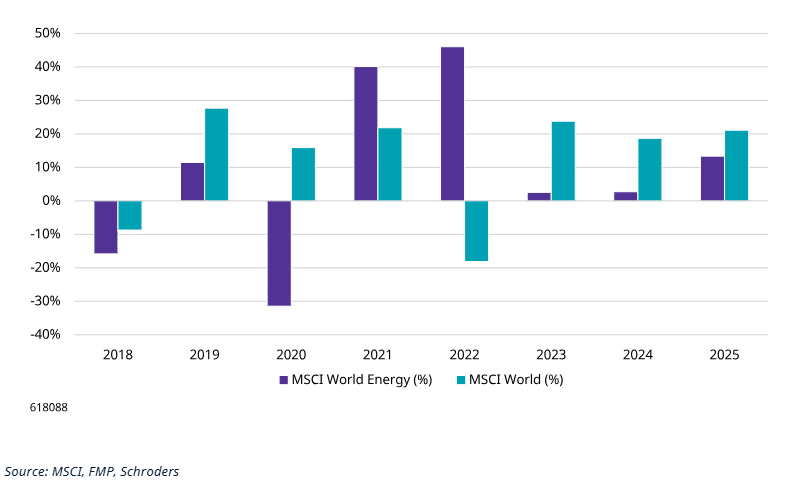
There are clear costs to exclusions. While the energy sector has underperformed global benchmarks across much of the past decade, it has also generated periods of significant outperformance.
During 2021 and 2022, the MSCI World energy sector outperformed the wider market by almost 100%, implying a performance drag of approximately 3% for globally diversified funds with no exposure to the sector.
Annual performance of MSCI World Energy and MSCI World indices
The challenge is not that the energy sector has, or will, continue to deliver consistently strong performance. It is that exclusions deny investors exposure during periods when it does, while pushing tracking error in many markets to levels that are incompatible with many investors’ risk appetite.
Applying the exclusions required under the SBTi’s new FINZ rules implies excluding a significant proportion of many indices from investment portfolios.
Without entering a debate over how “risk” should be defined, many investors continue to frame risk in terms of deviation from benchmark returns.
Exclusion-driven strategies can therefore absorb a substantial share of the available risk budget. For example, applying the FINZ policy today (capturing coal, oil and gas expansion companies) to the FTSE 350 could mean excluding 10% of the market.
This would see tracking error rise to around 2%. Even in globally diversified portfolios benchmarked to MSCI AC World, tracking error could increase by around 0.8%.

Shifting the focus from “excluding oil and gas companies” to “excluding companies expanding oil and gas production” appears clean in principle but does little to change the practical outcome.
For example, FINZ requires institutions to stop financing for coal expansion immediately, and by 2030 for companies expanding upstream oil and gas.
However, given oil and gas fields typically decline more quickly than demand, a significant majority of the sector must invest in new production simply to maintain output.
Expansion is therefore not the exception, but the norm. Urgewald’s Global Oil & Gas Exit List – a widely-used industry reference point – identifies that 96% of upstream oil and gas companies remain involved in exploration or development of new resources[3].
The European Fund and Asset Management Association (EFAMA) has highlighted similar concerns.
The European Commission’s proposed SFDR 2.0 rules for Transition and Sustainable categories – including exclusions of companies developing new oil and gas projects – would mean that “90-95% of the global energy sector would be excluded from transition-categorised investment products, with up to 50-60% of emerging market utilities facing exclusions,” and that this risks “excluding carbon-intensive sectors where transition efforts are most critical”.
The academic evidence reinforces this picture. Research published by the National Bureau of Economic Research found that a one percentage point increase in green fund ownership was associated with approximately 3% emissions reductions over four years – achieved through active engagement. By contrast, divestment produced no measurable effect on corporate emissions.
The effect of exclusions is unclear at best
The benefits of exclusion as a driver of global transition are unclear. Global oil and gas production in 2024 remains slightly above 2019 levels (~171 million barrels of oil equivalent per day (boe/day)), despite over a decade of the divestment movement.
It does not appear that major oil company has reduced production in response to divestment pressure.
The academic evidence confirms that divestment raises the cost of capital by only 0.44 basis points – effectively negligible – and would require over 80% of investable wealth to participate to achieve meaningful impact.
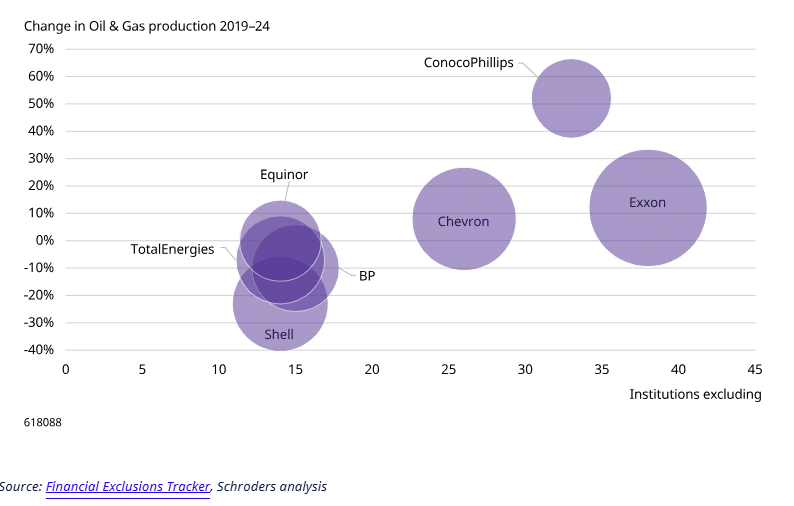
Indeed, the companies most heavily excluded from portfolios have, in many cases, increased production most quickly.
Exclusion intensity has correlated positively with production growth (bubble sizes proportionate to oil and gas production 2019-24)
Conclusion
The hurdle is not whether exclusions can be defended philosophically; it is whether they can be applied as a systematic, repeatable fiduciary policy through cycles, shocks, and regime changes.
For a manager with fiduciary duties across a wide range of client mandates, extensive exclusions materially reduce the ability to construct diversified portfolios and limit the investment flexibility required to deliver competitive returns.
More fundamentally, the issue is not that broad exclusions are too costly to implement. It is that more effective approaches exist.
Active managers who retain exposure to the full energy sector, apply rigorous transition-risk assessment, and deploy targeted engagement are positioned to generate alpha through the cycle: capturing upside during periods of energy sector strength, avoiding the most exposed companies through analysis rather than rules, and influencing corporate behaviour in ways that divestment cannot.
Our goal is to translate a sophisticated understanding of the transition into investment value for our clients – not to constrain our ability to deliver it.
Sources:
[1] SBTi’s Financial Institutions Net-Zero Standard requires cessation of new equity and bond purchases in oil & gas expansion companies by 2030. Insofar as most major oil & gas companies have expressed intent to expand production, this effectively represents an exclusion on new investment covering most of the sector.
[2] Unless certain exceptions apply, for example in relation to certain client Portfolios.
[3] Global Oil & Gas Exit List 2025: Expansion Outpacing Climate Action
Main image: sustainable, yohan-marion-nByLkhn1IsI-unsplash