























60% of the world’s largest asset owners have made public climate commitments or statements, mostly targeting reductions in portfolio carbon emissions1. Most of those commitments were made between 2020 and 2022, a period in which climate policies were strengthening and decarbonisation momentum was gathering pace.
Since then, political ambition and action have stalled, ambition across the corporate world has waned and the market’s willingness to reward climate action has dropped.
Against that more challenging backdrop, some asset owners are reconsidering whether their objectives, strategies and targets line up. The three components are different and targets should be a result of first two rather than the starting point.
Objectives establish the outcome sought; strategies explain how investors intend to contribute; targets make progress measurable and time-bound. Revisiting how progress is measured should not be confused with lowering ambition.
Organisations have many climate objectives. Different objectives require different strategies, even if an ultimate outcome is to “reduce portfolio emissions”.
Where the objective is to support real-economy decarbonisation, the relevant question is not simply how quickly portfolio emissions fall, but what is changing in the businesses held.
As the market’s willingness to reward companies better placed for decarbonisation has waned – amid stalling political momentum, rallying fossil fuel stocks and faltering clean energy expectations – tensions which were previously masked have become clearer.
Below, we map nine climate related aims and approaches. Drawing on 48 academic and practitioner studies, we have examined which reinforce one another and where tensions arise.
Objectives which are most closely aligned are closer together and those where tensions are greater are further apart. The analysis highlights a distinction between changing portfolio exposures and supporting change in the businesses held.
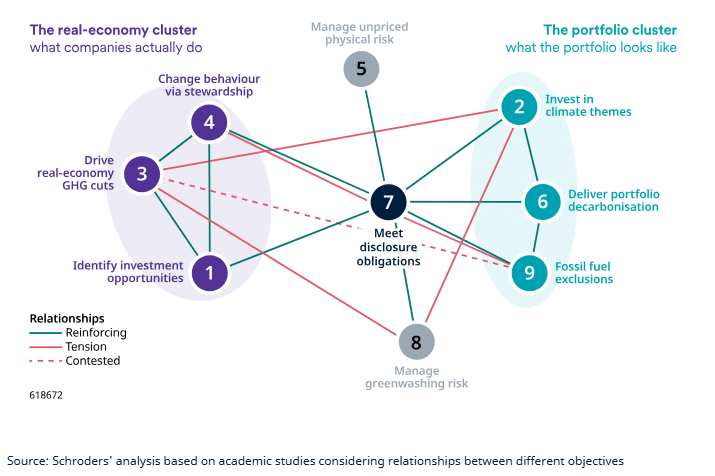
Not all objectives – and the strategies which deliver them – are in tension. Physical-risk assessment is relevant under either approach, while disclosure is an obligation across strategies rather than a competing investment objective.
The clearest distinction is between changing a portfolio’s holdings and supporting change in the companies and assets it owns.
The former can lower reported portfolio emissions by reducing exposure to carbon-intensive companies and sectors. That can be appropriate where the objective is to reduce such exposures or meet explicit investment restrictions.
Those constraints make it mathematically easy to meet emission targets, but they also shrink the investment opportunity set, reduce diversification and can undermine performance.
The latter – investing in companies as they decarbonise – is slower. The pace of decarbonisation in individual companies is dwarfed by the speed of trading exposure from high- to low-carbon companies.
It is also more difficult; it requires analysis of companies’ decarbonisation prospects and active engagement with management teams.
But it allows investors to maintain exposure to (selected) higher-emitting businesses, limits the costs of reduced diversification, and provides exposure to the outperformance transitioning companies have historically delivered.
The first strategy is appropriate – indeed necessary – to deliver targets which require rapid reductions in portfolio emissions in the short term.
The latter approach requires different measures, focusing on longer term objectives or tracking companies’ decarbonisation progress rather than portfolio aggregates. The challenge is to ensure targets, strategies and objectives are consistent.
Until a few years ago, the tension seemed academic; portfolio decarbonisation and performance went hand-in-hand.
That changed with the war in Ukraine and then the Middle East and although the equation is starting to reverse, the last few years have reminded us that exclusions and portfolio constraints can interfere with performance goals and that targets which require them can become challenging.
For our part, our climate strategy has always emphasised investment in the companies and assets which are transitioning, rather than treating a lower portfolio footprint as an end in itself.
Our client conversations suggest that some asset owners are looking for ways to ensure their objectives, strategies and targets line up.
The task is not simply to loosen or tighten climate targets. It is to be clear about the outcome they are meant to deliver, the actions intended to achieve it and the evidence that demonstrates progress.
Sources:
1. Schroders analysis of publicly available disclosures for the Thinking Ahead Institute AO100 universe and evidence verified in July 2026. Of the 100 asset owners, 46 had explicit climate targets and a further 14 indicated public discussion without an identified qualifying commitment.