






















When markets are volatile, moving to cash can feel like the safest option. Ella Davies, co-manager of the Schroders Global Multi-Asset Portfolios, explains why staying invested is often the more rewarding approach.

Should we sell now and wait for things to settle down?
It is one of the most understandable questions an investor can ask. It is also one of the hardest to answer.
The instinct to step aside during periods of uncertainty is powerful. Holding cash can feel like taking control. But it creates a second question: when should the investor get back in?
Markets rarely recover when the outlook feels comfortable. They often begin to turn while the news is still poor, the headlines are still alarming and confidence remains low.
That is why, over the long term, time in the market has generally proved more reliable than trying to time the market.
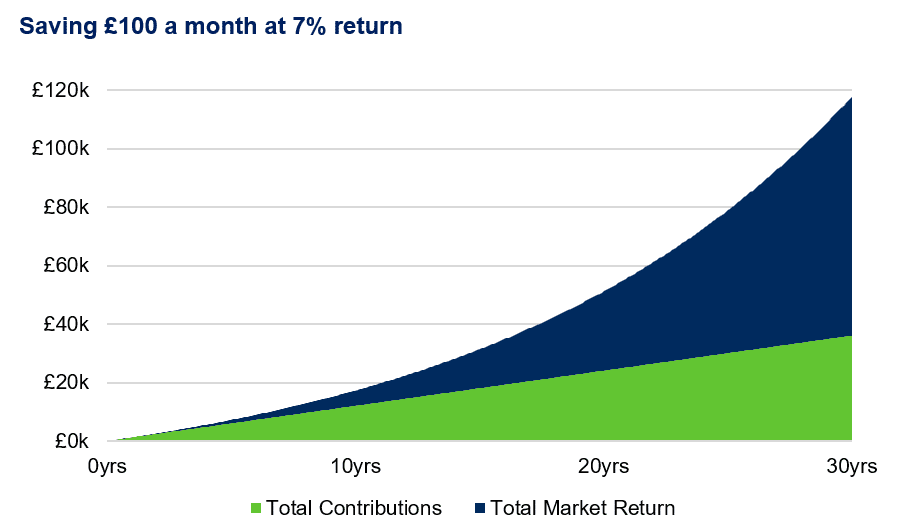
Source: assumes £100 saved per month, returning 7% p.a. RHS: S&P 500 and 30-day cash; daily rebalancing depending on the level of the VIX at the previous close; 33.0 marks highest 5% of days for VIX; 02/01/90 to 31/12/25; excludes costs, including transaction costs. For illustrative purposes only and should not be viewed as a recommendation to buy or sell.
The cost of missing the rebound
The first chart shows the importance of remaining invested. Over long periods, equities have historically delivered better returns than cash, despite passing through wars, recessions, political crises and severe market falls.
The reason is compounding. Regular savings can grow significantly when returns remain invested and begin to generate further returns of their own.
But compounding needs time. An investor who moves into cash after a market fall may avoid some further losses. But they also risk missing the recovery. If they wait until the outlook feels reassuring, the market may already have moved higher.
This creates a damaging sequence. Fear causes investors to sell. Relief causes them to buy back in. The market often rises in between.
The investor sells after prices have fallen and returns only after they have recovered. Even if both decisions feel sensible at the time, the long-term cost can be significant, and that can be seen in the second chart below.
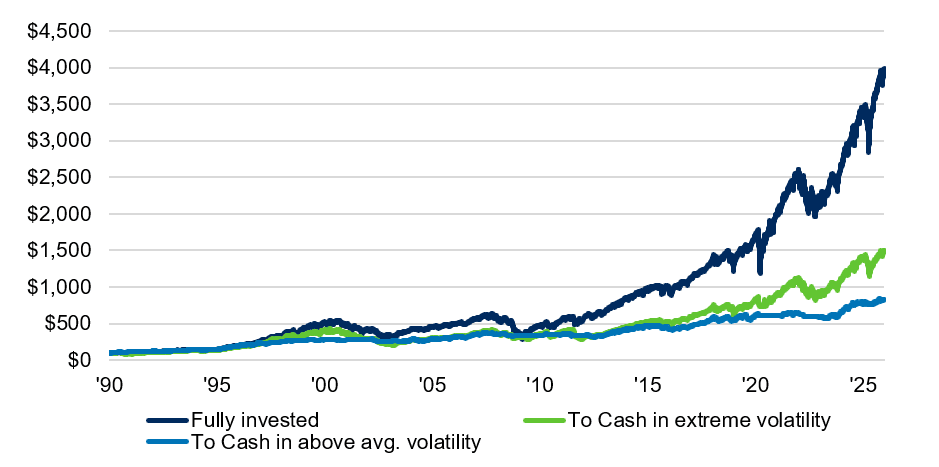
Source: S&P 500 and 30-day cash; daily rebalancing depending on the level of the VIX at the previous close; 33.0 marks highest 5% of days for VIX; 02/01/90 to 31/12/25; excludes costs, including transaction costs. For illustrative purposes only and should not be viewed as a recommendation to buy or sell.
Volatility is the admission price
The third chart puts market falls into context. A decline of 10% or more in global equities has occurred in more than half of the years shown. A 20% fall has occurred roughly once every four years.
Market volatility is not necessarily evidence that an investment plan has failed. It is often the price investors pay for accessing long-term returns.
The more important question is whether the portfolio is built to withstand those periods.
A client may say they are comfortable with risk when markets are rising. The real test comes when their portfolio is down 10%, 15% or 20%, and the future feels uncertain.
That is why suitability is about more than a theoretical risk score. It is also about how a client is likely to behave when markets fall.
A portfolio that causes a client to sell at the worst possible moment is not serving its long-term objective; however attractive its expected return may look on paper.
Biggest falls in the global stock market in each of the past 54 calendar years (MSCI World, USD)
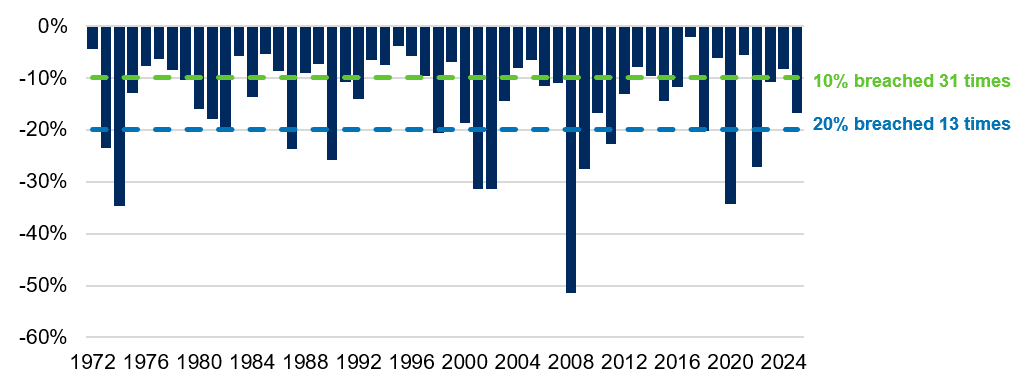
Source: LSEG Datastream, MSCI, and Schroders, as of 31 December 2025. Data 1972-2025. Bars shows the biggest peak-to-trough fall in the price index in each calendar year.
The strongest days can arrive when confidence is weakest
The difficulty with market timing is that the best days often occur close to the worst days.
Markets are forward-looking. They do not wait for the economic data to improve or for every uncertainty to disappear. They begin to move when investors believe the outlook is becoming less negative.
The market can therefore start recovering while the headlines still look bad.
By the time the recovery feels obvious, much of it may already have happened.
This is an important point. You do not need to predict the exact bottom; you need a plan that allows you to stay invested when the bottom is impossible to identify.
Staying invested does not mean staying static
The case for time in the market however is not a case for holding exactly the same portfolio forever.
Remaining invested and remaining static are different things.
The investment landscape has changed. Inflation is less predictable, government debt is higher, equity markets are more concentrated and the traditional relationship between equities and bonds can weaken when inflation becomes the dominant risk.
A portfolio that appears diversified may therefore contain more common risk than expected. Several funds may own the same large companies. Equities and bonds may both be exposed to interest rates. A global portfolio may be heavily influenced by one country or a small group of companies.
The answer is not to abandon markets. It is to understand what is driving the portfolio and adjust where appropriate.
Active asset allocation can help by responding to changing valuations, economic conditions and correlations. This may involve varying regional equity exposure, adjusting bond duration, using inflation-sensitive assets or adding other sources of diversification.
The portfolio remains invested, but it is designed with a wider range of outcomes in mind.
A portfolio clients can stick with
The most important outcome is not simply finding the portfolio with the highest expected return.
It is helping clients remain invested long enough for that return to have a chance to materialise.
That means understanding that market falls are normal, recoveries are difficult to time and diversification must be assessed by looking through to the underlying exposures.
The best investment plan is rarely the one that predicts every market turn. It is the one that prevents a temporary period of fear from permanently damaging a long-term financial plan.
Time in the market gives compounding room to work and active management can help make staying invested more manageable. Markets do not wait for certainty, and a good portfolio helps you participate before certainty arrives.
Main image: investment funds, dark blue, norbert-kowalczyk-BasVH2YQ1RA-unsplash