























David Bajada, Co-Head of Private Equity Investments Asia ex. China, and Ankita Baheti, Co-Head of Private Equity Investments Asia at Schroders, explore why capturing Asia’s growth potential requires a diversified approach across countries, sectors and stages of the investment lifecycle.
Asia has long been one of the world’s most compelling growth stories, though private equity markets in the region have become something of a conundrum in recent years.
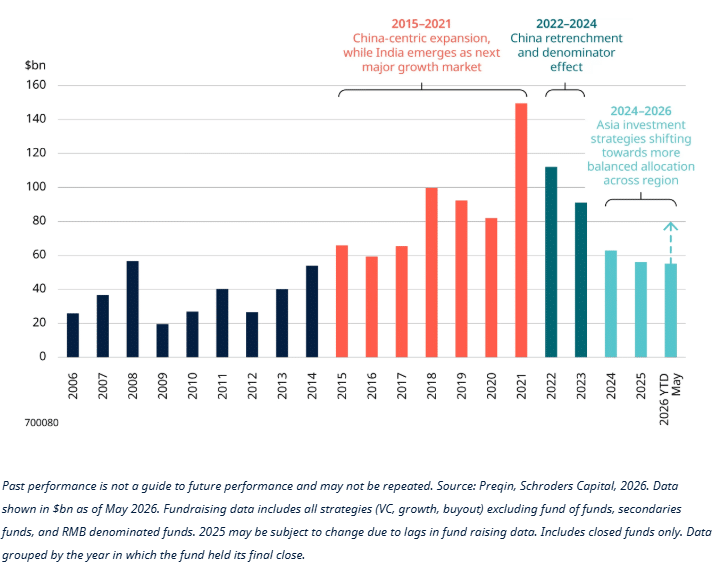
A combination of regulatory challenges in key countries, slower distributions across the board and broader geopolitical risk factors linked to global trade and supply chains have taken the sheen off what was once seen as a core growth allocation. Fundraising fell from a record high in 2021 to an 11-year low in 2025.
But we may now be at the beginning of a pivot.
In the first half of 2026 alone, Asian private equity fundraising exceeded the total for all of 2025 – a clear sign of returning investor confidence. Beneath the surface, however, the picture remains uneven: the headline number has been driven by a handful of large managers closing their biggest Asia funds to date.
The appeal of Asia is clear; less clear is whether concentrating capital in the large-cap segment is the best way to capture it.
We would argue not. Even as the rebound takes shape, the more compelling opportunity for discerning investors may lie beyond the largest funds, in markets with undeniably attractive growth dynamics.
Asia fundraising: Recovery following low point in 2025
Attractive market dynamics
Looking at Asia primarily through the prism of recent exit activity, or cross-market complexity, risks missing the bigger picture. The region remains one of the engines of growth globally.
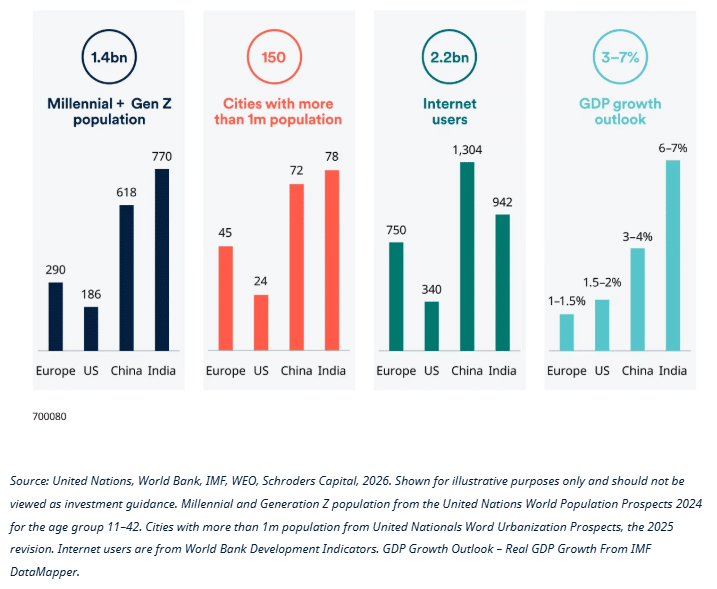
Asia, led by China and India, is the fastest-growing major economic region, accounting for 61% of global real GDP growth in 2025, according to IMF data.
The traditional drivers of growth across the region remain strong. For example, India benefits from a young population and rising spending power; China from urbanisation and a world-leading manufacturing base. Increasingly, though, these markets are also at the forefront of innovation, with potentially far-reaching global impact.
With Gen-Z and millennial populations far larger than those of developed economies, consumer businesses in India and China are pivoting rapidly to serve the consumer of the future – across products, designs and channels.
China also continues to capitalise on its deep-tech base, with technological advances that could match the West. India, for its part, has built digital public infrastructure – from digital identity to real-time payments – that is fuelling a new generation of fintech, software and AI-enabled businesses, and is increasingly seen as a template for other economies.
Sustainable long-term growth drivers in place
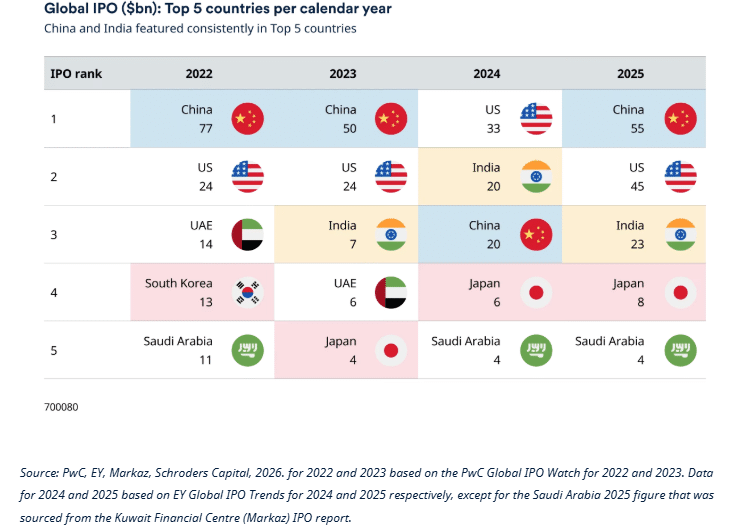
Domestic investors have taken note, increasingly backing their home markets. Despite a pullback by foreign investors, Asia – again led by China and India, with contributions from Japan and South Korea – has led global IPO issuance in recent years, highlighting the realisation path available to private companies and their backers.
Asian markets lead in global IPO listings
These factors create the conditions for investment opportunities in innovation and transformational growth that private equity is uniquely well placed to capture and unlock.
Yet private equity in Asia remains underpenetrated, partly reflecting the recent fundraising slowdown. Private equity investment represented around 0.5% of Asian GDP in 2025, compared with 3.6% in the US and 2.2% in Europe.
Asia private equity penetration low vs developed markets
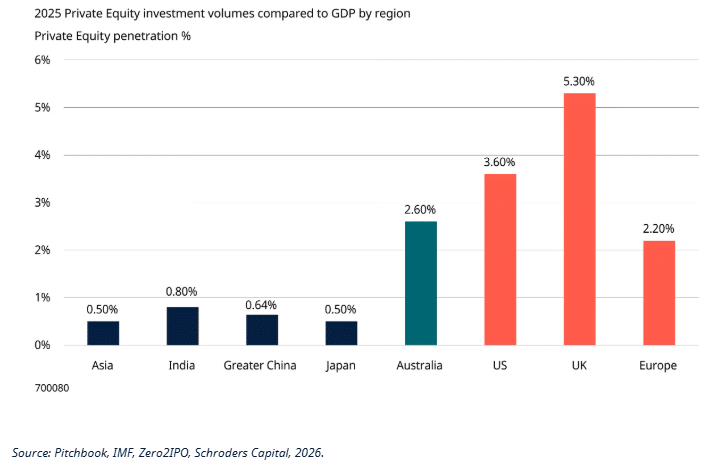
For investors able to deploy capital selectively, this combination of economic growth, low private equity penetration and a more constrained fundraising environment should create attractive entry points.
This is particularly true in the small and mid-market. As capital has concentrated at the larger end, this segment has become less crowded, offering more favourable valuations, a deeper pool of opportunities and multiple potential exit routes – from IPOs to sales to larger buyout funds
Not one market – taking a balanced approach
That said, the small and mid-market is not without risk. Smaller companies can be more exposed to economic shocks and varying governance standards. As a result, the gap between the strongest and weakest performers tends to be wider.
Equally, Asia should not be treated as a single investment case. China, India and developed Asia-Pacific economies such as Japan, Australia and South Korea have different economic structures, private equity ecosystems and, ultimately, drivers of underlying risk and return. The complexity is real.
In our view, the answer lies in diversification. Asia is less a single allocation than a collection of distinct opportunities that need to be carefully combined across markets, stages and strategies to help investors capture the region’s growth while managing risk.
Doing this well requires deep local knowledge. At Schroders Capital, we draw on our 20-year history in the region and an extensive network of specialist local managers to build portfolios around three core building blocks – growth capital in India and China, and small and mid-market buyouts in developed Asia, complemented by selective venture investments.
In practice this approach enables us to build a holistic portfolio that brings together compelling opportunities and provides investors with a balanced exposure to Asia.
1. India: investing in the growth of an innovation economy
India provides perhaps the clearest example of Asia’s growth potential. It is the fastest-growing major economy globally, supported by favourable demographics, rising consumer wealth and an increasingly sophisticated digital economy.
That growth is creating opportunities across healthcare, consumer services and AI-enabled technology.
In healthcare we have seen strong outcomes across medical technology, biopharmaceuticals, healthcare services and pharmaceutical contract development and manufacturing organisations (CDMOs), supported by rising access to healthcare and the expansion of private-sector provision.
Meanwhile, the country’s longstanding strength in technology services is evolving into a broader innovation ecosystem. For example, the Unified Payments Interface (UPI) processes more than ten billion transactions monthly, while more than 500 million new bank accounts have been opened since 2014, 60% of which are in rural areas.
Looking ahead, industrialisation could provide another source of growth. India’s efforts to expand its manufacturing base have drawn comparisons with China’s earlier development, although the two economies are following different paths.
The government’s Production Linked Incentive (PLI) scheme is designed to encourage domestic manufacturing and investment across sectors including electronics pharmaceuticals and automotive components.
For private equity investors, this combination of factors creates opportunities to back high-growth businesses looking to expand their operations, strengthen their market positions and reach new customers.
Targeted growth capital investments can help these companies capitalise on rising domestic demand, technological innovation and the expansion of India’s manufacturing base, while supporting their ambitions to to expand internationally.
2. China: scaling growth businesses in the world’s second-largest economy
For China, rather than early-stage digitalisation, much of the opportunity comes from the scale of its economy – the largest in the region and second largest globally – and the number of established businesses that have the potential to become considerably larger.
China’s superior industrial supply chain, large middle-class population with rising disposable income, and advanced capabilities in innovation and application have created vast business and investment potential in areas such as advanced tech, manufacturing, and healthcare – and headroom for growth that can be difficult to replicate elsewhere.
In a world with an increasing dispersion of innovation hubs globally, China therefore offers global investors exposure to a differentiated ecosystem, providing an important source of diversification as well as access to companies benefiting from the country’s continued growth and economic development.
The opportunity lies in providing growth capital to help established businesses scale, with access to both US dollar and RMB-denominated investment opportunities broadening the potential investment universe.
Innovation and import substitution are increasingly important parts of this story. In advanced manufacturing, efforts to develop domestic capabilities are supporting businesses across areas ranging from automation and robotics to sophisticated industrial technologies. Healthcare is also benefiting from structural demand and a growing research and development ecosystem.
At the other end of the investment lifecycle, there are signs that liquidity and exit conditions have improved. China’s capital markets have been outperforming global peers, and the IPO market has regained real momentum. China was ranked as the world’s largest IPO venue in 2025.
3. Developed Asia: a mature small and mid-buyout opportunity
Markets including Japan, Australia and South Korea have many of the characteristics investors typically associate with developed private equity markets in Europe and North America: established businesses, international connectivity, sophisticated capital markets and clearer routes to ownership and operational improvement.
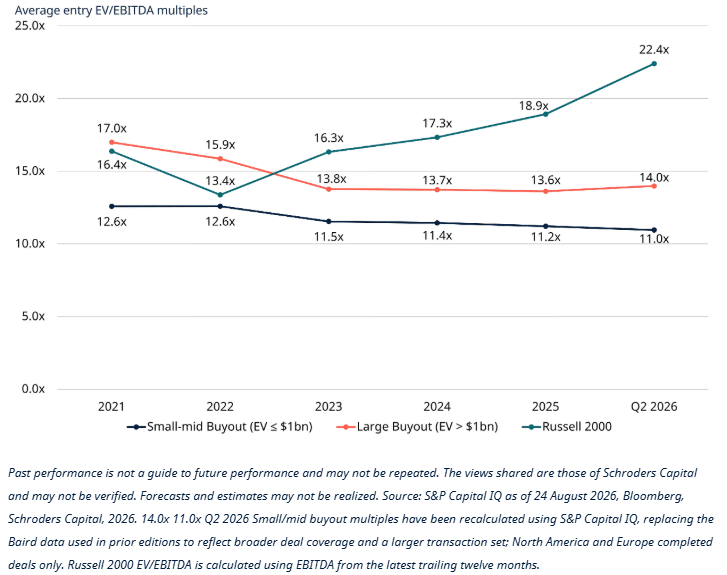
Here, the opportunity is increasingly centred on small and mid-market buyouts, which, globally, offer attractive entry points thanks to broader concentration of capital in recent years in large cap segments.
Our latest Global Private Equity Lens showed that small and mid-cap buyouts have a 3.0x entry valuation discount compared to large-cap buyouts – and much higher versus comparable small-cap public indices (see chart below).
Many of the underlying investment themes in these markets will be familiar to investors in Western markets. Founder and family succession can create opportunities for new ownership.
Fragmented industries can provide scope for consolidation. Other companies may require investment in technology, management or operations to realise growth and drive productivity.
Japan is a great example. Corporate governance reform and changing attitudes towards ownership and capital efficiency are creating opportunities for private equity to play a larger role in corporate transformation. Its combination of succession needs, corporate carve-outs and an established buyout ecosystem helps broaden the opportunity set.
Small-mid buyouts retain material entry discount that offers attractive entry point
Building a balanced Asian portfolio
There is no single investment thesis connecting every opportunity across Asia-Pacific. Instead, investors need to combine different building blocks – mirroring a broader private equity portfolio and capturing exposure to key growth markets and themes.
For our balanced portfolio approach, India provides exposure to high-growth businesses benefiting from digitalisation and rising domestic demand; China offers an unrivalled opportunity to access established companies with the potential for transformational growth on a global scale.
Developed markets in Australia, Japan and South Korea provide a fertile ground to access small and mid-market buyouts, where value creation may come through operational improvement, consolidation or corporate transformation.
Crucially, these allocations also have different risk-return profiles. Growth investments in India and China offer exposure to potential drivers of the next phase of global economic growth, with the prospect of higher returns accompanied by greater risk.
Small and mid-market buyouts in developed Asia provide a counterbalance, with returns less dependent on rapid economic expansion and more closely tied to company-specific performance and operational value-add.
Bringing these different exposures together can help investors balance risk and return, while reducing reliance on any single market or investment strategy. Selective venture investments can complement these exposures, providing access to emerging businesses and technologies at an earlier stage of development.
The aim is diversification not only by geography, but also across different stages of the investment lifecycle and different sources of value creation.
Accessing these opportunities requires specialist expertise. We’ve invested across Asia for more than two decades, developing relationships with local managers and experience across different markets and investment strategies.
This is particularly important in the lower mid-market, where businesses often attract less attention from larger private equity funds, and identifying the best opportunities requires a detailed understanding of local markets, industries and ownership structures.
Main image: Asia, India, map, globe, christian-lue-2Juj2cXWB7U-unsplash