






















Mark Tan – PFS Paraplanning Panel member and founder of PRISM.T – considers how the 2027 pension inheritance tax changes could reshape decumulation and estate planning strategies.

Meet John, 76. Before retiring as Chairman of his manufacturing business, he followed conventional financial wisdom to the letter.
Spurred by the 2015 pension freedoms, he aggressively funded his SIPP while still working, not for his own income, but because it was the ultimate tax-free legacy for his daughter and his two grandchildren.
For years, the golden rule of decumulation supported this: spend the GIA and ISAs first, leave the pension untouched. But from April 2027, pensions join the taxable estate, and the rulebook changes entirely.
The RNRB wipeout
The most immediate danger of aggregating pensions into the estate isn’t just the direct 40% IHT charge. It is the impact on the client’s existing allowances.
John’s position at 76, a widower:
- Main Residence: £800,000 (left to his daughter)
- ISAs, GIAs and Cash: £1,000,000
- SIPP: £1,200,000
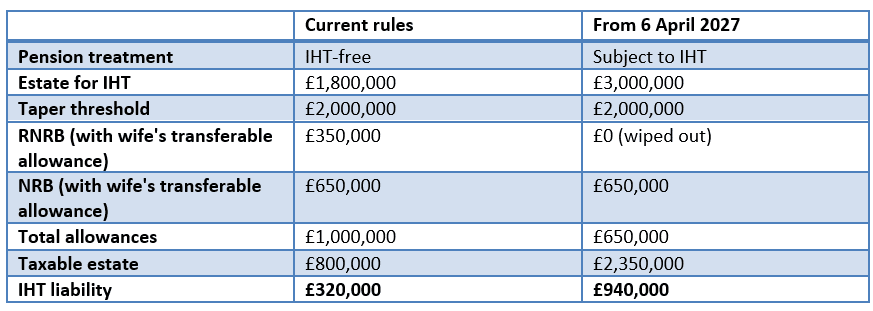
The IHT bill has increased by £620,000. Of that, £480,000 is direct IHT on the pension itself. But £140,000 is caused entirely by the loss of the RNRB.
The double taxation trap
If a client dies after age 75, the pension is subject to IHT, and the residual funds drawn by beneficiaries are subject to Income Tax at their marginal rate.
John’s £1.2m SIPP makes up 40% of the £3m estate, so it bears 40% of the £940,000 IHT bill: £376,000.
That leaves £824,000 for the beneficiary. If the beneficiary is an Additional Rate taxpayer, they pay 45% on the £824,000: £370,800.
Net value received: £453,200.
The £1.2m pension has been reduced to £453,200. An effective tax rate of 62.2%.
Probate delay and interest
If the estate is illiquid, executors may need cash to pay the IHT bill before they can obtain probate. From April 2027, the Pensions Direct Payment Scheme allows executors to instruct pension schemes to pay IHT directly to HMRC, but coordinating multiple schemes could still delay probate, with interest running at 7.75% on unpaid tax. For John, that is over £6,000 per month on his £940,000 IHT bill.
The Planning Angles
Expression of Wishes: Directing pension funds to a surviving spouse preserves the spousal exemption, delaying the tax charge. Nominations must align with the wider estate to avoid unintended beneficiaries bearing disproportionate tax.
Reversing the order of extraction: It may now be optimal to draw down the pension before the ISAs and GIAs. Drawing the pension reduces the estate value, potentially saving the RNRB, and avoids the 62.2% double tax charge. A blended strategy, drawing pension income up to the higher rate band while topping up with the GIA or tax-free ISA withdrawals, can optimise income tax while deflating the IHT problem.
Securing the PCLS: If a client dies after age 75 without having drawn their PCLS, the tax-free element is lost. Crystallising to draw it as soon as practical is worth exploring. The capital can be gifted, settled into a trust, or redirected into other IHT-mitigating structures.
Deathbed gifting to restore the RNRB: The RNRB taper is based on the estate value at death, after liabilities but before exemptions and reliefs. Lifetime gifts are not included, even if they are failed PETs. A deathbed gift reduces the taper estate immediately, regardless of survival. The gift consumes NRB as a failed PET, but preserves the RNRB.
Liquidity via protection: A Whole of Life policy written in trust provides liquidity outside the estate, ensuring executors can settle the IHT bill without forcing the fire sale of properties or portfolios.
These strategies must be stress-tested against the client’s circumstances, risk tolerance, and broader objectives. The tax tail should never wag the planning dog.
Main image: pen, paper, highlighters,jessica-lewis-thepaintedsquare-s55xuIpXMlA-unsplash