










Pension tax-free lump sums have changed significantly since the abolition of the lifetime allowance. Adam Cole, Pension Specialist at Quilter, provides an overview of the key allowances that now govern how much can be taken tax free during life and on death. This article is the first of a four-part series.
We often receive queries about how the current tax-free thresholds for pensions work. In response we have produced four articles about these. In this first one we give a high-level overview of an Individual’s Lump Sum Allowance (ILSA) and an Individual’s Lump Sum and Death Benefit Allowance (ILSDBA).
Individual’s Lump Sum Allowance (ILSA)
This allowance is a limit on how much money can be taken as tax-free lump sums from your pension whilst alive (ignoring pension income).
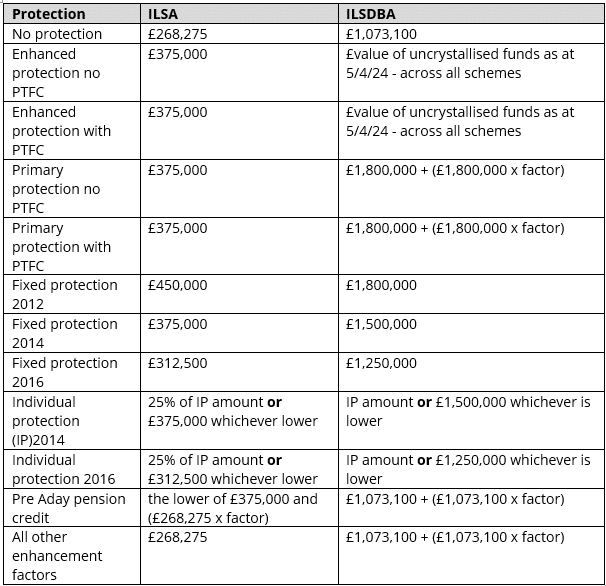
Most clients will have the standard allowance, which is £268,275. The allowance is modified by different forms of protection, for example Fixed Protection 2012 (please see quick reference table below which gives a summary for each type).
What counts toward this allowance is the tax-free portion of the following lump sums:
- Pension commencement lump sum
- Uncrystallised funds pension lump sum
- Stand-alone lump sums
- Deemed lump sum connected to a Pre A-day pension
Each time one of these lump sums is taken it will use up some of the ILSA until there is no ILSA remaining.
Individual’s Lump Sum and Death Benefit Allowance (ILSDBA)
Despite the name, the ILSDBA is a limit on the amount of all lump sum payments that can be paid tax free in respect of that pension owner, not just those on the pension owner’s death.
An easy way to remember this, is ILSDBA equals ILSA tested tax-free lump sums taken during the member’s life plus any serious ill health lump sum and certain tax-free lump sum death benefits paid after death.
The standard allowance is £1,073,100. As with the ILSA, the allowance is modified by different forms of protection.
What counts toward this allowance is the tax-free portion of the following lump sums:
- Pension commencement lump sum
- Uncrystallised funds pension lump sum
- Stand-alone lump sums
- Deemed lump sum connected to a Pre A-day pension
- Serious ill health lump sum
- Pension protection lump sum death benefit
- Annuity protection lump sum death benefit
- Uncrystallised funds lump sum death benefit
- Defined benefit lump sum death benefit
- Drawdown pension fund lump sum death benefit
- Flexi-access drawdown lump sum death benefit
Each time one of these lump sums is taken it will use up some of the ILSDBA until there is no ILSDBA remaining.
It’s worth noting that it only applies to death benefits that are paid where the member was under 75 when they died and it is paid within 2 years of the scheme administrator being reasonably aware of the members death.
Quick reference table of ILSA/ILSDBA by protection type
Tax-free maximums for lump sums
Although there is an overall limit to how much can be taken tax-fee whilst alive and after death, each type of lump sum payment (e.g. PCLS, scheme specific protected tax-free cash etc), has a maximum amount that can be paid tax free.
This is called the permitted maximum. Most of the time the permitted maximum will reference remaining ILSA and ILSDBA but not always (normally where there is a form of protection). It is important to make sure you are aware of the rules for the permitted maximum for each type of lump sum.
Below is a link to a table which sets out in detail how the permitted maximum applies to each type of lump sum across the various protections.
Please see our table for permitted maximums
As with so much in the world of pensions, the complexity comes with the changing of the tax rules twinned with a commitment not to adversely affect those with existing accrued pension rights. Enabling customers to understand how to navigate through this complexity is something paraplanners are well placed to deliver.
Main image: understanding, kelly-sikkema-pXmyDPziB8w-unsplash