























After a strong first half of the year, investors are asking whether emerging markets can continue to deliver on their undoubted promise. Against a backdrop of AI and semiconductor-led enthusiasm, the Fidelity International ETF team examine how emerging markets have performed this year and discuss why now may be the time to combine quality and income in the search for disciplined, research-fuelled alpha.
Emerging market equities have moved firmly back into focus in 2026. After a period in which developed markets, and particularly the US, dominated investor attention, the asset class has benefited from renewed enthusiasm around artificial intelligence, improving earnings momentum in parts of Asia, and a more diverse set of structural growth drivers across regions.
As we move into the second half of the year, the question is now whether this rally can continue and, if so, how to access the opportunities available without becoming overly dependent on a narrow group of mega-cap technology names.
Emerging markets have come back into focus
Emerging markets have delivered substantial gains so far this year, with the asset class returning approximately 24% in US dollar terms year-to-date and outperforming many developed markets.
Much of this strength has come from emerging Asia, particularly Taiwan and Korea, where semiconductor and AI-related companies have benefited from continued demand growth and strong earnings momentum.
At the same time, Latin American markets have been more subdued, reflecting weaker commodity prices and political uncertainty in several markets.
This has created a market that is attractive, but increasingly complex. Emerging markets have benefited from a stronger risk appetite from investors, AI-led demand, and a supportive commodity backdrop in some areas.
However, geopolitical uncertainty, shifting expectations around US monetary policy and concerns over stretched valuations within parts of the technology sector mean that some caution may be needed in the coming months, rather than taking a pure risk-on approach to equity allocations.
In the broad emerging market context, the three largest stocks in the MSCI Emerging Markets Index, TSMC, Samsung Electronics and SK Hynix, now represent around 30% of the index.
Their performance has been broadly supported by strong AI capital expenditure, tight capacity across advanced node production and rising demand for memory.
However, this concentration also means investors relying on broad passive exposure may be more exposed to a small number of companies, sectors and investment themes than headline index diversification would suggest.
The opportunity in emerging markets, in our view, is not limited to the most visible AI beneficiaries.
The wider emerging market universe includes companies linked to grid infrastructure, digitalisation, financial deepening, frontier market growth and less well-known parts of the semiconductor supply chain – a compellingly diverse opportunity set.
This diversity matters because the next phase of the rally may be less about simple exposure to the largest index constituents and more about identifying specific opportunities where earnings resilience, valuation discipline and structural growth can come together.
As such, investors need to be able to rely on a high-quality research platform in order to look past the headlines and identify those more compelling opportunities.
Why quality income matters now
A quality and income approach can be particularly relevant in this environment because it seeks to balance participation in rising markets with a focus on fundamental resilience.
In emerging markets, high headline yields can sometimes reflect financial stress rather than attractive income potential. A disciplined quality screen can help avoid dividend traps by focusing on companies with profitable business models, stable earnings, robust cash-flow generation and stronger balance sheets.
Figure 1: Emerging markets style factor returns
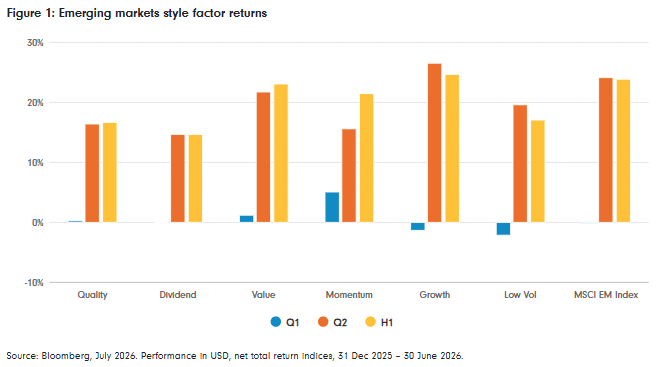
Exposure to a diverse factor set has provided a boost thus far in the year. Market leadership has shifted and, while AI-related growth stocks continued to contribute strongly to overall index returns, investors increasingly favoured companies with resilient cash flows, attractive valuations and sustainable dividend profiles as uncertainty increased around the macroeconomic outlook.
The combination of attractive valuations, stronger balance sheets and cash-flow generation helped support relative returns for quality income strategies in a market environment characterised by rising dispersion across sectors, regions and individual securities.
Broader EM equity rally supported performance
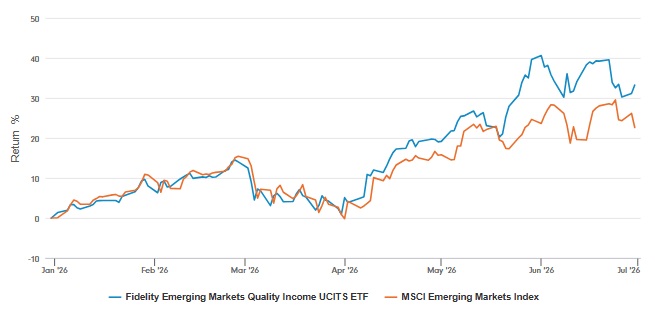
The Fidelity Emerging Markets Quality Income UCITS ETF delivered strong absolute and relative performance in the first half of 2026.
The underlying Fidelity Emerging Markets Quality Income Index returned 1.4% in Q1, outperforming the MSCI Emerging Markets Index, which declined 0.2%. Relative returns were supported by stock selection in Information Technology and Consumer Discretionary, as well as strong contributions from holdings including TPF and Chrome Ate.
The second quarter was materially stronger. The Fidelity Emerging Markets Quality Income Index returned 32.3% in Q2, outperforming the MSCI Emerging Markets Index by more than 8 percentage points.
Relative performance was driven primarily by strong security selection within Information Technology, supported by a beneficial underweight in Communication Services and strong stock selection across Asia Pacific.
Figure 2: H1 performance was positive
At stock level, Samsung Electro-Mechanics was the largest contributor to relative returns after rallying 436% in US dollar terms over the quarter.
Yageo, MediaTek, DB HiTek, Elite Material, King Slide Works, Lenovo and Largan Precision also contributed positively. Relative returns were further supported by not holding Tencent and Alibaba, both of which underperformed over the period.
The February 2026 rebalance helped position the strategy for this environment. Following the rebalance, the index contained 133 stocks, with turnover of 51.1% as valuation, dividend and quality characteristics evolved across the emerging market universe.
Additions included Samsung Electro-Mechanics, Hyundai Autoever, DB HiTek, MediaTek, Elite Material and Bharti Airtel, reflecting opportunities in the AI supply chain and broader digitalisation trends emerging across emerging markets.
The future looks positive for emerging markets
Looking ahead, we believe the broad direction for emerging markets remains constructive, but increasingly dependent on research-informed selectivity.
The AI supply chain continues to provide powerful support, particularly in parts of emerging Asia, but valuations and index concentration warrant careful monitoring.
At the same time, opportunities outside the largest companies remain significant, including in infrastructure, financials, frontier markets and less visible beneficiaries of digital investment.
While the future looks positive, broad emerging market exposure may need to be assessed for concentration risk, particularly where index-level allocations are increasingly dominated by a small number of technology-related companies.
In this environment, active and research-informed implementation may become more important as performance dispersion rises across sectors, regions and securities. Furthermore, when looking for income exposure in emerging markets, it should be evaluated through the lens of quality and sustainability, rather than yield alone.
The Fidelity Emerging Markets Quality Income UCITS ETF is designed to sit within this context as a differentiated emerging market equity allocation.
By combining quality screens, dividend discipline and risk-controlled construction, the ETF seeks to provide broad EM participation while reducing reliance on country, sector or individual stock tilts.
In a market where opportunities are widening but risks remain uneven, that combination may be well suited to investors seeking a more balanced route into emerging market equities.
Discrete 12 month % returns net of fees
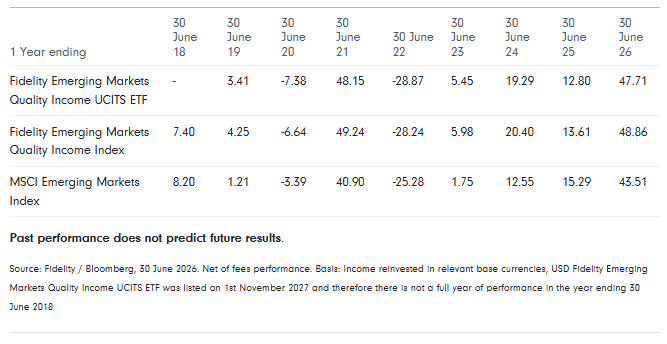
Past performance is not a reliable guide to future returns. You may not get back the amount originally invested, and tax rules can change over time. The writer’s views are their own and do not constitute financial advice.
This information should not be relied upon by retail clients or investment professionals. Reference to any particular investment does not constitute a recommendation to buy or sell the investment.
Main image: magnifying glass, analyse, research, markus-winkler-afW1hht0NSs-unsplash