























Upcoming inheritance tax changes mean pension death benefit trusts may no longer deliver the same tax advantages. Fiona Hanrahan, Senior Pensions Development and Technical Manager at Royal London, explains why existing arrangements should be revisited.

Many clients will have trusts in place which were set up to receive lump sum pension death benefits when they die.
Or, you might have clients thinking about it and they’re asking how the rule change from 6 April 2027 affects this decision.
From 6 April 2027, when someone dies and there’s a trust in place to receive the lump sum death benefits, this won’t save any IHT on that first death.
The decision whether to use a trust from 6 April 2027 will continue to be for reasons of control most likely, rather than saving tax.
Case study
Consider an unmarried couple in their 70s who have one child each from their previous marriages and two children together.
A trust was set up to receive the pension death benefits to allow the surviving partner to continue to receive an income from the funds, then on the subsequent death the funds shared amongst all four children.
This scenario could not be guaranteed under the pension rules as when someone accepts pension death benefits, it is then up to them how they spend it or who they pass it to when they die. Using a trust would achieve the desired outcome in this situation.
Currently the funds would pass to the trust IHT free and income tax free if death occurred before age 75 and the lump sum is within the remaining lump sum and death benefit allowance.
But from April 2027, the pension will be included in the estate and IHT will potentially apply. In our example the couple are not married, so there would be no spouse exemption. This IHT charge would therefore apply whether the funds stayed within a pension or not.
On death after age 75 the special lump sum death benefit charge of 45% will apply. This will be deducted by the pension provider before the payment is made to the trust. The ultimate beneficiary can use this as a tax credit during the tax year they receive a payment from the trust. IHT could also apply.
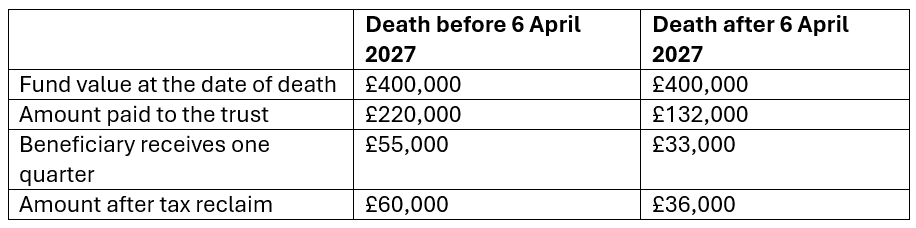
Let’s add some figures and look at the situation if death occurred before and after 6 April 2027.
Assumptions
- The fund is £400,000 at the date of death
- IHT of 40% applies after 6 April 2027
- The beneficiaries pay income tax of 40%
- Death occurs after age 75 so the special lump sum death benefit charge of 45% applies
- The beneficiary can claim overpaid tax of the difference between the 45% deducted and their income tax rate of 40%
Any trusts already set up to receive pension death benefits should be reviewed. For example, if there is a surviving spouse, it might make sense for an expression of wish form to be completed in the spouse’s favour as this will avoid IHT.
But, this doesn’t address the control issue we discussed earlier or avoid IHT on a subsequent death that the trust route would.
Completing a new expression of wish form does not bring the trust to an end in this situation.
It was likely set up with a nominal amount, for example £10, so this is still within the trust. Other gifts could be paid to the trust if appropriate or it could be brought to an end by paying the proceeds to one of the intended beneficiaries.
Summary
The IHT changes coming into effect from April next year mean any trusts already set up to receive death benefits should be reviewed.
This is especially true if there is a surviving spouse or civil partner. If the decision is to set the trust aside, it is simply a case of completing a new expression of wish.
It could be that the reasons for setting up the trust remain valid and the preferred option is to continue the trust route. This can be reviewed and updated at any time if circumstances change.
Main image: trust, ronda-dorsey-ZoVR7mPHMGo-unsplash