























Albane Poulin, Fixed Income Fund Manager for the TM Gravis Digital Infrastructure Income Fund, explores why bonds can offer an attractive way to access the digital infrastructure theme while helping to reduce portfolio volatility.

Digital infrastructure is expensive to build. JLL expects nearly 100GW of new data centre capacity to come online globally between 2026 and 2030, doubling the world’s capacity.
It estimates this will create around $1.2tn of real estate value and require roughly $870bn of new debt financing – before tenants spend a further $1tn to $2tn fitting out the space with servers and networking equipment†.
Add the towers needed to carry growing 5G traffic and the warehouses behind rising e-commerce penetration, and the sector’s need for capital is vast. Much of that growth is funded with debt.
In our three-part series on digital infrastructure, my colleague James Peel looked at e-commerce logistics, communications towers and data centres, and the listed companies that own and operate these mission-critical assets.
In this third case study, I’ll look at the case for investing in the bonds of some of those same companies.
The investment case
Since May 2026, the TM Gravis Digital Infrastructure Income Fund has been building a fixed income sleeve (capped at 20%) alongside its equity portfolio. The rationale is simple: to increase yield and reduce the volatility, without changing the underlying businesses we believe in.
While dividends can be cut or suspended at the discretion of a company board, a bond’s coupon is a legal obligation. Bondholders also rank above shareholders in the capital structure giving them a prior claim on a company’s assets. That makes bond income more predictable and offers a degree of downside protection that equity does not.
The bond market is also deep and highly liquid, offering a wide choice of maturities and levels of seniority through which to express a view on a company.
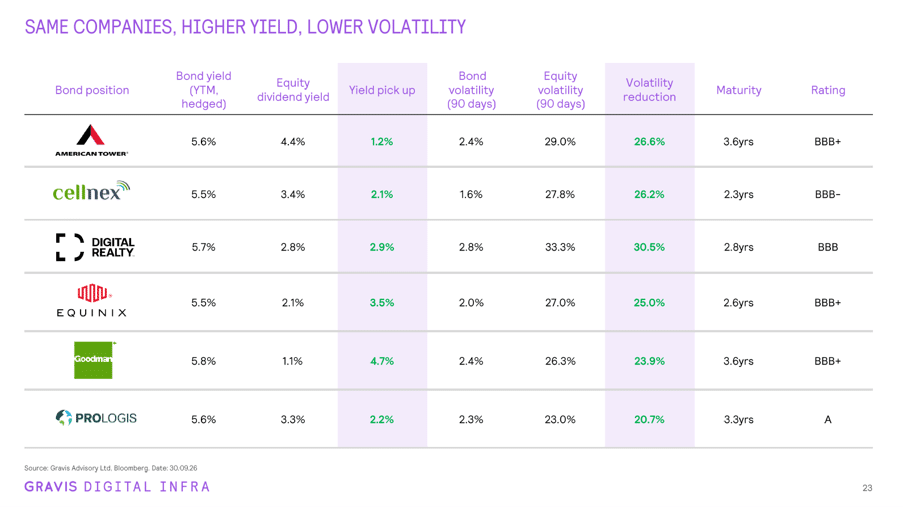
Then there is the yield. Across all of the bond holdings we have added, the bond yield sits above the dividend yield on the same company’s shares, by between around 1.2 percentage points (American Tower) and 4.7 percentage points (Goodman)*.
Because the coupons are fixed, that income can be locked in until maturity, which is particularly valuable while interest rates remain elevated. Measured against UK inflation, using the CPIH index (the consumer prices index including owner occupiers’ housing costs), real yields are also attractive.
The second benefit is lower volatility. Bondholders care primarily about cash flow, liquidity and credit rating, so bonds are far less sensitive than shares to market sentiment, earnings revisions and newsflow.
We focus on investment grade bonds, which are stronger credits and have typically shown low correlation with equities. We also favour short-dated bonds for this strategy, averaging around three years to maturity, which are less sensitive to interest rate movements.
Finally, all non-sterling bonds are hedged back to sterling, so unlike the Fund’s overseas equities they carry little currency exposure. All bond yields quoted in this article are on that hedged basis.
How to gain exposure to digital infrastructure bonds
For most investors, direct exposure is difficult. These bonds are typically issued in minimum denominations of $100,000, which puts them out of reach of most retail investors and many wealth managers. Holding them through a fund opens up an asset class that would otherwise be hard to access.
Every bond the Fund owns is issued by a company whose equity it also holds. Same company, same conviction, expressed through different parts of the capital structure. Some of these are growth stories, where the shares pay relatively little income.
Equinix, the data centre REIT (real estate investment trust) we profiled in our last case study, has a dividend yield of 2.1%; its bond yields 5.5%*. Goodman, the Australian-listed industrial property group, offers a dividend yield of only around 1.1%, because the market prices it for growth – much of it expected from a data centre pipeline, roughly half of which is still under development*.
The Fund holds a euro-denominated Goodman bond yielding 5.8%, with a 90-day volatility of 2.4% against 26.3% for the shares*. In short, we own the equity for growth and the bond for income, from the same company.
Prologis, the world’s largest logistics REIT, is the only single A-rated company among our bond holdings, and the strongest credit. It is well known for a prudent, consistent capital strategy.
Its recent offer for SEGRO, financed roughly 75% in shares and 25% in cash, together with its recent equity issuance, shows a management team committed to protecting its credit profile even while pursuing a deal of that scale.
Comparing total returns over the past three years, Prologis shares returned 27.6% against 16.3% for its January 2030 bond*. The equity delivered more upside, but with volatility of 15.6% versus 3.2% for the bond – roughly five times higher – so the timing of buying these shares is also crucial.
American Tower, one of the largest US TowerCos covered in our towers case study, owns a globally diversified portfolio of towers, with cash flows underpinned by contractual rents from mobile network operators such as T-Mobile and AT&T.
Its weighted average remaining lease term is 5.1 years, so the Fund’s bond matures before those leases roll off. The bond therefore provides an attractive yield while insulating the portfolio from the longer-term demand uncertainty, and associated equity valuation volatility, that could affect the sector.
Looking ahead
We continue to see an attractive window for the asset class. Yields on short-dated investment grade bonds remain elevated, both relative to the dividend yields on the same companies’ shares and against UK inflation.
Short-dated bonds should also continue to act as a stabiliser. The credit spread makes up only a small part of a short-dated bond’s total return, so if spreads widen in a sell-off, the impact on bond prices should be meaningfully smaller than on share prices.
Recent events in the towers sector show why that matters. In October, SpaceX agreed to buy low-band spectrum for a reported $8bn, fuelling speculation that it could become a fourth US mobile carrier.
The next day, shares in the three largest US mobile network operators fell by between 10% and 13%, while US tower stocks rose by between 7% and 16%**. For an equity investor, newsflow like this can move valuations sharply in either direction.
For a bondholder, the question is narrower: will contracted rents keep covering interest and repayment until the bond matures? With American Tower’s leases running beyond our bond’s maturity, and satellites still dependent on terrestrial towers to carry most mobile traffic, we believe the answer is yes.
Bonds are not without risk. Issuers can be downgraded or, in extreme cases, default; bond prices can fall if interest rates or credit spreads rise; and the income locked in at purchase is only fully realised if the bond is held to maturity. Our emphasis on investment grade issuers and short maturities is designed to limit, rather than eliminate, those risks.
For investors in digital infrastructure, the question is no longer only which companies to own, but through which part of the capital structure to own them.
†Source: JLL, 2026 Global Data Center Outlook, 5 January 2026: https://www.jll.com/en-us/insights/market-outlook/data-center-outlook
*Source: Gravis and Bloomberg, data as at 30 September 2026. Bond yields hedged to sterling. Volatility figures are 90-day. Forward yields are based on forecasts, which are not a reliable indicator of future results.
**Source: Gravis, SpaceX’s $8bn spectrum bet: why satellites still need towers, 18 October 2026: https://www.graviscapital.com/news/spacexs-8bn-spectrum-bet-why-satellites-still-need-towers
No information contained in this article should be construed as providing financial, investment or other professional advice and should not be considered as a recommendation, invitation, or inducement to subscribe for, dispose of or purchase any such securities. Professional investors only. Capital at risk. Past performance is not a guide to future performance.
Main image: digital, infrastructure, joshua-sortino-LqKhnDzSF-8-unsplash