























Digital infrastructure is not just about the data itself. It also relies on a vast physical network that allows us to stay connected. In the second of a three-part series exploring digital infrastructure, James Peel, Senior Research Analyst at Gravis, looks at communications towers and the companies that own and operate them.
The investment case
Global mobile data consumption is scaling at a remarkable rate, driven by 5G adoption and the growth of data-heavy applications like video games and social media.
According to Ericsson, the number of mobile 5G subscriptions is expected to rise from about 3bn today to more than 6bn by the end of the decade.
All of this ‘virtual’ internet traffic is supported by physical digital infrastructure, for example communications towers, which are tall metal structures placed strategically on hills, rooftops or open land, and which host heavy equipment like antennas and microwave dishes.
Historically, these towers were built and used by mobile network operators (MNOs) like AT&T and Vodafone, and were a source of competitive strength.
However, as mobile technology evolved, upgrading the towers became both a financial and operational bottleneck. As a result, MNOs sold or spun out their towers into standalone businesses, giving rise to the modern day ‘TowerCo’.
The TowerCo business model is attractive, relying on several core drivers. The most important is operational leverage. Helios Towers, for example, achieves a 12% return on invested capital (ROIC) on a tower with a single MNO tenant.
Adding a second tenant increases ROIC to 25%, and a third to 34%. TowerCos sign long-term, inflation-linked contracts with MNOs, providing a reliable organic growth engine.
How to gain exposure to communications towers
The TM Gravis Digital Infrastructure Income Fund owns multiple TowerCos listed in the USA and Europe. In the USA, the market is dominated by American Tower, Crown Castle and SBA Communications, which together own and operate more than 200,000 towers, most of which are located in the USA. American Tower and SBA both have sizeable international portfolios too.
In Europe, the Fund owns Cellnex, which offers exposure to various markets across the continent, and INWIT, which focuses exclusively on Italy. One of Cellnex’s most eye-catching sites is the Torre de Collserola, designed by architect Sir Norman Foster for the 1992 Olympics in Barcelona.
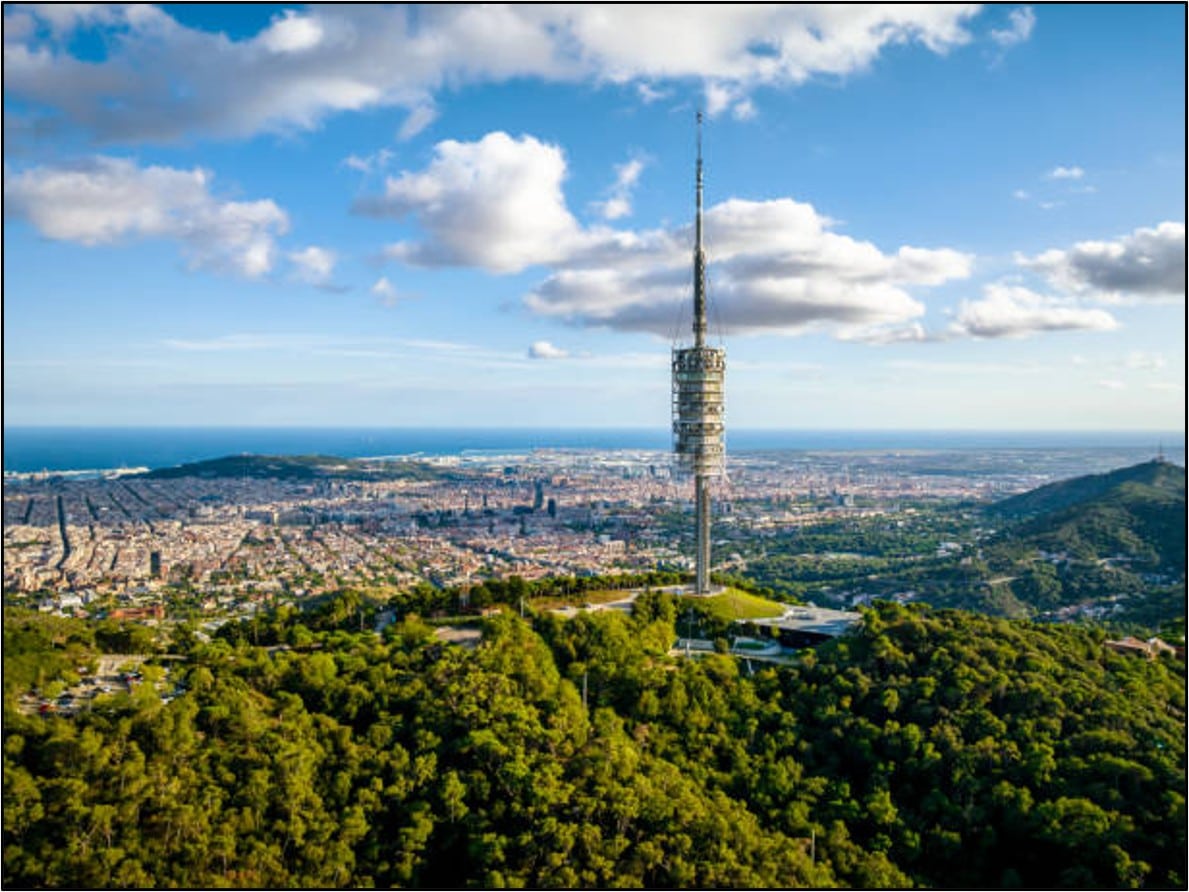
Figure 1 Torre de Collserola
The most recent addition to the Fund was Helios Towers, which although listed in the UK, owns more than 15,000 towers across nine markets in Africa and the Middle East. After a period of acquisition-led growth,
Helios Towers has shifted its focus to recurring free cash flow generation, which is expected to reach as much as $235mn this year. The company is using some of that cash to conduct share buybacks and recently announced its first dividend.
Looking ahead
TowerCos are currently trading at depressed multiples after a period of share price weakness. This is partly because their business models are interest rate-sensitive and rates have increased meaningfully in recent years, but also due to sector-specific risks, for example consolidation amongst MNOs and the growth of satellite networks.
The former could lead to reduced demand for tower space and the latter represents a potential new source of competition to terrestrial networks.
However, we believe these risks are somewhat overstated. MNO mergers rarely result in a material reduction in demand because the combined entity must still invest to improve network capacity, and although satellites work well in rural areas, the technology is a poor substitute for terrestrial networks in dense urban environments.
In recent months both SBA and Cellnex have been the subject of M&A speculation, indicating that some investors have reached a similarly positive conclusion as it relates to the sector risks, and see an opportunity to invest in mission-critical digital infrastructure at an attractive price point.
No information contained in this article should be construed as providing financial, investment or other professional advice and should not be considered as a recommendation, invitation, or inducement to subscribe for, dispose of or purchase any such securities. Professional investors only. Capital at risk. Past performance is not a guide to future performance.
Main image: communication, kelly-sikkema-sWRPYgjpygQ-unsplash