























The growth of e-commerce has created a vast network of warehouses and fulfilment centres that underpin the digital economy. In the first of a three-part series on digital infrastructure, James Peel, Senior Research Analyst at Gravis Advisory Limited, explores why logistics real estate continues to offer compelling long-term opportunities for investors.

When we think of digital infrastructure, the first thing that comes to mind is data centres. But that is just the latest hot-topic in a sector that has seen tremendous growth in recent years.
In the first of a three-part series exploring this area of real estate, we look at e-commerce logistics. Over the past decade, online shopping has transformed the global economy.
This shift has, in turn, created demand for a vast network of warehouses and fulfilment centres, with online retail typically requiring around three times more logistics space than traditional shops.
As more shopping moves online, demand for modern logistics facilities continues to grow, creating long-term opportunities for investors in the companies that own and develop these assets.
The investment case
The internet has fundamentally changed the way people shop because buying goods online improves choice, convenience and cost when compared to the high street or shopping centres.
In the UK, internet sales as a percentage of total retail sales has increased materially over the last decade, and currently sits at almost 30%. The figure is lower in the USA, but is expected to rise to a similar level to that of the UK by the end of the decade.
Part of the reason for that growth is, according to survey data from Whistl, younger generations buy more online than older generations.
The rise of e-commerce has necessitated the development of complex supply chains. For real estate investors, the opportunity set encompasses two main types of property.
First, ‘big boxes’, or large warehouses, which tend to be highly automated and located along key transport corridors. Second, smaller warehouses in urban areas, which enable ultra-fast delivery of goods.
How to gain exposure to e-commerce logistics
Prologis, a top ten holding in the TM Gravis Digital Infrastructure Income Fund, is based in the USA. It is one of the largest REITs globally, and comfortably the largest listed landlord in the logistics sector.
The company’s portfolio spans almost 1.3bn square feet across 20 countries. Prologis calculated that in 2024 $3.2tn of goods passed through its warehouses, equivalent to 3% of global GDP. Other examples in the USA include Rexford, EastGroup, First Industrial and LXP.
In the UK the listed market is dominated by SEGRO and Tritax Big Box (also in our top ten), both of which are constituents of the FTSE 100. The former is more than 100 years old, and operates a £19bn portfolio of big boxes (c.35%) and urban warehouses (c.65%). Tritax is not even two decades old, but has grown quickly.
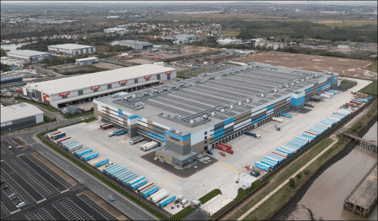
Having delivered an excellent set of results in 2025, improving both rents and occupancy, the company has set an ambitious target to grow earnings by 50% by 2030. Tritax’s largest warehouse is located on the former Littlebrook power station site in Dartford, and is leased to blue chip tenants like Amazon and IKEA.
Figure 1 Littlebrook
Elsewhere in Europe the Fund owns CTP, Warehouses De Pauw and ARGAN. It also has exposure to REITs based in Australia, Japan and Singapore. Altogether, this amounts to a global portfolio of approximately 9,000 buildings let to almost 15,000 tenants.
Looking ahead
The positive trend in e-commerce penetration looks set to continue, which bodes well for investors in REITs that own mission-critical logistics assets, especially those with sizeable development pipelines. Prologis estimates that for every percentage point increase in e-commerce share, up to 70mn square feet of new warehousing is required, or nearly 1,000 football pitches worth.
REITs like Prologis have also responded to adjacent mega trends within digital infrastructure, for example the growth of cloud computing and artificial intelligence (AI).
These technologies are powered by data centres, which in many ways are similar to traditional warehouses. Prologis, SEGRO, Goodman and others have been able to leverage their skillset and landbanks to develop multi-gigawatt data centre pipelines, representing a potentially significant source of future profits.
M&A has been a dominant feature of the listed real estate sector over the past few years. For the logistics sub sector, that can be explained by the combination of powerful mega trends, strong operating results and attractive valuations.
In July alone, deals for LXP, SEGRO and ARGAN were announced. For SEGRO and ARGAN the would-be buyers are listed peers Prologis and Warehouses De Pauw, respectively.
It remains to be seen whether these deals will complete on the current terms, although at the time of writing all three have been recommended by the target company’s Board.
No information contained in this article should be construed as providing financial, investment or other professional advice and should not be considered as a recommendation, invitation, or inducement to subscribe for, dispose of or purchase any such securities. Professional investors only. Capital at risk. Past performance is not a guide to future performance.
Main image: logistics, marcin-jozwiak-oh0DITWoHi4-unsplash