























Introducing Schroders Climate Transition Model – a lens to assess the pace of transition beyond headline targets. Analysis from the latest proprietary model, highlights an alarming gap between what companies have promised versus what they are delivering. Dan Wilson, Sustainable Investment Models Analyst and Frances Grier, Head of Sustainable Investment Models tell us more.
Around one third of the global equity market has published a net zero target [1], but tangible action to decarbonise falls far short. Whereas the market has focused on transition plans and long-term targets, history tells us that targets have proven a poor predictor of emission reductions.
Despite political noise and short-term headwinds, there is scientific consensus that unchecked global warming poses risks to societies and ecosystems, economic stability and long-term investment outcomes.
While the pace of political action to tackle that threat has slowed in recent years, it does continue to build. How quickly and credibly companies adapt will influence future costs and capital allocation across markets.
Markets need to evolve transition risk assessments
As TCFD (Task Force on Climate-Related Financial Disclosures) reporting and net zero target-setting entered the mainstream in the early 2020s, investors gained new insights into transition risk thanks to better data on company emissions and decarbonisation commitments.
Since then, disclosures have become more detailed and investor understanding of the opportunities and risks of the transition across economies have deepened.
This brings an opportunity to re-think transition assessments, moving away from targets toward a wider range of measures and a more powerful basis to project future emissions.
The question is not “does the company have a target” or even “is the target credible” but rather “how quickly do we expect this company to decarbonise, whether it has a target or not”.
Targets and emissions data alone do not provide a complete picture. First, headline commitments can be misleading: companies operating in very different sectors, geographies and regulatory environments may present similar climate ambitions on the surface, but feasibility and cost of delivery vary widely.
Targets do little to explain how a business plans to adapt its operations or product mix in a changing economy.
Second, backward‑looking metrics offer limited insight into future risk.
Historical emissions cannot tell us the extent to which companies are positioned for tightening regulation, technological disruption or shifts in demand.
Why credibility matters
To model the future emissions pathway of a company, we need to be able to assess whether companies are taking transformative action.
This is where our Climate Transition Model comes in. The CTM assesses forward-looking emissions trajectories for companies using three equally weighted pillars:
- Ambition: decarbonisation targets
- Credibility: management action and operating environment
- Progress: realised emissions intensity change
Combining these pillars gives us a clearer forward-looking view of transition.
The credibility pillar plays an important role, contextualising targets by assessing how plausible it is that an issuer can deliver emissions reductions in practice.
It does this by assessing direct company action across more than 25 indicators which have demonstrated strong and consistent correlation to successful decarbonisation.
- For more information on the CTM pillars, see the full methodology document: Climate Transition Model: A forward-looking framework for assessing transition.
The assessment of each pillar produces an Annualised Emissions Reduction Rate (AERR) from -11% to +11%. Combining all three pillars, we can project a company’s possible pathway to net zero, and calculate the expected year in which they will reach net zero.
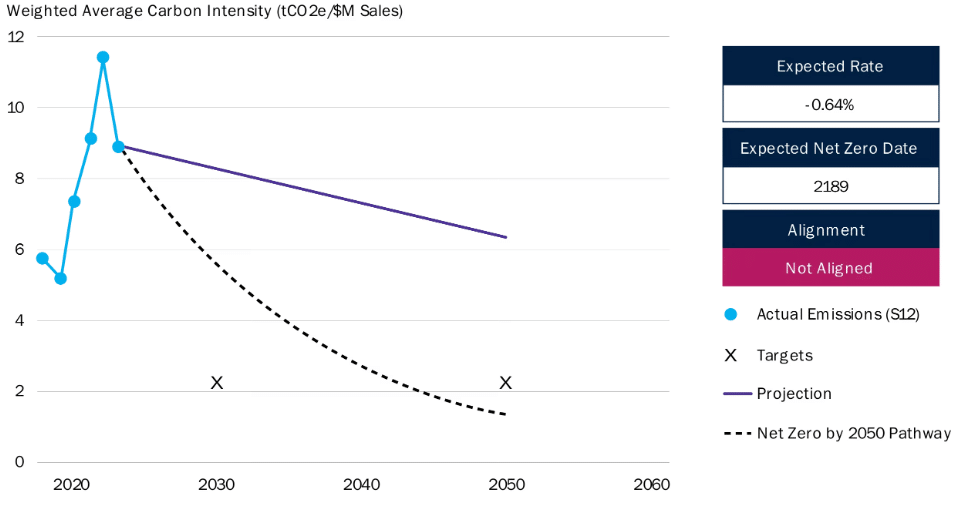
Figure 1 illustrates this using a major technology company. While the firm has ambitious near-term and long-term emissions reduction targets (Ambition), its historical emissions (Progress) have significantly increased since 2021 and its management and grid outlook (Credibility) results do not provide confidence that it will meet these targets.
As a result, its projected decarbonisation pathway sits well above a net zero pathway.
Figure 1 below: CTM analysis of a major technology company
Source: Schroders, March 2026. For illustrative purposes only. Not a recommendation to buy or sell any security.
The CTM helps investors differentiate between companies that may look similar on paper but are on track for very different transition paths.
Using the CTM, we can assess company transition pathways in light of their local context and the regulatory pressures they are likely to face.
For active ownership, it supports prioritisation of engagement. By focusing on management actions with demonstrated links to decarbonisation, it provides a rigorous framework for effective engagement.
Finally, portfolio‑level insights can provide greater clarity on whether investments are helping or hindering progress towards stated climate objectives.
Markets are off the mark
The CTM can be applied at issuer, sector, region, portfolio and benchmark levels. Across global equity markets, current projections suggest that scope 1 and 2 emissions won’t reach net zero until around 2090.
Individual company contributions to this vary; while some companies are moving quickly and aligning to net zero before 2050, many lie behind that goal.
While the pace of political climate action has slowed, policy does continue to tighten in most regions, presenting risks to companies which fail to prepare and adapt.
While our findings highlight a gap between current trajectories and 2050 ambitions, they should not be interpreted as a fixed outcome. There remains significant scope for change.
Policymakers can continue to strengthen regulation and incentives, companies can accelerate the implementation of transition strategies, and investors can play a critical role through capital allocation and active ownership.
In that sense, the results underline not just the scale of the challenge, but the importance of action, reinforcing that there is still meaningful runway to close the gap and deliver real progress towards net zero in line with the Paris Agreement.
The CTM provides a pragmatic lens on transition, helping investors position portfolios towards assets that are making credible progress, mitigating the risks transition presents.
For more information on Schroders’ Climate Transition Model, please refer to the full methodology document below.
[1] 32% of MSCI ACWI IMI constituents have published net zero targets (Transition Finance Tracker)
Main image: net zero, ESG, sustainable, hakon-grimstad-7PFR6fncbM0-unsplash