























In the second of three case study-based articles, Julia Peake – Technical Manager at Nucleus, looks at how making a pension contribution could help the client reduce their income tax bill once they have a chargeable event gain added to their income.

When a chargeable event gain (CEG) arises on an investment bond, this is subject to income tax. Depending on the circumstances, top slicing relief might be applicable should this gain move the client up a tax band once added to their other income.
If it does, then the gain can be divided by the number of full years the policy has been in place for to determine the “slice.” The calculation itself is more complex than this and to see how top slice relief applies please see our factsheet here in the investment bond section Technical Factsheets | Nucleus Financial.
In this case study, we look at how making a pension contribution could help the client reduce their income tax bill once they have a CEG added to their income due to a full investment bond surrender.
A couple of key points to remember:
- The order of income tax:
- Non-savings- salary, property, pension, self-employed earnings etc.
- Savings- bank interest, Gains without a tax credit (offshore bonds) corporate bonds etc
- Dividends- after £500 allowance
- Redundancy- after £30,000 tax free element
- Gains with a tax credit- onshore bonds
- In the top slice calculation, in step 2, assume CEG forms the highest part of income. Meaning, CEG is taxed after other income, e.g. after non-savings, savings, and dividend income.
- Gains from offshore bond are ordinarily taxed before dividends so in the top slice calculation this may need to be adjusted if the client has dividend income as well.
- Allowances:
- Personal allowance (PA) currently used in most tax efficient way and reduced by £1 for every £2 over £100,000 of taxable income. Changes to rates applicable to saving and property income rates how allowances and relief will apply from April 2027.
- Personal savings allowances and the starting rate savings band (SRSB) may be available to offset against savings income. The SRSB is reduced on a £1 for£1 basis for non-savings income exceeding the personal allowance.
- In step 4 of the top slice calculation, (if applicable) if the personal allowance, personal savings allowance, or the starting rate band for savings is lost or reduced in step 1 then then can be reintroduced in step 4 depending on the income and value of the top sliced gain.
Case Study
Anna has gross salary of £49,000 and a CEG of £15,000 (bond held for four complete years).
Once adding the CEG to her income, Anna becomes a higher rate taxpayer so speaks to her advisers about making a pension contribution (relief at source) to help reduce her tax bill and help save for her future. Let’s have a look at the tax benefits she could receive.
Current position:

This is the position before applying top slicing relief, which would apply for Anna as the CEG has pushed her into higher rate tax.
To apply top slicing relief we take the information above which we call step 1 (calculating the total taxable income) and we continue with:
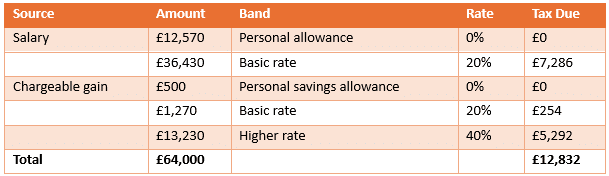
Step 2 – Calculate the total tax due on the gain across all tax bands and deduct basic rate tax
- Total tax on gain £5,546 – basic tax credit £3,000 (£15,000 @ 20%) = £2,526
Step 3 – Calculate top-slice of gain
- £15,000/4 = £3,750
Step 4 – Calculate the individual’s liability to tax on the top-slice
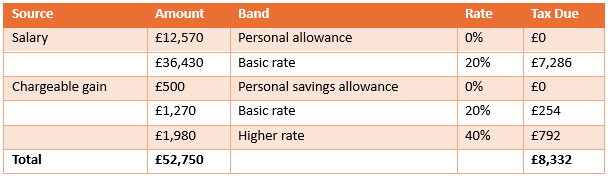
- Tax on gain = £1,046 (£254 + £792)
- Deduct basic tax credit – £750 (£3,750 @ 20%)
- Total liability on top-slice = (£1,046 – £750) x 4yrs = £1,184
Step 5 – Calculate top-slice relief: deduct Step 4 from Step 2
- Step 2 – £2,526
- Step 4 – £1,184
- Top-slice relief = £1,342
This would then be applied to the investment bond depending on if this was an onshore and tax in the fund already paid or an offshore bond.
Let’s look at the difference if Anna makes a pension contribution
Anna makes a pension contribution of £10,200 (£12,750 gross) her basic rate band is extended by the gross figure and brings her total income wholly back into basic rate.
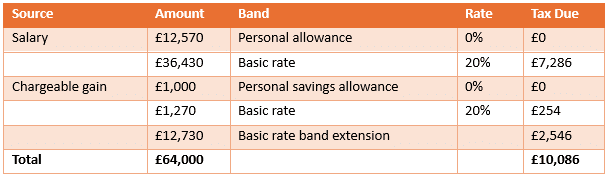
The benefits to Anna for making the pension contribution are:
- She remains a basic rate taxpayer after the gain is now applied due to the extension of the basic rate band by £12,750, there is no top slicing relief required.
- Her income tax bill has reduced from £12,832 to £10,086, a saving of £2,746.
- Her pension contribution received tax relief at 20%.
- The pension fund benefits from no income and capital gains tax during the accumulation phase and currently no inheritance tax on death until the rules change in April 2027.
- She makes additional saving for her future retirement
- If this is an onshore bond, there would be no further tax to pay, though still a requirement to report to HMRC as the gain exceeds £10,000. These reporting requirements are simplified and she could save money and time by not having to seek advice from a regulated tax adviser to do the top slicing calculation.
Other case studies in this series:
Pension contribution case study: Income tax and extending the band – Professional Paraplanner
Disclaimer:
This information is based on our understanding of current legislation, including (but not limited to) FCA, PRA and HMRC regulation. It does not constitute any form of advice. Nucleus will take no responsibility for any loss which may occur as a result of reliance on this information.
Main image: pencil, pad, exam, study, notes, angelina-litvin-K3uOmmlQmOo-unsplash