
























In the first of three case study-based articles, Julia Peake – Technical Manager at Nucleus, looks at at how making a pension contribution can help clients reduce their income tax bill and regain some allowances, reliefs and benefits.

Pensions are one of the most tax efficient savings vehicles available and the bedrock to a good holistic financial plan for many clients.
The introduction of new rules bringing most unused pension funds into the scheme member’s estate for inheritance tax (IHT) purposes from April 2027, is something that should be kept under consideration.
However, the primary purpose of a pension, is to provide an income in retirement. Therefore, with careful planning, reframing the conversation around how we use pensions during their lifetime, and having a flexible plan in place, could mean the client could achieve their retirement goals but also make any residue tax efficient for their beneficiaries as well.
The following case studies look at how making a pension contribution can help clients reduce their income tax bill and regain some allowances, reliefs and benefits they might have lost due to their earnings.
1. Income in excess of £100,000.
Individuals with income in excess of £100,000 see their personal allowance (PA) reduced by £1 for every £2 it is over that threshold, up to income of £125,140 where all the PA is lost entirely for clients who are additional rate taxpayers.
Danny, aged 53, has a salary of £125,140. This means he has no personal allowance available to offset against his income tax bill. However after speaking to his adviser Danny decides to make a pension contribution of £25,140 gross, £20,112 net. The table below shows the impact of this pension contribution to his income tax bill.
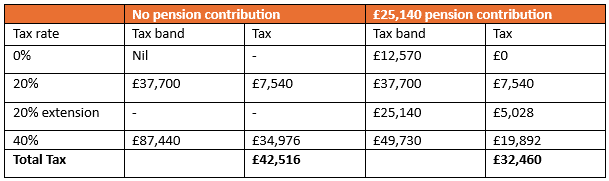
£25,140 contribution saves £10,056 tax outside pension plus £5,028 tax relief in pension, a total saving is £15,084. That’s 60% tax relief (£15,084/£25,140).
Danny, could contribute up to the annual allowance of £60,000 plus any carry forward which he might be eligible for, further increasing tax savings if suitable for him. As a higher rate taxpayer, he can also claim higher rate tax relief on his pension contributions as well.
This example is also applicable to individuals who earn over £100,000 and have their “tax free” childcare removed from them. The total top up you can get for each child is £500 every 3 months (£2,000pa max). Whether clients are eligible for Tax-Free Childcare depends on:
- the child’s age and circumstances (has to be living with the client)
- if the client is working
- if either client has expected adjusted net income (including any foreign income) over £100,000 in the tax year
- the client’s immigration status
The important note here is the income is “adjusted net income over £100,000”. So by making a pension contribution this can be deducted from this definition of income and could mean that the tax free childcare is restored.
2. The Higher Income Child Benefit Charge (HICBC)
Child benefit is available as follows:
- £25.60 a week for oldest child
- £16.95 a week for others
The HICBC applies to individuals who have income above £60,000 and completely eliminates the benefit once income is above £80,000. While there were proposals to move this from an individual to a household based assessment, these have been rejected. This means, there could be a couple each earning £59,000 who still receive full child benefit. Whereas if one person earns £20,000 and the other earns £70,000 (lower household income than couple 1) their child benefit entitlement is affected.
Brian lives in England and earns £75,000. His wife Emma works part time earning £25,000. They have two children, so Child Benefit is:
(£25.60 + £16.95) x 52 = £2,212.60 a year
However, Brian faces a tax charge of 1% for every £200 he earns above £60,000
£15,000/£200 = 75%. When you apply this charge to the child benefit, they would receive it effectively reduces it from £2,212.60 to £553.15.
If Brian makes a pension contribution of £12,000 net, £15,000 gross, Brian’s taxable income is now £60,000 meaning no HICBC would apply. In addition to the £3,000 basic rate tax relief added to pension he could claim a further £3,000 in higher rate tax relief via his self-assessment.
As there is no HICBC of £1,659, his £15,000 gross pension contribution has actually cost:
£12,000 – £3,000 – £1,659 = £7,341 (51% tax relief)
Disclaimer:
This information is based on our understanding of current legislation, including (but not limited to) FCA, PRA and HMRC regulation. It does not constitute any form of advice. Nucleus will take no responsibility for any loss which may occur as a result of reliance on this information.
Main image: case study, joanna-kosinska-1_CMoFsPfso-unsplash