
























Water scarcity is increasingly influencing how businesses operate and where they invest, argues Will Thompson, Chief Sustainability Officer at Pacific Asset Management. As the build-out of AI infrastructure accelerates, understanding companies’ exposure to water stress is becoming an important part of assessing long-term resilience and investment risk.

There’s a liquidity crisis unfolding, but this one has little to do with central banks. Across the globe, increasingly frequent dry spells are depleting rivers, reservoirs and aquifers, intensifying demand from households, agriculture and industry for a resource that many economies have long treated as abundant.
According to the UN’s World Water Development Report, up to half the global population now experiences water stress for at least one month each year. That global trend is now playing out much closer to home.
Across Europe, the European Drought Observatory has warned that large parts of the continent are experiencing drought conditions following successive heatwaves, with shrinking river flows and critically dry soils placing pressure on agriculture, energy production and public water supplies.
Water scarcity isn’t simply a case of insufficient rainfall. It reflects the combined pressure of a changing climate, population growth and industries that consume vast quantities of water. Agriculture, mining, textiles and heavy manufacturing have long ranked among the most water-intensive sectors. Now they are being joined by a newer source of demand: artificial intelligence.
A material risk, not just a moral one
For investors, water scarcity has quietly shifted from a secondary ESG consideration to a material business risk. Companies that depend on water-intensive operations or supply chains face growing exposure to disruption, tighter regulation and public scrutiny as communities question how limited water resources are allocated.
When water becomes scarce, businesses may be forced to reduce production, relocate operations, invest in alternative water sources or pay higher input costs. Agricultural producers can experience lower yields, manufacturers may face temporary shutdowns, and utilities or mining companies can encounter stricter abstraction limits.
These pressures can compress profit margins, delay growth plans and increase capital expenditure, ultimately weighing on revenues and earnings underlining the importance of treating water as a factor that increasingly shapes corporate resilience, much like energy costs or carbon exposure.
The rapid infrastructure investment into data centres
The rapid infrastructure investment into data centres illustrates how water scarcity is becoming increasingly relevant to the digital economy. As demand for AI, cloud computing and digital services grows, so too does the need for computing infrastructure.
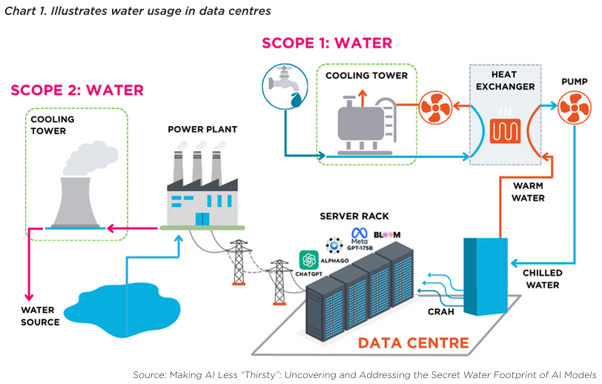
Data centres rely on water not only to cool the servers that power these technologies, but also indirectly through electricity generation and the manufacture of computing equipment. Their water footprint can therefore be divided into three broad categories:
- Scope 1 – Direct cooling: Water used to manage server heat.
- Scope 2 – Electricity generation: Water used by power plants supplying data centres.
- Scope 3 – Supply chain: Water used to manufacture servers, chips and other equipment.
The scale is difficult to ignore. Around two-thirds of U.S. data centres built or under development since 2022 are located in water-stressed areas, reflecting the industry’s pursuit of affordable land, reliable electricity and strong network connections.
Ceres estimates that water use for data centre cooling could rise from around 1.5 billion litres to more than 14 billion litres annually, enough to supply over 100,000 UK households for a year and could increase stress in already strained river basins by up to 17% per year.
The risk is more than reputational. NPR reported in 2022 that roughly one in five U.S. data centres already depended on watersheds facing moderate to high water stress, even before the recent surge in AI infrastructure demand.
Some operators are responding with lower-water cooling technologies, including advanced air cooling and liquid immersion, while others are using reclaimed wastewater. Local communities are also pushing back: in South Carolina, residents above an overdrawn aquifer have sought restrictions on data centre groundwater withdrawals.
The bottom line
Water scarcity is no longer a niche environmental issue. It is becoming a material business risk that can influence where companies operate, how they allocate capital and how resilient they may prove over time.
As AI drives further investment in computing infrastructure, the industry’s dependence on reliable water supplies is likely to come under increasing scrutiny from regulators, communities and investors alike.
Whether that creates opportunity or poses a challenge for any individual company will depend on its particular circumstances. What is becoming clear is that water availability is becoming an increasingly relevant consideration in assessments of corporate resilience and long-term financial risk.
Main image: impact, ripple, water, sonika-agarwal–xcouO3bxr8-unsplash