
























Michael Browne, global investment strategist at the Franklin Templeton Institute, explores whether the era of UK property acting as a reliable retirement nest egg is coming to an end, with pensions playing an increasingly important role in long-term wealth creation.

An Englishman’s home is his castle and his nest egg. As property values soared, politicians now eye up those tax-free gains to fill Treasury coffers.
But what created this magic formula where you buy with the help of the bank, pay off the mortgage, and end up rich?
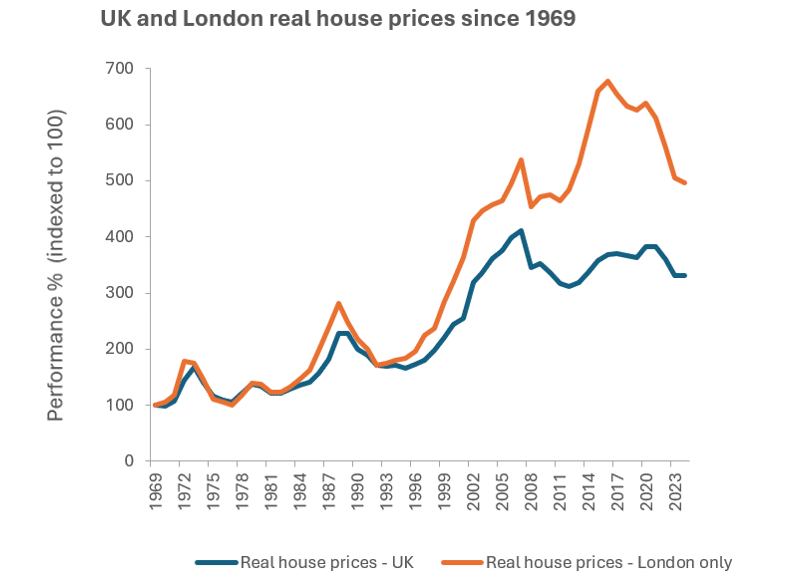
Uk home price records date back to the late 1960s, when mortgages were rationed and pricing was centralised. Everything changed in 1971 when banking deregulation accompanied leaving the Gold Standard.
A young, optimistic population setting up home wanted to do better than their austere, post-war parents. Home ownership rose to 50%, eventually reaching 69% by 2001. The home-owning democracy dream was complete.
Beating inflation
Throughout this period, house prices beat inflation – remarkable when inflation hit 20% annually in the 1970’s. But governments prioritised full employment over squeezing inflation, keeping interest rates below inflation while wages rose faster.
If you bought during the 1971 boom, your mortgage shrank by 80% in real terms by decade’s end while real income rose – a licence to print money.
The 1980s boom and 1990s shock
The 1980s saw continued rises, particularly in London and the South East. City deregulation and the Big Bang created yuppie culture and another injection of wealth. But the early 1990s brought the first absolute prices falls.
Post-1988 house price boom and end of cycle inflation was met by interest rates as high as 15%. The 100% mortgages of 1988 suddenly meant debt exceeded assets – not supposed to happen! Relief only came when the UK crashed out of the European Exchange Rate Mechanism on Black Wednesday in September 1992.
The Blair years and beyond
Politicians learned that rising house prices make voters happy. The first decade of the Blair government marked the zenith, peaking in 2007. London buoyed by zero interest rates post-financial crisis, kept climbing until 2016. Elsewhere, falls were steep.
The store of wealth that our parents enjoyed had ended, but none of us realised it.
The new reality
For a decade, buying a house has failed to keep its real value. Today, London agents report that a quarter of all sellers sell below purchase price, wiping out deposit savings. Brexit, Covid, the Ukraine oil price shock, rising rates compounded by the Truss budget, and subsequent government taxation all contributed to this crisis.
The knock-on effects
Two major effects emerged: the wealth effect on consumers and the demise of the house builders.
The wealth effect crept up slowly. Consumers didn’t realise how poor their investment was until after Covid. The temporary price spike was doused by MPC rate hikes struggling with Ukraine’s oil shock.
Savings rates shot up during Covid and stayed high as householders rebuilt wealth through cash, even as inflation devalued it. Weak house prices have impacted consumer behaviour and confidence – no government has turned it around.
Secondly, for house builders, rising materials and labour costs without corresponding price rises squeezed margins.
Add regulatory inflation of 30 – 40% of developments set aside for social housing, plus rising building standards. Since 2016, Persimmon’s profit before tax fell from £782m to £395m, with margins dropping from 24% to 14%.
They have culled production, building fewer homes in 2024, just 10,000 v 2016 when they built 15,000.
The government wanted more houses but forgot about profitability. Releasing more land while threatening prices via wealth effect backfired. The solution requires rising prices and reduced cost burdens on builders, giving them margins to grow – not removing first time buyer subsidies and raising regulatory costs.
The missing piece: pensions
Homes account for around 40% of average UK household wealth, pensions 35%, the rest cash and other assets. What about pension wealth?
Defined Benefit owners face no crisis beyond drawdown timing. But as DB disappears, Defined Contribution takes over with completely different asset allocation: heavy equites, light bonds and cash. Last year was a bumper year for DC holders with equity markets up 15 % plus.
Why don’t consumers feel this wealth? Pensions offers nothing today except lowering pay packet via contributions. House prices are consumer catnip; DC pensions are sleeping lottery wins.
Conclusion
Should we own smaller houses and bigger pensions? Undoubtedly – we’d be wealthier and tax -free. “My house is my pension” days are over. Buy to let investors have been driven out by tax changes and landlord costs.
Periodic market pops will occur – Northern Ireland sees sharp growth today – but it may not be where live.
Could property capital gains become taxable? That would shift the dial to pension saving. But the reality is only house prices make you feel wealthier. For politicians to stay popular, they need rising house prices. To build more houses, you need the same.
Main image: house, home, buildings, mortgage, ierra-mallorca-JXI2Ap8dTNc-unsplash