






















In a market defined by uncertainty and concentration, not all multi-asset funds are built the same. In this latest article from Schroders, Tim Carr – Multi-Asset Investment Director – helps us discover what advisers and paraplanners should be demanding from managers in 2026 and why active management matters more than ever.
Multi-asset funds have long been a cornerstone of adviser portfolios, but today their role is being tested like never before.
Rather than simply offering diversification, they provide clients with a ready-made portfolio: a blend of equities, bonds and alternative investments from across the globe, aligned to different risk profiles.
In effect, they offer a one-stop, diversified solution designed to meet a range of client needs within a single portfolio.
That role looks even more important in 2026. Advisers are balancing a complex mix of client concerns: the cost of living remains front of mind, interest rate expectations continue to shift, equity markets are increasingly concentrated, and geopolitical headlines regularly test investor confidence.
In that environment, clients do not just want growth, they want reassurance, resilience and a smoother investment journey.
For advisers, this shift is not theoretical. It shapes how portfolios are built, how expectations are managed and how successfully clients stay invested during volatility. Increasingly, it raises a more fundamental question: how well portfolios can adapt as conditions change.
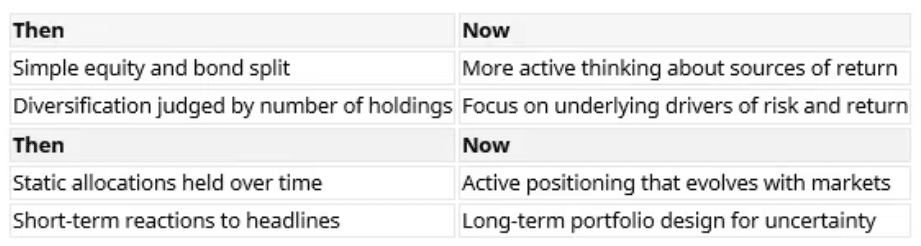
That is why the conversation around multi-asset has moved on. Static asset mixes and long-term averages are no longer sufficient. A strong multi-asset fund must demonstrate not just what it holds, but how actively it is managed; how it adapts, manages risk and seeks new return opportunities over time.
Process matters when markets feel unsettled
This is a key theme in our research. Joven Lee, Multi-Asset Strategist at Schroders, highlights in his Trust the process article that periods of heightened uncertainty can lead to reactive decisions that harm long-term outcomes.
His core message is simple: a disciplined, active investment process matters most when markets are hardest to read.For advisers, this means looking beyond current views to understand how decisions are made.
At Schroders, this takes the form of regular scenario analysis – mapping a range of plausible macroeconomic outcomes across growth and inflation, from stagflationary to reflationary to deflationary, and assigning probabilities to each. Portfolio managers then adjust exposures accordingly, rather than reacting to individual headlines.
That matters because traditional assumptions do not always hold. Bonds do not always offset equity weakness, correlations can shift, and market leadership can become concentrated.
In this environment, static allocations can create hidden risks. A modern multi-asset approach needs to combine diversification with active decisions about where returns may come from and how portfolios should evolve as conditions change.
Diversification needs to do more than look good on paper
Our research shows that trying to position portfolios around geopolitical events directly has historically proved difficult and often counterproductive.
Analysing eight major geopolitical events since 1990 – from the Gulf War to the Israel-Iran conflict in 2025 -Joven Lee found that equity returns showed enormous dispersion across events, with the mean being slightly positive. Geopolitical risk alone, however alarming it feels, has not been a reliable signal for market direction.
The reason is context. The Russia-Ukraine war and the Israel-Hamas conflict both involved active military confrontation yet produced markedly different portfolio outcomes.
Russia-Ukraine coincided with rapidly tightening monetary policy and produced sharp equity drawdowns. Israel-Hamas unfolded against improving inflation dynamics and the early emergence of the AI investment theme – markets rose strongly despite the conflict. The event was similar; the surrounding conditions were not.
As Johanna Kyrklund, Group Chief Investment Officer at Schroders, argues, the key question is not what will happen next, but how portfolios behave under different scenarios. That requires flexibility, discipline and ongoing adjustment, not a fixed defensive playbook.
For advisers, this is the critical implication. Diversification is not static. It requires active management of how exposures interact, because the relationships between assets shift depending on whether a shock is perceived as a growth risk, an inflation risk, or both.
Why older assumptions are being tested
What to look for in 2026
So what should advisers look for?
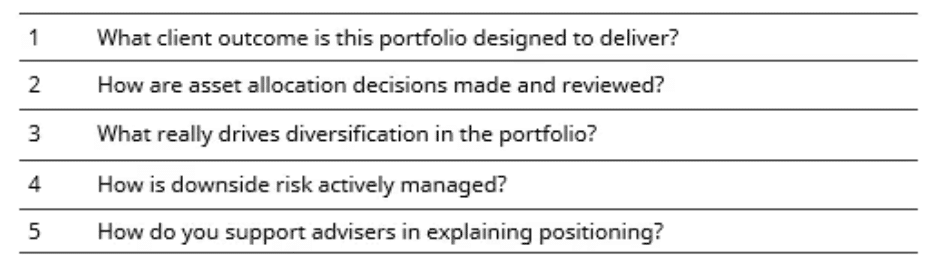
First, clarity of outcome. Clients have different needs: growth, income or a core holding. Advisers should ensure a fund’s objective is clear and aligned to those needs. A defined outcome also provides the foundation for active management, guiding how risk is taken and adjusted over time.
Second, the asset allocation process. This is where the quality of active management is most visible. Is there a disciplined framework for adding or reducing risk? In concentrated markets, active asset allocation is often the primary driver of long-term outcomes.
Third, real diversification. A portfolio may hold many assets yet still be exposed to the same risks. Advisers should understand what drives returns and whether exposures are actively managed. Effective diversification requires ongoing monitoring and adjustment.
Fourth, risk management. Clients experience risk as worry during losses, not as a statistic. Strong multi-asset funds take an active approach, adjusting exposures, incorporating defensive assets and maintaining flexibility as conditions change.
Five questions advisers can ask a multi-asset manager
Supporting better client conversations
Communication is critical. In uncertain markets, the ability to explain what is happening in plain English can be as important as investment decisions themselves.
Duncan Lamont, Head of Strategic Research at Schroders, provides some compelling context. Over the past 54 years, global equities fell 10% or more at some point during the year in 31 of those years, yet most years still ended positively.
On average, stocks fell 15% intra-year but rose 23%. Volatility is not the exception; it is the normal cost of long-term returns. Clients who moved to cash whenever markets turned volatile would, historically, have reduced their long-run returns by nearly 80%.
The implication is clear: staying invested is often the more effective strategy, even when headlines are at their worst.
This is where provider support matters. Active multi-asset managers do not just manage portfolios; they help advisers communicate effectively. By combining active investment decisions with clear, timely insights, advisers can guide clients through volatility and maintain discipline.
The case for a dependable multi-asset approach
Ultimately, the role of multi-asset funds in 2026 is not simply to blend assets, but to deliver a more dependable investment experience. That means focusing on the quality of active decisions across asset allocation, diversification and risk management.
These are the challenges Schroders’ multi-asset approach is designed to address. Our research-led perspective emphasises that conviction should come from a disciplined process, and portfolios should be actively managed to cope with a range of outcomes.
The Schroder Global Multi-Asset Portfolios are actively managed for a changing world. They combine dynamic asset allocation with a cost of just 22bps, similar to a passive strategy, offering a compelling blend of active management and value.
They also provide access to the best of Schroders’ investment capabilities, investing across a range of underlying funds spanning equities, fixed income and alternatives. This allows portfolios to draw on deep global research while maintaining flexibility.
The result is a solution designed to deliver more consistent client outcomes without unnecessary complexity, combining active management, adaptability and value in a core investment solution.
Main image: multi, colour, diverse, range, alexander-grey-W7cPLHOa0eQ-unsplash