























In a recent Parameters survey, we questioned the demand for the investments, how advice firms approach ESG investing with clients and paraplanners knowledge to the sector. Fiona Bond writes.
Demand for environmental, social and governance investing has risen in recent years, amid growing awareness of the need to build a more sustainable future.
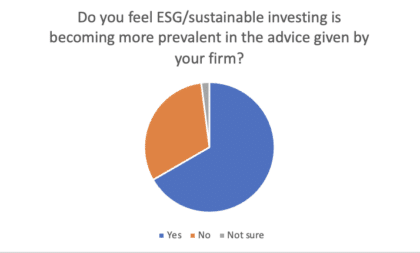
Against this backdrop, two thirds (66%) of paraplanners said ESG/ sustainable investing had become more prevalent within the advice given by their firm, according to the latest Professional Paraplanner Parameters Survey, versus 31% who said it had not become more prevalent.
Several firms Professional Paraplanner spoke to said they have already introduced sustainable funds/ portfolios, driven by growing interest from clients, particularly among the younger generations.
One paraplanner said: “Many more clients are asking about it, especially younger clients, who feel more at ease investing via ESG/sustainable/ ethical. It is also becoming more prevalent as the sector matures with increased performance history and an increase in funds available.”
While there was general agreement that growing awareness of ethical issues and climate change was driving interest both at client and adviser level, others said the key consideration for most clients was performance.
One respondent told Professional Paraplanner: “We have introduced an ESG discussion into each client review meeting, and this is now part of their annual review structure. More and more clients are adopting this although the main driver for this appears to be the difference in performance between the ESG portfolios and non-ESG – the ESG portfolios having achieved almost double the performance.”
However, a fellow respondent noted that growing awareness had not translated into rising investment. They said: “Whilst a few clients have been warm to this, it has not been an important ‘driver’ for any of them in reality,” before describing ESG investment as “lip service for the more aware types.”
The response was similar from a fellow paraplanner who said: “Most clients aren’t bothered about ESG either way. They just want a good return for their investment.”
Fact finds
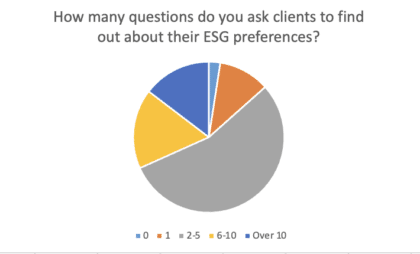
When asked how many questions firms ask clients to find out about their ESG preferences, the most popular answer was between 2 and 5 (55%). Only 17% asked between 6 -10 questions and 15% asked over 10. By contrast, just over one in 10 firms (11%) said they asked just 1 question and 2% said they don’t ask their clients any ESG questions.
Despite the difference in approach, nearly three fifths (59%) said they feel the questions they ask provide them with enough information to fulfil their paraplanning role, with just 12% saying they did not feel they had enough information to work with. However, nearly a third (29%) were unsure.
One paraplanner said: “Much of this is handled by investment managers. Most clients are not interested in a deep dive initially, more that they feel that they are doing the ‘right thing’.”
Others admitted that a lack of certainty among clients about what they want made the process harder.
One respondent told Professional Paraplanner: “It depends on the responses from the clients, however, in the most part they don’t seem to know exactly what they want, so it is hard to find a good match to their objectives unless they specifically want to avoid certain things.”
A further respondent said: “Most of our clients have no strong feelings as regards ESG, they have amassed their wealth by seeking the greatest return and that is what is driving the ESG adoption rather than any concern for the environment or workers’ rights.”
However, one paraplanner whose firm only asks clients one question on ESG admitted that it would be beneficial to have more information.
They said: “It would be useful to have further information on client’s ESG preferences either as a stand- alone questionnaire or through the addition of further questions on attitude to risk questionnaires. As a paraplanner who does not attend client meetings, I have to rely on the information about client ESG preferences given to me by the adviser.”
The results of the survey also found that ESG demand is largely client-led (47%), compared to 30% who said the demand came from advisers. Just over a fifth (23%) were unsure who was driving demand within their firm.
One paraplanner told Professional Planner: “Demand is mainly from clients but more adviser-led ones are appearing due to the additional questions we now ask.”
However, another respondent told Professional Paraplanner that clients may be missing out as a result of a lack of drive from advisers: They explained: “We have a small number of clients who are very vocal from the start on ESG and who end up with that because it is important to them. I think the majority of clients want to be led by their adviser and take what they suggest. I feel most advisers shy away from ESG so leads to clients who maybe should have it, not having it.”
Need to know more
The survey also revealed that most paraplanners feel they need to know more about ESG. Just shy of three fifths (57%) believe they could learn more, a far greater percentage than the 36% who feel they know enough.
Respondents cited the breadth of the ESG sector and the intricacies involved as their reasons for wanting greater information and acknowledged that the standardisation of ESG remains an unresolved challenge for the industry.
One said: “I am a firm believer in more information, especially as it’s the new hot topic and there is not enough data in comparison to standard funds.”
Another paraplanner surveyed called for more information from providers regarding their offerings.
Meanwhile, more than half (56%) of paraplanners said they were not aware of the new Sustainability Disclosure Requirements labels, a marked increase on the 44% who said they did know. However, respondents raised a question mark over how effective the labels would be.
One paraplanner questioned: “They can be difficult to understand and are they really a true picture of a company/ funds ESG status?”
Another admitted they felt a “little sceptical” about the labels and firms trying to get a label for more investment.
Not surprisingly, 60% of paraplanners also said they were unsure the labels will help stop greenwashing within the industry, significantly above the 21% who believed they would and the 19% who disagreed.
One paraplanner commented: “Nothing will stop this as it is such a grey area and open to interpretation.”
Main image: hj-barraza-l2Eb_cV6a7A-unsplash