























Global equity markets have been driven higher by enthusiasm for artificial intelligence, but Ben Whitmore, Fund Manager at Brickwood Asset Management, says that attractive opportunities may now lie in overlooked value stocks where valuations remain firmly grounded in fundamentals.

Global equity indices have rewarded investors handsomely over the past decade. It is tempting to extrapolate this success into the future, particularly as enthusiasm for AI drives markets higher.
Yet history shows that when valuations are ignored, even the strongest narratives can end badly.
Today, global indices are dominated by US stocks trading at elevated valuations not seen since the dotcom era.
For investors willing to take a long-term view, this has created a growing opportunity to buy high-quality businesses which are not viewed as AI beneficiaries at unusually attractive prices.
Below, we outline three reasons why we believe global value looks increasingly compelling.
1. Extreme current valuations of global equity indices suggest poor returns ahead
Valuation is not a reliable guide to how markets will perform over the next few months. But it has proved a remarkably effective predictor of longer-term returns.
At Brickwood, we use CAPE Yield as our primary valuation measure[1]. This metric takes the average real earnings of companies over ten years and divides it by their market capitalisation.
Historically, CAPE yields have been highly correlated to future returns: higher yields tend to lead to higher future returns, and vice versa.
US equity valuations, as measured using CAPE Yield, have now exceeded their Covid-era peak to reach a level last seen at the heights of the dotcom bubble (2.5%).
Using the longest dataset available to us, we can see that comparable valuations have only been reached on a handful of occasions since the 1870s.
Over 150 years of stock market history suggests that 10-year returns at prevailing valuations are likely to be disappointing, averaging between 2-4% per annum[2].
Other major stock markets are less richly valued, however, as the US now accounts for nearly two-thirds of the MSCI ACWI (64%) the aggregate valuation of the index is very high (CAPE Yield of 3.4%) despite many regions trading on more reasonable valuations.
By contrast, the TM Brickwood Global Value Fund trades on a CAPE yield of 13%, several times higher than its benchmark.
This valuation advantage has been achieved without investing in overly indebted or low-quality businesses, but through a disciplined focus on companies where market expectations appear unduly pessimistic.
From today’s starting point, we believe the balance of probabilities favours value-oriented portfolios over broad market indices.
2. Global equity indices are increasingly dependent on a single theme
US equities look less expensive when valued on forward rather than trailing earnings, reflecting sell-side analysts’ expectations of earnings growth.
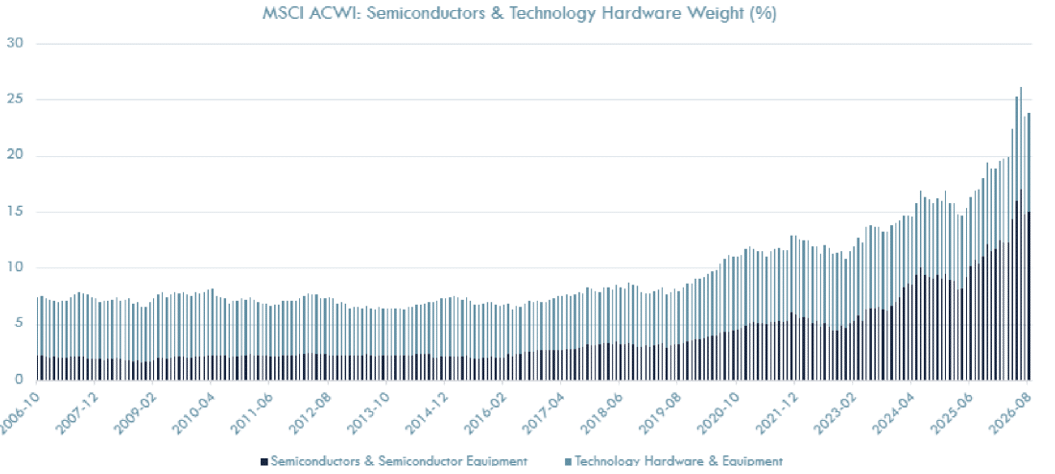
Rather than reflecting broad-based economic growth, the optimism embedded in these forecasts is increasingly driven by one dominant theme: AI.
AI is driving huge demand for memory and compute capacity, and semiconductor manufacturers have been, and are expected to continue to be, primary beneficiaries.
As a result, a small number of very large, highly cyclical businesses now account for a substantial proportion of global equity indices. Indeed, our analysis indicates that, including semiconductors, as much as 35% of the MSCI ACWI represents a direct bet on AI.3
Moreover, these anticipated profits ultimately depend on spending by a small number of AI labs which have raised capital at very high valuations while generating substantial cash losses.
Those businesses are, in turn, partly funded by large technology companies which have increasingly relied on debt markets to finance infrastructure investment.
You don’t have to be a sceptic about the transformational potential of AI to question the wisdom of owning the index today.
Elevated valuations suggest to us that the market is pricing in a perfect future: sustained revenue growth, delivered on time, with high margins, limited competitive erosion and an absence of adverse macroeconomic shocks. The long-term data shows that investing on the promise of a perfect future has rarely been a successful strategy.
The TM Brickwood Global Value Fund is positioned very differently. The portfolio is diversified across a broad range of geographies, sectors and revenue streams.
Rather than relying on a single macroeconomic or technological outcome, we seek to own businesses whose valuations already incorporate a degree of scepticism, providing multiple potential drivers of future returns.
3. The opportunity set for value investors has improved
While the indices have become dominated by a single theme, the opportunity set for value investors has markedly improved. Five or ten years ago, many of the companies meeting our valuation criteria were highly cyclical, capital-intensive businesses.
Today, we are finding an increasing number of high-quality companies with resilient earnings streams, strong cash generation and attractive valuations.
Some of these companies are themselves viewed by the market as likely to suffer AI-disruption. But others are experiencing cyclical issues or have simply seen their share prices deflate after valuations became stretched during the era of ultra-low interest rates.
This year, we have selectively added attractively valued businesses in sectors like healthcare, consumer staples, and software. These companies typically benefit from resilient revenue streams, strong competitive positions and good cash generation.
As a result, the fund is overweight healthcare, consumer staples and communication services and underweight energy, financials and utilities. We believe the combination of quality, balance sheet strength and valuation within the portfolio should enable it to perform resiliently in a wide range of economic conditions.
Opportunities to combine valuation, quality and diversification in this way are rare. Looking across our careers, we struggle to recall many periods when the prospective long-term risk adjusted return available to value investors have appeared more attractive than they do today.
Sources:
1. ‘CAPE’ stands for cyclically adjusted price-to-earnings ratio.
2. Source: Professor Shiller’s Data (available at ShillerData.com) from 01.01.1871 to 28.02.2026, Refinitiv and Brickwood, data as at 30 June 2026. The value of assets can go up and down, past performance is not indicative of future results
3. Source: MSCI, Brickwood as at 29th September 2026.
4. Source: MSCI, as at 31st August 2026.
Past performance is not a reliable guide to future returns. You may not get back the amount originally invested, and tax rules can change over time. The writer’s views are their own and do not constitute financial advice.
This information should not be relied upon by retail clients or investment professionals. Reference to any particular investment does not constitute a recommendation to buy or sell the investment.
Main image: growth, imagine-buddy-vsLbaIdhwaU-unsplash