

















Nadina Stodiek, Co-Head of Impact Management, and Holly Turner, Head of Sustainable Investment at Schroders, explore how investors can incorporate sustainability and impact considerations into portfolio construction while balancing financial and long-term investment objectives.
Sustainability and impact (S&I) considerations are increasingly shaping investment decisions.
As investors seek to balance financial returns, resilience, regulatory requirements and measurable real-world outcomes, portfolio construction has become central to delivering these objectives.
Different asset classes offer distinct opportunities to manage sustainability-related risks, access long-term investment themes and influence real-world outcomes.
Bringing these capabilities together through a multi-asset approach can help investors build portfolios that reflect both their financial and S&I priorities.
In our latest paper, we explore how investors can integrate S&I considerations into investment strategy, the tools needed to implement them and the different routes available, including across private market asset classes and different investment structures, to translate objectives into long-term outcomes.
Key takeaways
- S&I is fundamentally a portfolio construction question. Sustainability-related risks and opportunities affect asset classes differently. Integrating S&I objectives at the strategic allocation stage, rather than treating them as an additional consideration, can help investors make more informed decisions.
- A total portfolio approach can help balance multiple objectives. Investors increasingly need to reconcile financial returns, risk management, climate commitments and impact ambitions. Looking across the entire portfolio allows capital to be allocated towards the assets and strategies best placed to meet these objectives.
- Different asset classes offer complementary sustainability levers. Public markets provide opportunities to influence corporate behaviour through engagement and voting, while private markets can offer more direct influence through capital allocation, governance and ownership.
- Effective implementation requires a consistent investment toolkit. Common frameworks for sustainability assessment, impact measurement, climate analysis and governance can help investors evaluate opportunities across asset classes while accounting for their different characteristics.
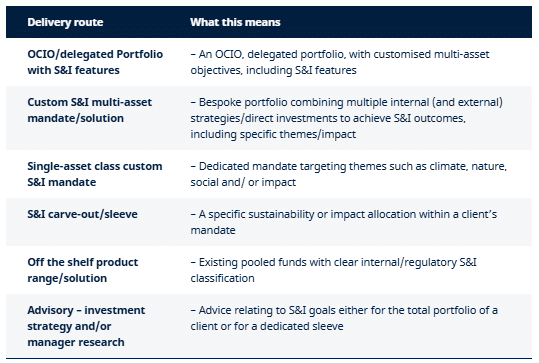
- Flexible implementation can help translate ambitions into outcomes. From delegated portfolios and bespoke multi-asset mandates to dedicated impact allocations and existing investment strategies, investors can select structures that reflect their priorities, liquidity needs and desired level of customisation.
Putting objectives into practice
There is no single approach to implementing S&I objectives. The appropriate structure depends on an investor’s financial requirements, sustainability ambitions and degree of delegation.
Schroders Capital offers a range of delivery routes, drawing on investment capabilities across public and private markets alongside specialist sustainability and impact expertise.
The table below outlines the different approaches available to investors seeking to translate their S&I objectives into investment outcomes.
Read the full report from Schroders: From aligned objective to investment outcomes: Enhancing the S&I toolkit
Main image: sustainable investing, micheile-henderson-lZ_4nPFKcV8-unsplash