














A client’s investment choices should reflect their values. Fear and inertia often are the barriers to this. Professional advice should be able to take away the fear and uncertainty and help clients understand how to align their values with where they are investing, argues Phil Greenwood, Head of Technical Consulting, EQ Investors and PFS Paraplanner Panel member.

I’m definitely someone who enjoys a good sci-fi film and they don’t come much better than the 1982 film Blade Runner. I caught the end of the film the other day which includes a famous and intriguing soliloquy delivered by the Android, Roy Batty, just before he shuts down. The end is particularly evocative:
“All those moments will be lost in time, like tears in rain.”
It’s a dilemma a lot of people are facing – does anything we do matter?
Sustainable investing can sometimes feel a bit like this. What’s the point? Is it actually doing anything?
The simple answer is, yes. It is.
Fundamentally, what you invest in matters.
Are returns an issue?
Interestingly, there is still a prevalent attitude that investing sustainably is a decision to give up returns, which could be dominating conversations around this subject and causing investors to dismiss it as an option.
It turns out that this isn’t necessarily true. Research from Morgan Stanley shows sustainable funds have actually outperformed traditional funds in the first half of 2025. And it’s not just a short-term trend. From Morgan Stanley’s analysis, investing in sustainable funds since Dec 2018 would have provided a return of 54% compared to 45% via traditional investment.1

Although not guaranteed, sustainable mandates can lead to investing in areas that perform well.
Who cares?
Most clients will have specific things they care about, and sometimes it is about educating them on what the impact of their investments actually is, both positively and negatively. I hear “my clients just don’t care,” quite a lot. But I’m not sure how true that is.
A recent YouGov poll2 commissioned by the UK Sustainable Investment and Finance Association (UKSIF) found that “79% of Britons support their pension being invested in renewable energy”. This obviously doesn’t mean that they all want a fully sustainable mandate, but it does show that there is an active interest in this area of investment.
So, what is driving the continued pervasiveness of traditional investing? In my view, fear is the ultimate enemy when looking at the future. Clients fear making the wrong decisions but making no decision can also be wrong. To ad-lib from Blade Runner, “living in fear is what it means to be a slave”. Fear of the unknown is damaging decision making; inertia is ensuring the status quo.
This is where we can help. A client’s investment choices should reflect their values. It’s part of our job to take away the fear and uncertainty, to help clients understand how to align their values with investing.
Giving clients perspective
Part of helping clients with understanding is to highlight the impact of investment choices. There are a lot of harmful industries that are still heavily invested in:

Funding these industries has real world consequences. You might think it’s an individual choice to smoke. But when you know that of the 8 million deaths from tobacco, 1.3 million are non-smokers who are killed through second hand smoke, could this knowledge change a client’s perspective on supporting this industry?
Nothing is quite that black and white of course, but investment decisions have consequences whether you engage with them or not. They are still there. Education and creating new perspectives are key to better engagement and understanding.
Taking responsibility
It’s our responsibility as advisers and paraplanners to dig deeper into investments with clients, see what is there. Educate, provide clarity, and give transparency. Challenge them, and their answers may surprise you. If there is something they don’t like, act.
Exclusions are merely the starting point; there is so much more that money can do. By actively seeking out positive outcomes, you can make a difference as well as preventing harm.
Talking to clients about the spectrum of capital, and where they sit on this, can be helpful in aiding understanding of what options there are:
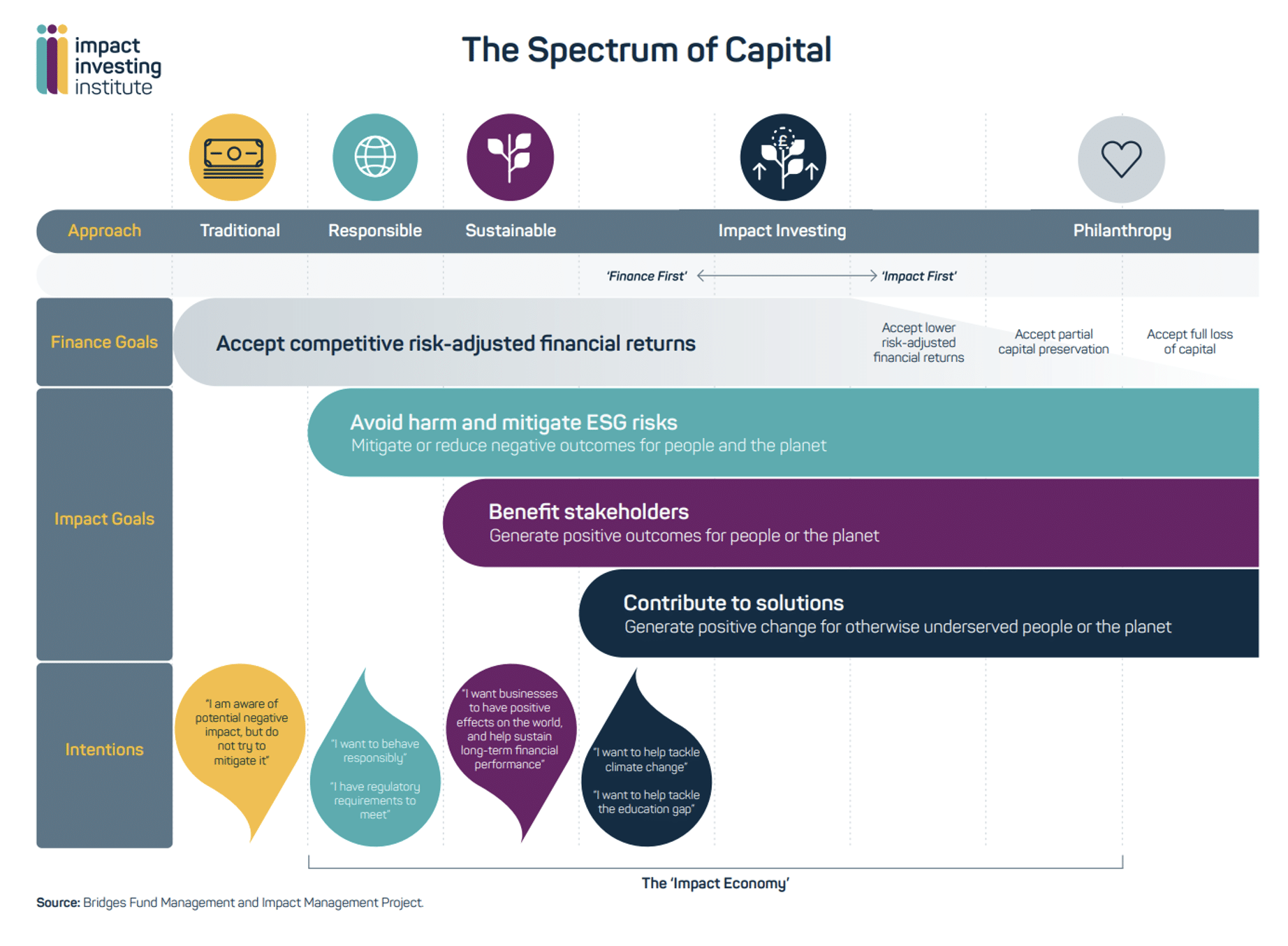
It’s clear from this that there are options to suit different appetites. Not everyone needs to be a philanthropist to make a difference.
While this can be a great starting point, it’s also important to talk to clients in language they will understand, and use references they will recognise. Like anything else, overuse of technical language can be off-putting and clients may not be able to engage as fully. There may be more practical examples of what is happening in the world that they can relate to better.
Talking points
The main takeaways should be:
- Returns are not necessarily sacrificed when you choose to invest sustainably.
- Clients need your help to understand what options they have and the impact of their investment choices.
- More people than you think are open to investing sustainably.
- Talk to clients about this in ways they can understand.
Maybe our experiences, choices, and influence will be washed away with death and time, but I do think individually we can make a difference. Individual choices matter. How we invest money matters.
The last line delivered by Roy Batty is “time to die”. When it’s my time, I don’t want to feel like Roy – like nothing I did or experienced mattered or made any difference.
But that’s up to me.
Sources
- Sustainable Investing Funds Beating Traditional Funds in 2025 | Morgan Stanley
- https://uksif.org/nearly-80-of-britons-support-their-pension-being-invested-in-renewable-energy/
- Disruptions In Energy Security And Climate Security Part 2: What’s Coming. – Ian Dexter Palmer, PhD
- Tobacco (who.int)
Main image: noah-silliman-i2J9jnvaAbU-unsplash