























As markets grow more uncertain, Schroders say investors want income allocations to deliver more than just yield.
Income is being used to support investor objectives around diversification, resilience and inflation protection rather than purely for yield generation. That’s according to the 2026 Schroders Global Investor Insights Survey.
The survey shows that income is evolving from being a standalone yield component to a more flexible building block which plays a critical role in context of investors’ growing focus on stability and resilient returns.
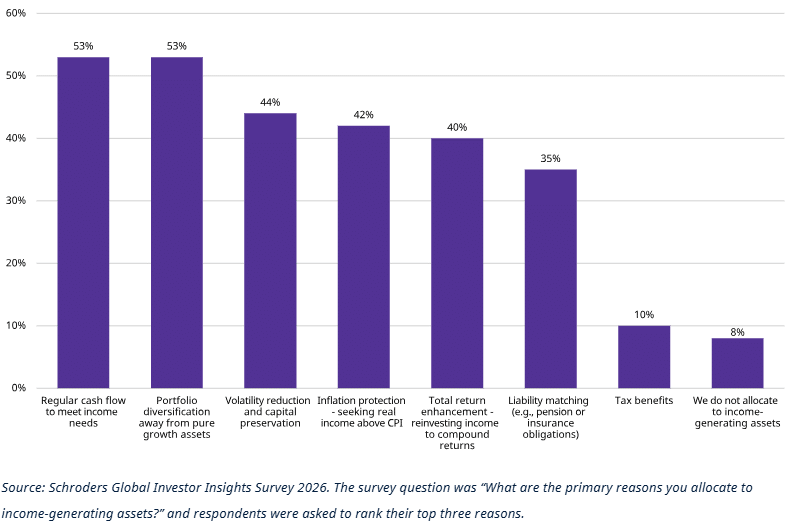
Survey respondents were asked to rank their top three reasons for allocating to income-generating assets.
The need for portfolio diversification away from pure growth assets was in the top three for 53% of global investors, as was requirement for regular cash flow to meet income needs. Volatility reduction and capital preservation ranked third.
Figure 1: Income allocations have multiple functions
This is perhaps unsurprising as investors seek to navigate an investment landscape characterised by divergence and dispersion.
For example, dynamics such as deficit spending and debt sustainability are increasingly important concerns for several developed markets, but less so for many emerging markets.
Meanwhile, after more than a decade of interest rates at near-zero, the return of a persistently higher cost of capital is re-introducing dispersion across sectors, balance sheets and countries.
Geopolitical risks, including events in the Middle East, have the potential to intensify both trends, particularly through renewed pressure on energy prices and inflation.
Against that backdrop, it is notable that investors in APAC ranked inflation protection – in other words, the ability to generate real income above CPI – among their top three priorities when allocating to income-generating assets.
This helps explain why investors are casting the net wider. Rather than relying solely on traditional bond exposures, they are increasingly looking across a broader opportunity set for income sources that can play multiple roles within a portfolio.
Dorian Carrell, Head of Multi-Asset Income, said: “In this more volatile and inflation-sensitive environment, it becomes increasingly important to adopt a portfolio approach capable of delivering consistent natural yield from a diversified stream of assets, whilst not sacrificing capital growth.
Looking beyond traditional asset class silos and accessing a broader opportunity set is vital.”
The survey bears this out. Investors are looking across a wide range of asset classes in search of the best risk-adjusted income. Equity income, for example, ranked in the top three for 43% of global investors but the spread of answers was fairly even across income sources, as Figure 2 below shows.
Figure 2: Investors seek income from wide range of asset classes
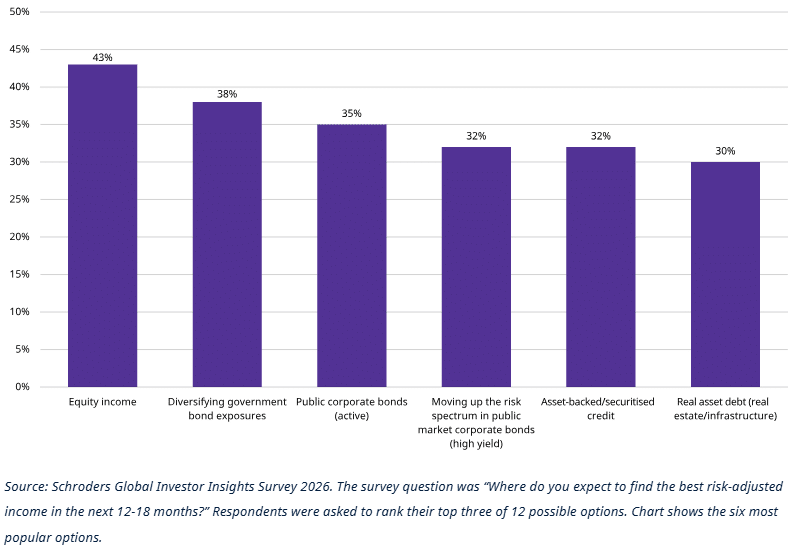
hat relatively even distribution reinforces the idea that investors are taking a diversified approach to finding income streams that are capable of playing multiple roles in portfolios.
Equities can play a key role in an income strategy, offering diversification, protection against inflation and potentially higher total return.
However, investors need to be wary because an exclusive focus on dividend yield typically leads to high exposure to defensive areas, and leave a portfolio structurally under-exposed to areas like growth and cyclicals.
An active approach with an eye on finding growth-oriented income opportunities can help to manage this compromise on long-term returns.
The same preference for selectivity is evident in credit markets. Among survey respondents, 35% cited active public corporate bonds as one of their top three sources of best risk-adjusted income, compared with just 9% for passive public corporate bonds.
This chimes with the more uncertain market backdrop. Higher funding costs are reshaping markets and re-introducing dispersion.
This may lead to more frequent issuer-specific defaults and downgrades, alongside deeper scrutiny of corporate business models and refinancing strategies.
For credit investors, that means generating returns increasingly depends on rigorous fundamental research and disciplined portfolio construction.
This also applies to government bonds. As fiscal vulnerabilities become more concentrated in developed markets, emerging market debt may offer a compelling source of risk-adjusted income.
On a debt-to-GDP versus real-yield basis, investors are often better compensated for holding emerging market debt than developed market debt, where debt burdens are higher and real yields are lower by comparison.
Julien Houdain, Head of Global Fixed Income, said: “Bond yields, even after adjusting for inflation, provide an attractive starting point for investors, with the resulting level of income offering a reliable and stable source of return. However, increasing dispersion across regions and sectors means that selectivity is key”.
Ultimately, the survey points to a more holistic approach to income investing. A majority of global investors – 56% of respondents – said they assess the full range of income-generating opportunities across public and private markets, and across equities and fixed income, rather than viewing income through the lens of a single asset class.
In today’s environment, income is no longer simply a source of yield; it is increasingly being treated as a flexible tool for building stronger, more resilient portfolios.
To find out more about investors’ current concerns and how they are responding, visit Schroders website: Schroders Global Investor Insight Survey 2026
Main image: income, micheile-henderson-lZ_4nPFKcV8-unsplash