























In the tenth of a series of real asset investment case studies, Matteo Quatraro, Director and Head of Portfolio at Gravis Capital Management, looks at a portfolio of hydro assets.

Hydroelectric power is produced by turning the energy of falling or flowing water into electrical power, typically by means of a turbine. Hydroelectric energy facilities fall into three main categories: (i) impoundment facilities where a dam is used to control the flow of stored water, (ii) diversion facilities which use a series of channels to direct flowing water to a turbine, and (iii) pumped-storage which stores energy by pumping water uphill for release at a later time, typically during periods of high electricity demand / price. The power produced depends on the volume of water passing through the turbines and the height differential between the inflow and outflows. This height is called the ‘head’ of a scheme.
Hydroelectric power accounted for approximately 14.3 % of the world’s total electricity generation and 45% of renewable electricity in 2024, making it the largest individual source of renewable generation.
China is the largest hydroelectric producer globally, while in the UK, it makes up approximately 1.7% of the renewable energy mix. .
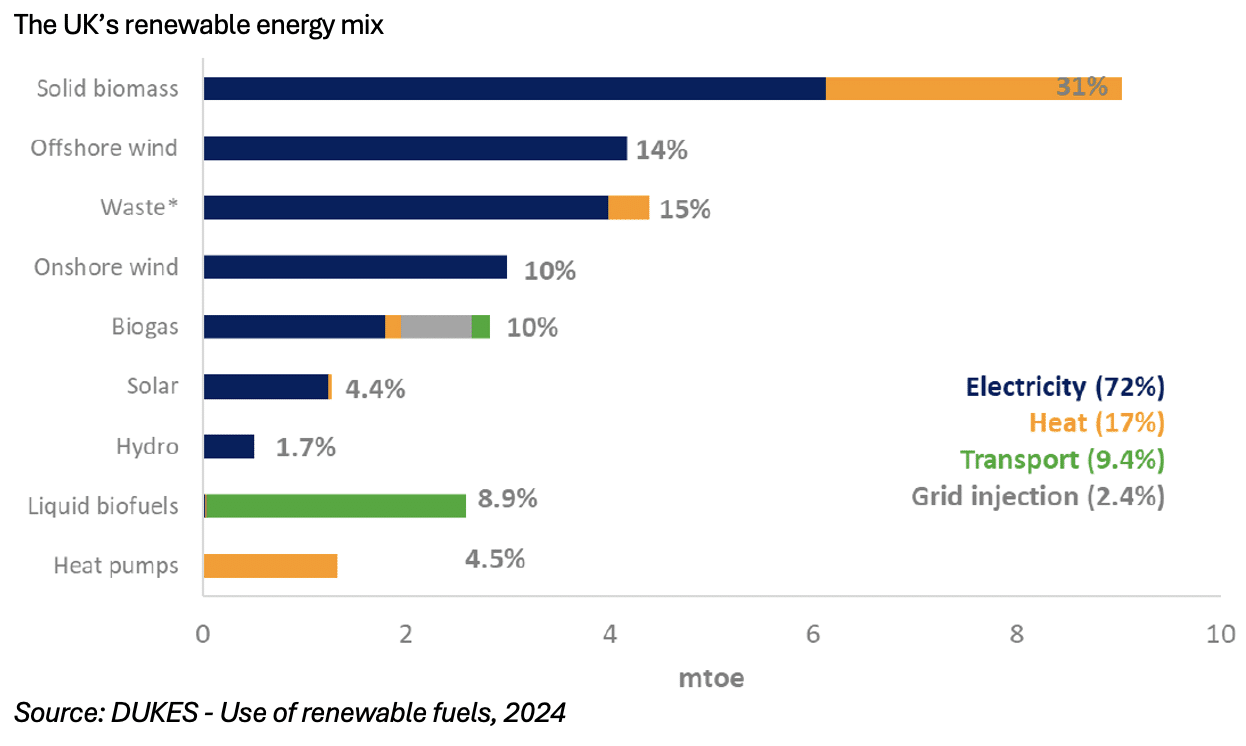
The UK’s largest concentration of hydro assets (~80-90% of the total UK hydro capacity) is in Scotland. Many of these hydro plants are reservoir-based (storage) or run-of-river, with the Highland mountains and lochs providing natural sites for large and medium-scale hydro schemes.
Hydro generation increased by 6.1 per cent in 2024 to 5.8 TWh. There was a small increase in average rainfall and new capacity (up 2.1 per cent on 2023).
The investment case
In 2019, Gravis, as investment adviser to GCP Infrastructure Investments Limited (“GCP”), recommended an investment in 14 run-of-river hydro projects with operations located in Scotland for a total capacity of 20.9MW. The portfolio includes 16 turbines supplied by Gilbert Gilkes and Gordon, the UK leading hydroelectric turbine manufacturer, which are spread across 14 locations in northern Scotland. The investment represented an attractive opportunity to further diversify GCP’s renewable generation exposure, with best-in-class technology. These hydro assets benefit from public subsidy in the form of inflation-linked Feed in Tariffs (“FiT”).
How revenue is derived
Under the FiT scheme, generators of electricity from renewable or low carbon sources such as solar or hydro assets (the “FiT Generators”) are entitled to receive Tariff Payments from those licensed electricity suppliers defined as FiT Licensees. The initiative was designed to promote the development of small-scale renewable electricity generation, through incentive mechanisms. Households and businesses are eligible for fixed payment rates for the electricity they produce, making it more financially viable to purchase and install renewable energy generators.
FiT Payments fall into two categories, the Generation Tariff and the Export Tariff. The Generation Tariff is a set rate paid by the FiT Licensee for each unit (or kWh) of electricity generated, the set rate being dependent on the size and type of the installation, as well as the time at which the generator was completed, and fixed for the life of the generator. The Export tariff is paid for the electricity exported to the grid. It is government-set, index-linked, and paid for the length of the FiT term.
On an annual basis, FiT Generators can elect to receive either the FiT generation tariff or sell the electricity into the market and receive the wholesale value of electricity together with any embedded benefits associated with such supply.
How the sector could evolve
There are many small rivers and watercourses where run-of-river schemes could be installed, especially for local community energy projects. However, with limited size opportunities they would not be very attractive to investors.
Instead, Pumped Storage and Hybrid Systems could be the answer for a future growth in the sector. This is a proven technology for grid balancing and energy storage and, thanks to a new Scheme introduced in the UK, there will be the prospect of a cap and floor price mechanism from the Government that would guarantee a long-term and reliable cash flow.
In 2025 the Government introduced a financial support mechanism for Long Duration Energy Storage (LDES) projects (like pumped hydro) to guarantee a minimum return (floor) while capping excessive profits, ensuring investment stability, protecting consumers from high costs, and encouraging new storage for grid balancing. Developers get a safety net (floor) to cover costs if revenue is low, and share surplus revenue (above the cap) with consumers, creating a win-win for investment and affordability in the green energy transition.
Furthermore, these solutions become even more sustainable when using old mining or quarry sites for closed-loop pumped storage, and bring new job opportunities for local communities.
This is a crucial financial tool to de-risk large storage projects, making them attractive investments by providing a revenue “safety net” (floor) while ensuring public benefit through profit sharing (cap), enabling a more secure, cheaper, and greener energy system.
No information contained in this article should be construed as providing financial, investment or other professional advice and should not be considered as a recommendation, invitation, or inducement to subscribe for, dispose of or purchase any such securities. Professional investors only. Capital at risk. Past performance is not a guide to future performance.
Main image: dylan-skinner-B3tKMpv2AfM-unsplash