






















Fidelity International’s Multi-Asset team has published their latest views on which asset classes and markets are presenting the greatest opportunities and risks, and this article zooms in on the key take aways.
To download Fidelity International’s full Global Asset Allocation Insights for April 2026: Global Asset Allocation Insights – April 2026
The key insights:
What has changed?
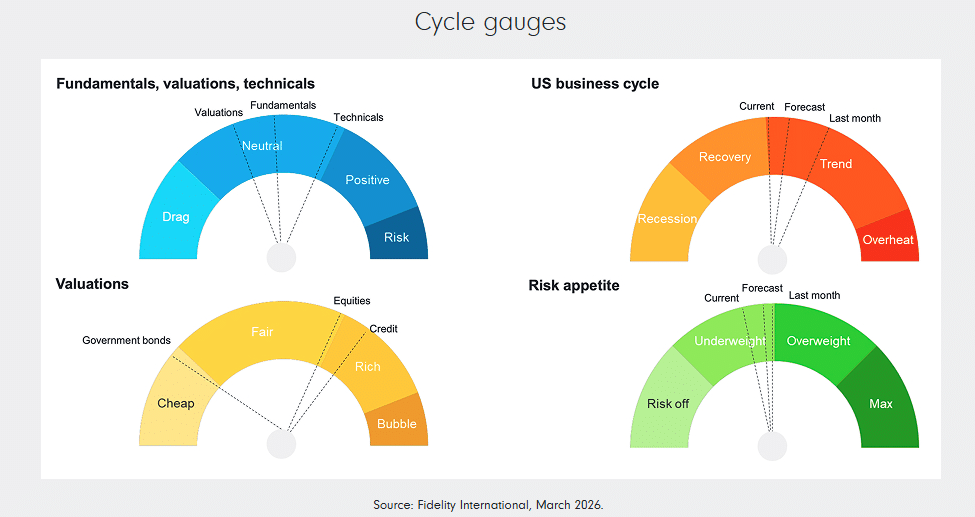
- Geopolitical risk dominates: The Iran conflict has introduced greater uncertainty around growth, inflation, and policy through the energy channel.
- Move to neutral risk: We prefer to preserve flexibility and wait for opportunities.
- Traditional safe havens less reliable: Commodities, particularly energy, are proving more effective hedges together with cash than duration or gold in the current environment.
What has stayed the same?
- The global economy entered this period from a position of relative strength. We still expect earnings resilience and fiscal expansion to support risk assets.
- Credit valuations remain tight, particularly in investment grade, limiting the attractiveness of the asset class.
- The medium-term outlook for a weaker US dollar remains intact, although near-term dynamics are being driven by geopolitical developments.
What are we watching?
- The duration and evolution of the Iran conflict, particularly pertaining to the impact of higher energy prices on inflation and central bank policy, and whether this begins to materially affect growth expectations.
- The effectiveness of traditional diversifiers.
- Opportunities to re-engage risk if conditions stabilise, particularly in areas where valuations have adjusted but underlying fundamentals remain intact.
Best ideas for investment outcomes
Growth
- EM equities, particularly Korea, South Africa, and Greece, and selectively Brazil, supported by structural reform, earnings momentum, and attractive valuations.
- Thematic equities related to the grid upgrade benefit from idiosyncratic return drivers as the US and EU look to accommodate greater demand and more renewable energy.
Income
- Emerging market bonds in select local markets continue to look attractive given elevated yields and commodity-exporting fundamentals.
- Quality income equities provide relative defensiveness and stability, particularly in an environment of higher uncertainty. Dividend growth and strong balance sheets remain key filters.
Capital preservation
- Commodities, particularly energy exposure, have proven to be the most effective hedge in the current environment, providing protection against geopolitical risk and inflation.
- Gold remains a medium-term diversifier, however its behaviour has been less consistent as a hedge during the recent volatility.
- We remain positive on selected real assets, particularly transition materials such as copper, supported by structural demand from electrification, reshoring, and AI demand.
Uncorrelated returns
- Absolute return strategies, driven by active investment decisions and incorporating idiosyncratic sources of risk – particularly those with a focus on tail risk mitigation.
Source: Fidelity International, March 2026. Views reflect a typical time horizon of 12–18 months and provide a broad starting point for asset allocation decisions. However, they do not reflect current positions for investment strategies, which will be implemented according to specific objectives and parameters.
Main image: background, colourful, anton-darius-jvR9ieZVG64-unsplash