























Parameters survey: In the seven months since we last undertook our survey into the use of AI in advice businesses, there has been a significant change in how many firms are now using AI, even if AI has not fully permeated the paraplanning role as yet.
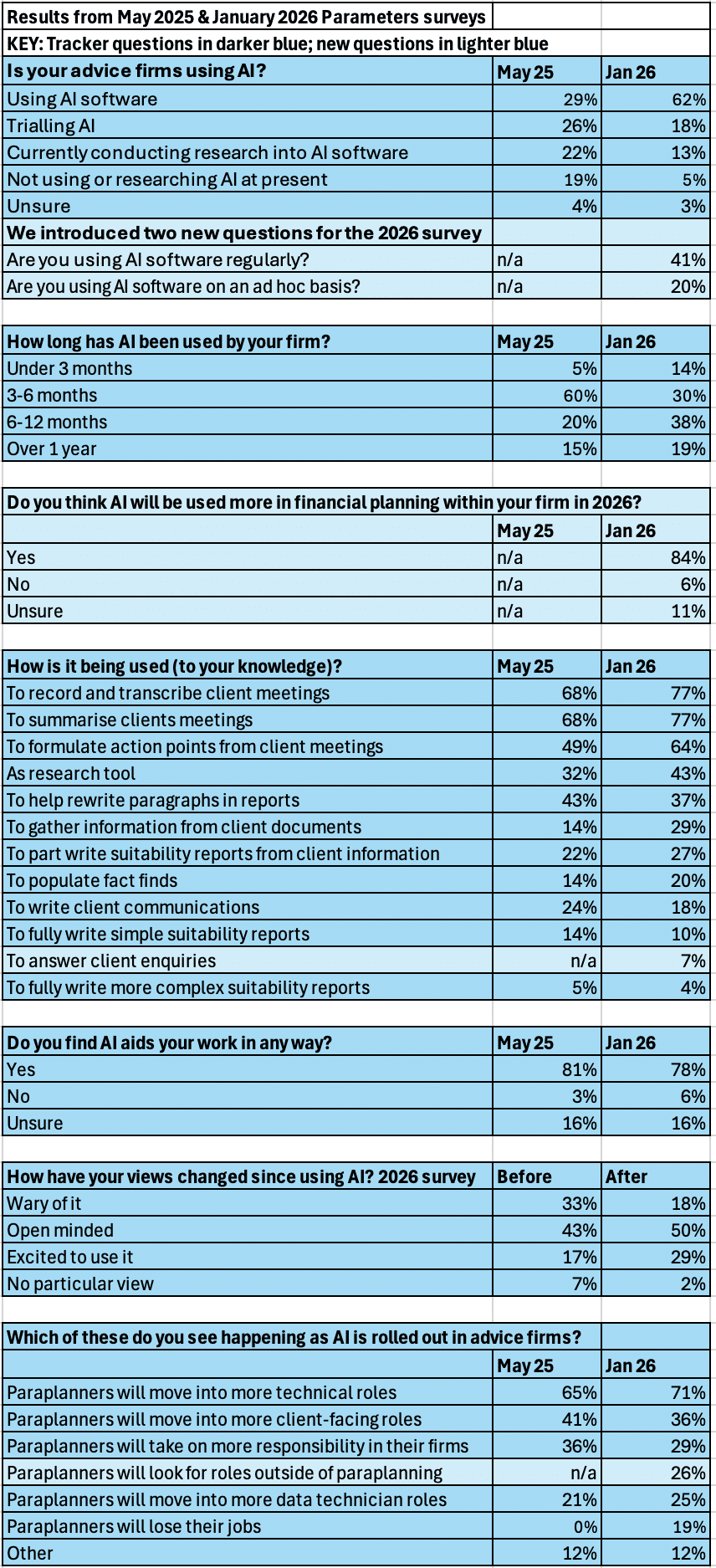
In May 2025, paraplanners told us that 29% of their firms were using AI in the business. That has risen to 63% in January 2026.
Firms not using AI within the business have dropped from 19% to just 5%.
Asked whether they felt AI will be used more in financial planning within their firm in 2026, 84% of paraplanners said they believed it would be.
Currently, 41% of respondents said they were using AI on a regular basis and 20% on an ad hoc basis.
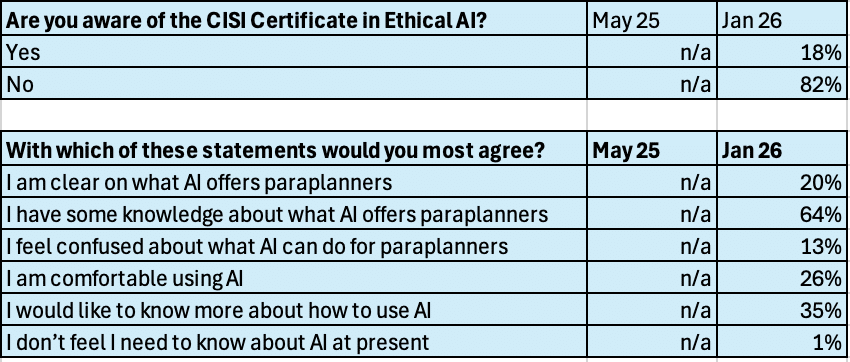
Nearly two thirds of paraplanners said they had some knowledge of what AI offers paraplanners, but only 29% felt they were clear on what it offered and just 26% said they felt comfortable using it.
Asked about their views on AI since having used it, more paraplanners were excited about using it (29% up from 17% before using AI), more people were openminded about AI, (50% against 43%), while those wary of it dropped from 33% to 18%.
[See the full results at the foot of the page.]
How AI is being used in advice and paraplanning
From the survey responses, it is clear that AI systems are still primarily being used at the front end of the advice process, to record, transcribe and summarise client meetings, and to formulate action points from the meetings.
In general, this is meeting with approval from paraplanners: “The AI meeting notes are very good and much more in depth than the written ones we used to get,” and “We have much more soft facts from a client’s meeting than we would ever get before just from the adviser’s notes.”
However, others were not so complementary, finding the software “often transcribes a much lengthier and repetitive set of meeting notes than those that would have been typed by an adviser. Thus, whatever time the software is saving for advisers it is lengthening the process for paraplanners/admin having to decipher the information obtained.”
Paraplanners said mainly they were using AI as a research tool, to gather information from client documents, and to help rewrite paragraphs in reports. Comments included:
“From a paraplanning perspective, once I’ve completed the research and uploaded, I can get on with another task while AI basically ‘types it all up’”
“It is useful for rephrasing, good for writing Excel formula, and we are currently finding it useful for exporting date from PDFs,” and
“Sometimes if I am stuck on how to word something I ask it to rewrite my letters or emails.”
“I’m now using it instead of Google.”
More paraplanners are using AI to help part write suitability reports from client information (27% in 2026 against 22% in May 25) but few are using AI to fully write suitability reports as yet.
“It is excellent at summarising client meetings and information from providers and we use it to part write Suitability Reports but it is more of a hindrance than a help in this,” one paraplanner said.
Where AI seems to be more useful, according to comments, is in helping rewrite, review and summarise reports: “It is helpful to summarise sections of a suitability report.”
The collective data reflects the fact that, to date, much of the focus of AI software has been aimed at the adviser role, improving records from client meetings as well as freeing up adviser time at the front end, rather than improving the efficiencies within paraplanning roles.
However, we are now seeing software vendors aiming more firmly at the paraplanning role, which should see AI deliver greater efficiencies for paraplanners going forward.
Rob Harradine and Caroline Duff, co-founders of ammonite, feel the capabilities of AI are becoming clearer to paraplanners. Duff said: “Perhaps the biggest opportunity for AI in paraplanning is in reducing the time spent drafting and reworking advice reports, rather than replacing technical judgement. By speeding up report drafting and editing, AI allows paraplanners to spend more time on analysis, quality control, and adviser collaboration, rather than repetitive writing and formatting. Used this way, AI improves efficiency and consistency while keeping responsibility firmly with the paraplanner.”
Harradine added: “We feel it’s essential the paraplanners actually have control of the AI, with an intuitive system that allows for a high degree of customisation. There is no question paraplanners are going to win hours back each week with AI. We see users of our Planbot AI tool more than halving the time it takes to create their suitability reports.”
Pros and cons of AI as experienced by paraplanners
Asked about their overall view of AI within advice businesses, paraplanners views ranged from those who fully embraced it “No brainer – use it or be left behind” through to those who see it undermining the knowledge and capabilities within the firm: “It’s breeding in yet another weakness – making our advisers dumber and of lesser quality. If you don’t use it, you lose it.”
Paraplanners who commented seem to be far more open minded about using AI than before but are still fairly wary of its output at the moment. “I believe it can create efficiencies but it is not to be solely relied upon”; “It leaves a lot of room for errors, potentially to go unnoticed”; “I am wary of people using it for technical knowledge which I have seen give poor results,” some commented, while another said: “You just need to be careful, especially with calculations – I won’t use it for that as I haven’t seen a correct technical calculation yet!”
Many said they could see the benefits, however.
Reducing the time taken to complete compulsory tasks was one of the most cited benefits: “I feel AI could help to speed up processes and take some pressure off time frames for certain jobs. If AI can reduce time taken to write a report from a day down to a few hours then I’m happy to accept the help,” one paraplanner said, while a team leader added: “I’m very open to it and I love that it can do some of the mundane tasks and free the team up to do more meaningful and interesting work, but also mindful of the restrictions/need to sense check.”
Paraplanners felt the benefits also depend on the way AI is used and in which areas of planning it is used. “I’m excited for some uses, particularly around standard wording for reports and administration but wary of its use in detailed/complex regulated advice,” were sentiments reflected in many comments. “I think it can drive large efficiency gains and better client experience. However, at this stage of development I think it is no substitute for a decent technical paraplanner.”
There were those who having used AI, were more excited about its future within financial advice and the paraplanning role: “Used well and with full awareness of data security, AI can take paraplanning to a whole new level. I’m optimistic about the future,” one said, while another also commented: “I believe it will become a foundation technology within the financial planning industry, enhancing efficiency and productivity within firms, and the end client experience as a result.”
One response probably summed up the range of comments about where AI is at currently: “I am excited for the benefits it can bring, but I have a certain amount of wariness due to inaccuracies.”
Effect on the paraplanning role
We also asked paraplanners what they could see happening as AI is rolled out in advice firms. The majority of paraplanners could see paraplanners moving into more technical roles (71%), but 26% thought paraplanners would look outside of paraplanning and 19% thought jobs would be lost.
Comments included: “I believe there will be a number of changes based on each firm. For those paraplanners who are not as experienced as others, they may lose their jobs as simpler tasks are carried out by AI. Those more experienced paraplanners will either move into more technical roles or take on more responsibility within the firm. Others may look for roles outside of paraplanning.”
Some respondents were sceptical and concerned by AI’s use in paraplanning. They said:
“I believe the paraplanning role and its uniqueness will be diminished, leading to less hires of paraplanners.”
“I think most applications of AI are a solution searching for a problem that hasn’t yet been found. I think the end goal of AI providers is to replace human critical thinking.”
“I am concerned that wholesale use will mean we lose the ability to think critically and weigh facts. Like muscle memory, I think you need to practice these things regularly.”
“Firms are using AI as an opportunity to reduce the wage bill but will need technical people to check what the AI produces unless they want to invite complaints
Others were more optimistic about the role of humans in the paraplanning role:
“It can be a help, not a hinderance and personal touch will still be needed.”
“I think that paraplanners will continue to get the complex cases. I can’t see AI ever being able to see the nuances in financial planning.”
“I am concerned that paraplanners will lose their jobs and so have advised my team to greatly extend their technical expertise. There will be people needed to monitor the AI and so some may move to a more data-technician type role. Presently, it is obvious to me what has been generated using AI and so I also wonder if there will be a backlash against this due to this being a very bespoke and personal touch industry for clients with more assets.”
As can be seen, there was a mixed bag of responses and thoughts on how AI is and can be used in advice firms and in particular the paraplanning role, as well as concerns matched with optimism.
The jump from 29% of firms using AI to 63% in the space of seven months is a firm indicator of where the market is heading. The move of AI software more into the paraplanning space means that advice firms are going to be looking at how it can be used and what that means for paraplanning productivity and teams. Paraplanners will need to understand how best it can be used to enhance their practical skills and also what threats it comes with and what opportunities it offers in terms of their careers.
See also: Adviser interest in AI providers soars
Main image: robynne-o-HOrhCnQsxnQ-unsplash