






















In the second edition of EdenTree’s quarterly Field Notes, the Sustainable Investment team have looked at the AI workforce transition and what it really means more broadly.
In a period dominated by headlines of trillion-dollar AI giants and the transformational power a handful of companies are having on the modern world, it is worth reflecting on what this means for the broader workforce and what a responsible workforce transition should look like if AI materially reshapes, or reduces, certain roles.
As the image below highlights, these impacts will not be evenly distributed, with studies predicting some white-collar, administrative, financial, technology and professional-service roles are more likely to be reshaped by AI.
The concept of a “just transition” was developed to ensure that social interventions sit at the heart of decarbonisation, so that communities are not left behind by the move from fossil fuels to renewables.
That same principle should surely be applied to the workforce most exposed to significant transformation from AI technologies.
While the UK government is encouraging AI upskilling, and redundancy protections already require employers to consider alternatives before dismissal, there remains limited emphasis on whether how companies, and their boards, are managing AI-related workforce change.
We increasingly see a role for investors in setting expectations for a “just AI” workforce transition, especially in highly affected sectors.
Poorly handled AI-led restructuring can create operational disruption, reputational risk, loss of institutional knowledge and weaker employee trust.
Expectations should therefore include board oversight of AI impacts, early workforce risk assessment, worker consultation, retraining and redeployment pathways, support for affected employees and post-exit outcome monitoring.
This is not a new idea – SSE has shown what good looks like in its transition to renewables – but it now needs to be applied more widely to AI-exposed sectors.
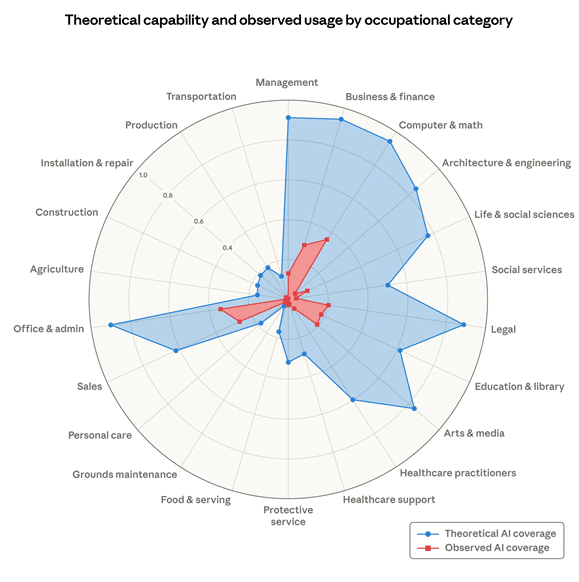
Source: Theoretical capability and observed exposure by occupational category
Main image: sustainable, AI, immo-wegmann-w69Z8K-HGQU-unsplash