






















Pensions have undergone significant change over the past decade, yet they remain central to most retirement plans. Julia Peake, Technical Manager at Nucleus, considers how recent inheritance tax reforms are reshaping conversations around pension planning and why advisers may need to rethink how clients use their pension wealth in later life.
In the Spring Budget 2014, George Osborne announced, that from April 2015, pensions would be able to be accessed flexibility and, if you so desired, you could withdraw all pension funds and buy a Lamborghini, (without mentioning that fact that you would most likely lose nearly half your pension in tax if you did that).
This announcement led to many clients re-evaluating their holistic financial plans. As there was no longer a requirement to buy an annuity or be limited by the amount you could withdraw, how clients viewed their pension funds changed. For some, it meant pensions could be passed down to future generations tax efficiently, becoming part of the estate planning conversation and not just to provide income in retirement.
Fast forward to the Autumn Budget 2024, when Rachel Reeves announced that from April 2027, most unused pension funds will now form part of an individual’s estate and be subject to inheritance tax (IHT).
Another significant change in the rules governing pensions, so do we need to rethink the way we now view pensions?
Probably, however pensions fundamentally are still a savings vehicle to provide income for retirement and offer tax benefits that clients value. Though some may not need some or all their pension to provide an income, for many, pensions savings will be the primary source of income in retirement.
This is why, despite the rule changes from April next year, pensions, for many, remain the cornerstone of a holistic financial plan and this is shown in the most recent publication from HMRC on private pensions.
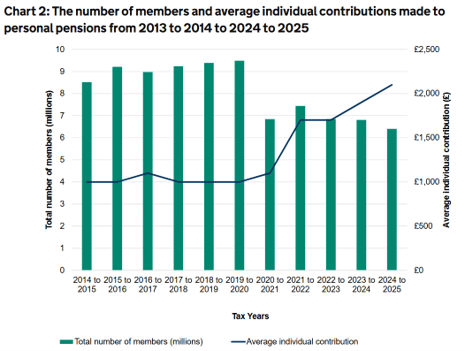
HMRC’s annual private pension statistics commentary: July 2026 [1] show that up to tax year 2024/25, there has been a steady increase in the number of individual contributions to private pensions.
Also in tax year 2024/25, 15.9bn people, including 3bn self-employed, contributed to their private pensions, an increase of 1.3bn people compared to the previous tax year.
However, the graph below shows that while the number of contributions and the value of those contributions has increased, the number of members contributing has decreased in recent years.
Given some of the changes, some may be making alternative arrangements to fund their retirement. However, those who are using pensions are increasing the amount they contribute, building their pots for when they do retire.
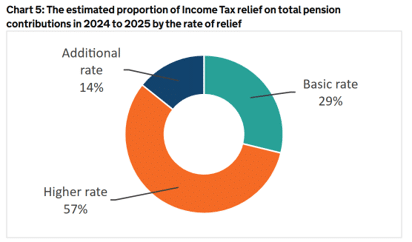
For those making pension contributions, the data shows that the rate of income tax relief is mainly received at higher rate, as per the chart below. This is important for a couple of reasons.
Firstly, with the gross pension income tax and national insurance contributions (NICs) relief in 2024 to 2025 estimated to be £83.9bn, an increase of nearly £4bn compared to the previous tax year [2], this may again raise the topic of amending tax relief at the Autumn Budget in October.
This in turn could lead to more uncertainty and some clients making hasty decisions. During periods of uncertainty is where financial professionals can really add value to their clients. They can help provide clarity and navigate a path suitable for their needs, in spite of all the rumours and noise.
Secondly, this emphasises the beneficial impact that tax relief on pension contributions can make when you retire, boosting pension savings, so long as any higher rate relief is claimed through self-assessment.
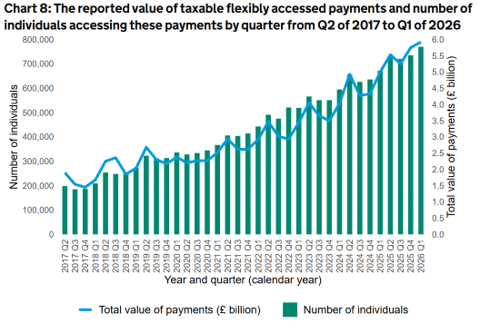
The number of people accessing their pensions flexibly, as well as the amount being taken has generally increased over the last few years. We know the cost of living has rocketed at times in recent years, so higher withdrawals are required to maintain a standard of living.
However, if you look at the graph below, another reason could be due to those pension and IHT changes due in April next year. People may be taking money out of their pensions during their lifetime to make lifetime gifts and reduce their taxable estate.
Since the announcement in Autumn 2024, there has been a substantial increase in enquiries about utilising the normal expenditure out of income exemption, and utilising different trusts and investment bonds.
Reviewing how clients fund their retirement income and utilising pension savings earlier than previously planned may be a conversation we should now be having with clients.
For many, their pension savings will most likely be the second biggest asset in the estate after their house. By accessing this first, it could “kill two birds with one stone” by providing the income required in retirement, but also reducing the value of the fund, which could be liable to IHT.
Clients should also review their other assets and engage in some lifetime planning if wealth preservation and estate planning is a priority. Clients may wish to look at the range of trust options available and make gifts and or loans to the trustees and start to reduce their taxable estate or at least get the growth on the assets outside the estate.
Pensions remain one of the most tax efficient savings vehicles available, even with these changes. For the majority of clients, pensions are still a fundamental piece of a holistic financial plan.
Financial professionals can add real value to their clients by ensuring they work with them during times of change. Providing clarity by communicating important changes and adapting the plan as and when its required, not only builds client relationships but also allows them to achieve their financial goals.
[1] Private pension statistics commentary: July 2026 – GOV.UK
[2] Private pension statistics commentary: July 2026 – GOV.UK
Main image: lightbulb moment, ondrej-supitar-u5l8ded3n3Y-unsplash