






















Challenges with the changes due to come in for pensions and IHT remain a hot topic, and there are extra layers of complexity to estate planning when dealing with unmarried individuals. In this article, Fiona Hanrahan, Senior Pensions Development and Technical Manager at Royal London, gets into some of the detail.

In recent months we’ve been talking a lot about the future changes to how IHT will apply to pensions. We now know that from 6 April 2027 pensions will no longer be exempt from IHT.
With pensions being included in the estate from April 2027 this could make estate planning for unmarried individuals even more challenging.
When it comes to estate planning, it can be more challenging for unmarried individuals as the spousal exemption doesn’t apply.
Even if you have been a couple for many years, if you are not married or in a civil partnership, inheritance tax (IHT) could apply on the first death even if you leave everything to your partner.
During lifetime, gifts to a spouse or civil partner would be free from IHT but, again, this exemption would not apply to unmarried couples. The ability to pass on any unused nil rate band or residence nil rate band does not apply to unmarried individuals either.
Most people’s main assets will be their house and their pension. Let’s look at how IHT would apply for an unmarried individual if they died before or after April 2027. In this example we have assumed that there are no direct descendants to pass the house to, and therefore the residence nil rate band will not be available.
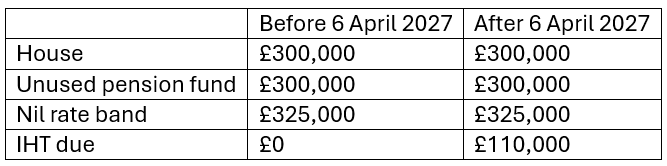
In this example there is a significant difference when pensions are included in the estate for IHT, which is made worse by no spouse exemption or residence nil rate band being available.
It’s also worth remembering that the nil rate band of £325,000 will remain at this level until 2031, which will likely see increased numbers of people in scope of IHT as asset values rise.
If death occurs after age 75, there will also be income tax payable by the beneficiary when they take the benefits from the remaining pension fund after the portion relating to IHT has been deducted.
Ensuring beneficiary drawdown is available could mean less income tax is paid in this situation as the beneficiary can control when income tax is paid rather than when it is taken as one lump sum.
Potential strategies for unmarried individuals
Lifetime gifts. Make use of the available exemptions. If a gift is exempt, it means IHT will not apply regardless of when you die. The main ones are the annual exemption of £3,000, gifts of up to £250 to any number of people, regular gifts out of surplus income and gifts to charities.
If you make a gift which doesn’t come under any of the exemptions and survive for seven years after making the gift, it will also not be included in the estate.
Think about marriage or civil partnership. In our case study we have seen how this could be beneficial from an IHT perspective, though this may not suit everyone.
Protection policies. A life insurance policy written in trust can provide funds to cover the inheritance tax bill, ensuring the surviving partner is not forced to sell a home to pay the tax.
A joint life annuity. If you are living as a couple but aren’t married or in a civil partnership this might be worth considering. This is because IHT won’t apply to the survivor’s benefit.
Being unmarried can result in significant inheritance tax liabilities that married couples and civil partnerships do not face. Understanding the rules and planning ahead is essential to ensure assets pass on with as little tax as possible.
Making use of the available exemptions, considering a joint life annuity or a protection policy written in trust could be very worthwhile strategies if marriage or a civil partnership is not suitable.
Main image: james-lee-YpDkIh137ws-unsplash