






















As the technology sector experiences heightened volatility and attracts investor scrutiny, portfolio manager Hyun Ho Sohn of Fidelity International, gives his views on recent market movements, with a focus on what’s next for the AI cycle.

The volatility we’ve seen over the last few months has been driven by a combination of factors. With the elevated level of AI investment and deteriorating cash flows of big spending companies, the market is increasingly concerned about the sustainability of this level of capex.
In addition, rising interest rates are increasing the cost of capex, particularly hitting second-tier companies such as neoclouds.
Lastly, investors who were heavily positioned in AI capex beneficiaries have quickly unwound their positions, which led to a sharp de-rating of hardware and semiconductor stocks exposed to the AI theme.
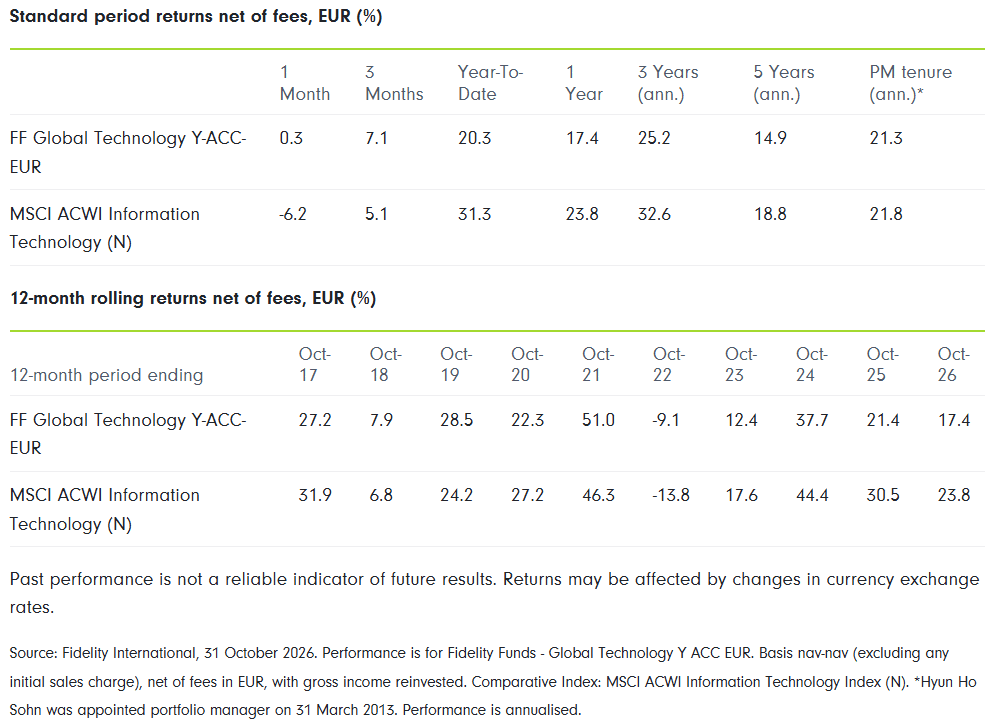
Against this backdrop, fund performance has been recovering quickly in recent months, although it remains behind the benchmark year to date.
Underweight positions in large-cap AI semiconductor names have been the largest positive contributor to performance as AI trades reversed, while IT services and software stocks such as Accenture and Intuit also contributed as they recovered quickly from historically low valuations.
On the other hand, underweight positions in mega-cap stocks such as Apple and Microsoft have weighed on performance, as these stocks have been viewed as safe havens in the recent volatile market.
What’s next for AI capex?
I believe the tightening funding environment will make it difficult for AI capex to continue growing at this strong pace, and I remain cautious on related plays.
The significant equity and debt capital raised by hyperscalers is crowding out smaller neocloud companies that need external capital to continue their AI data centre buildouts. Indeed, we have seen widening credit spreads and failed IPOs of neocloud companies.
Neoclouds in aggregate account for a significant part of industry capex, and tightening funding conditions for neoclouds will have significant implications for overall AI capex.
The most interesting takeaway from the recent earnings season was, in fact, about AI capex. Most hyperscalers didn’t raise their capex guidance as in previous quarters.
Some neocloud companies explicitly cut their capex plans, while others turned cautious on next year’s capex growth. This is a complete change in tone from previous quarters.
Hyperscalers remain well positioned
I remain positive on the hyperscalers, as they are well positioned to enjoy profitable long-term growth driven by AI adoption. Hyperscalers don’t just provide commoditised compute for AI – they also provide comprehensive solutions including compute, storage, security and multiple AI models, depending on customer needs.
Amazon, in my view, is a long-term winner in both consumer retail and cloud computing. I particularly like Amazon Web Services (AWS) due to its proprietary compute capabilities, large and sticky customer base, and focus on high-margin inference services.
Alphabet has been de-rated recently because of market concerns about its Google Search business, but I see this as a temporary monetisation issue that is fixable, given strong user engagement on its platform.
I see significant value in Alphabet’s cloud computing business, with its full-stack AI compute capabilities. And the company is now selling TPU hardware to external customers, which should provide an additional source of growth.
Elsewhere, I recently increased the position in Meta, where Meta Muse demonstrates its continued innovation and monetisation potential beyond its core social media advertising business.
Cautious on semiconductors
The semiconductor sector is cyclical in nature – I believe the best time to own semiconductor stocks is when the demand environment is weak and companies are under-earning.
Given the consistently strong AI capex tailwind over the last few years, I believe the market is under-appreciating the cyclicality of the semiconductor space.
Many semiconductor companies are over-earning, which is why I remain significantly underweight, particularly those that have benefited most from AI capex.
It is worth highlighting that the portfolio is selectively positioned in sub-segments such as analog semiconductors, which tend to have higher-quality business models and more diversified end-markets.
Texas Instruments is a good example. It has aggressively built highly automated in-house manufacturing capacity over the last few years, which is paying off in the current market cycle.
I am also modestly overweight European semiconductor equipment stocks, including ASML, which has a very strong competitive position and is trading at an attractive valuation.
Selectivity in software and IT services
I am open-minded, but increasingly selective and valuation-sensitive in approaching software stocks. AI could be disruptive to software business as coding becomes cheaper and easier, but software companies are also embracing AI to make better products for customers.
While some software can be displaced easily, others are deeply embedded in business processes and integrated with other software and IT platforms – so the switching cost is very high.
Importantly, not all software businesses are equal, and management execution is important. I selectively own software stocks that have high customer switching costs, the potential to monetise AI, and relatively cheap valuations.
I view Oracle as a mispriced stock. Its core products are very sticky, and I believe that concern over its AI data centre business are overblown. Intuit is another name I favour.
Although mindful of AI disruption risk in its exposure to small and medium-sized businesses, Intuit has strong potential to monetise AI and is trading at a very attractive valuation.
IT services stocks are trading on historical trough valuations, but again, I prefer to own stocks where I am more comfortable on execution.
Accenture is a good example. The company will play an important role in AI adoption, with its consulting, tech implementation and management capability helping enterprise customers deploy AI in a productive, secure, responsible manner.
The stock is trading cheaply because the market is currently focusing more on AI disruption risks, underappreciating potential upside.
Attractive opportunities across the broader space
More generally, I continue to seek opportunities where companies are underappreciated and mispriced. The portfolio is currently overweight China, where many stocks are under-earning due to the current weak macro environment, but have strong long-term fundamentals, solid balance sheets, cheap valuations, and improving shareholder returns.
In China, I am focused on industry leaders in areas such as e-commerce, travel, property transactions, and recruitment.
China’s semiconductor sector also offers interesting opportunities as domestic companies continue to develop their own technological capabilities and expand manufacturing capacity, increasingly replacing imported products with domestic alternatives.
Elsewhere in the world, I have selectively added cybersecurity and data centre stocks following some market weakness. One area that I believe will be more resilient to AI disruption is media and entertainment stocks such as Netflix and Spotify.
Their products have become basic utilities for consumers, so they are less sensitive to the macro environment. They have strong, scaled distribution platforms, which are unlikely to be disrupted by AI. In fact, I believe AI will be beneficial as these companies use the technology to improve their products and operational efficiency.
Outlook for 2027: Volatile, but a diverse opportunity set
Looking ahead, 2027 will likely be another volatile year for the technology sector, given the many potential risks to the AI trade.
These include elevated level of AI spending, risks of supply disruptions, tightening financing conditions, increasing stock supply through equity raises and IPOs, and market expectations for continued strong AI capex.
Nonetheless, the technology sector is diverse and I continue to see a range of underappreciated, attractively valued opportunities across consumer technology platforms, media and entertainment, Chinese technology, and software and services.
I will continue to focus on long-term earnings power and avoid cyclical earnings momentum, while managing downside risk with a strict valuation discipline.
Past performance is not a reliable guide to future returns. You may not get back the amount originally invested, and tax rules can change over time. The writer’s views are their own at the date of publishing and do not constitute financial advice.
This information should not be relied upon by retail clients or investment professionals. Reference to any particular investment does not constitute a recommendation to buy or sell the investment.
Main image: technology, AI, robynne-o-HOrhCnQsxnQ-unsplash