























A reduction in funds suggests that sustainable investing is shifting toward a more specialist allocation that now requires a more deliberate alignment between a client’s specific objectives and the concentrated nature of the strategies that genuinely deliver those outcomes says Will Thompson, Chief Sustainability Officer at Pacific Asset Management.

ESG has been prominent in industry news lately, yet not always in the most positive light. Backlash, outflows, greenwashing cases, and regulation are all examples that may have appeared in your news feed.
Without wanting to turn this article into a historical overview of the concept, it may be useful to take a step back and try to understand where we are, how we got here, and what it really means for advisers.
Growth of ESG and Sustainability strategies
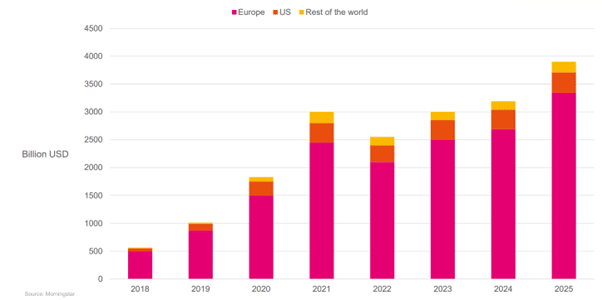
ESG funds began to experience significant growth in 2018 (Chart 1), with assets in funds that could be grouped into this category almost doubling yearly.
While investors in ethical propositions have existed for longer, the 2015 Paris Agreement and the adoption of stakeholder capitalism by Wall Street’s biggest names led to a meteoric rise.
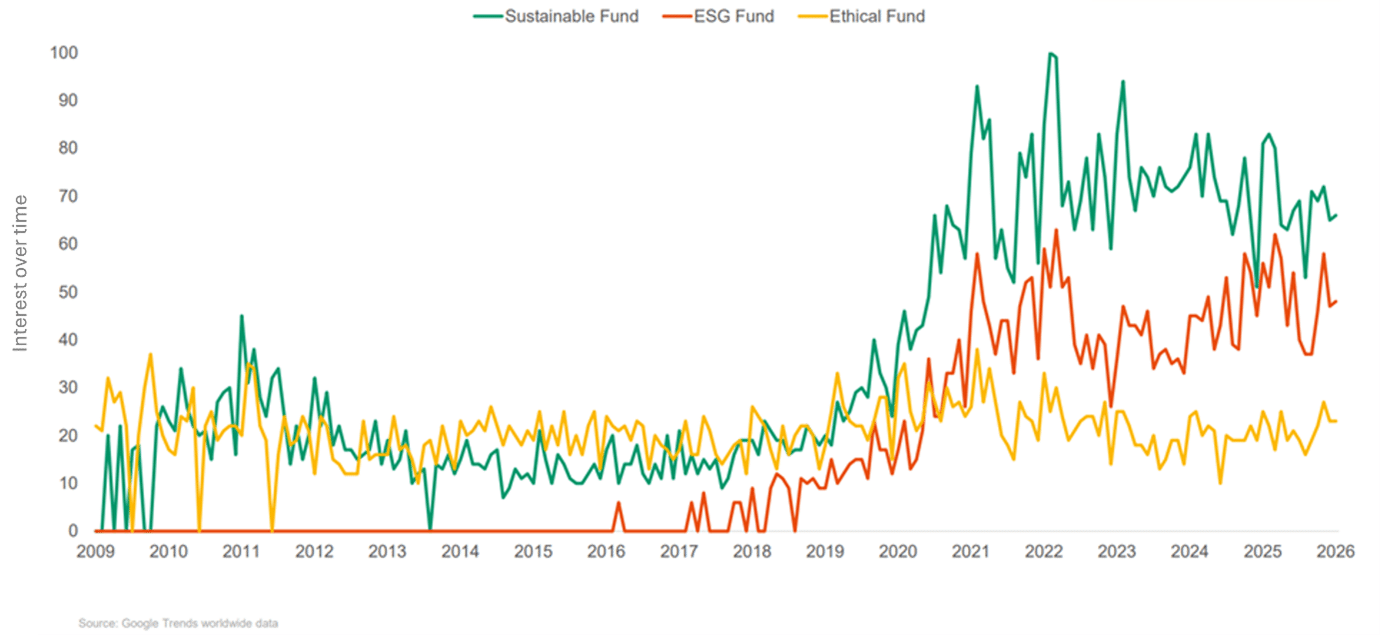
Consumers followed suit, with worldwide Google Trends data for “ESG fund” (Chart 2) shown below serving as a proxy for retail investor sentiment during this period and mirroring AUM behaviour.
Fast-forward a few years and two key factors shifted this trajectory and optimistic narrative. First, regulators (specifically in the UK and EU) grew concerned about the abundance of products being categorised as ESG without much robustness.
They increased the work and scrutiny for managers offering these products by mandating disclosures, labels, and anti-greenwashing rules. Second, in 2022 the Russian invasion of Ukraine and inflationary impulse led to interest rate hikes that severely affected the performance of stocks linked with ESG funds and trackers, such as clean energy and tech.
As such, ESG investing went from a common conversation topic with clients and managers to an uncomfortable subject in some contexts.
Explaining the differences
The learning from this period of upheaval is that a line must be drawn to differentiate the terms ‘ESG’ and ‘sustainable investing’. In our view the former ought to be considered as a risk management technique which embeds material Environmental, Social, and Governance factors into investment decision-making.
We also think, taken in this light, ESG investing is simply a furthering of conventional financial analysis, ensuring all conditions that could impact business performance are captured in the analysis process.
Sustainability on the other hand is about attaining dual objectives, specifically risk-adjusted returns and sustainability outcomes. These are different in terms of the outcomes for clients, put simply in a sustainability strategy a client should expect to be invested in businesses that have strong environmental or social characteristics.
The concepts of ESG and sustainability, when understood in this light are undergoing a recalibration or evolution (nouns to be chosen depending on the reader’s optimism).
The regulatory environment
In this context, it is understandable that regulators had concerns about the use of terms evoking environmental or social characteristics in products, mainly because of the differing standards in products with ESG-related names.
An increasing number of managers across different strategy types are considering ESG characteristics to manage risks in their portfolios without overselling the sustainability characteristics of their funds to clients.
With the increasing impact of phenomena such as extreme weather events fuelled by climate change, many managers are embedding these risks into valuation models.
In simple words, rather than marketing the sustainability of the fund, they are more likely to highlight the portfolio’s risk management and the manager’s fiduciary duty.
Equally, both managers who embed sustainability in investment decisions and clients who truly care about these outcomes are becoming clearer about what they ought to see in a portfolio.
This has been one of the clear consequences of the UK’s SDR and investment labels regime, which has resulted in a significant narrowing of funds with a label compared to the previous, broader universe of ESG funds.
Conclusion
This represents a significant change from the earlier industry standard, where these preferences were often addressed via a simple checkbox in a suitability questionnaire that triggered a broad, default allocation.
The current reduction in the universe of labelled funds suggests that sustainable investing is shifting toward a more specialist allocation.
It now requires a more deliberate alignment between a client’s specific objectives and the concentrated nature of the strategies that genuinely deliver those outcomes. In short, we are landing in a market where what sustainability looks like and where it is suitable is clearer.
Main image: pao-dayag-54fhWCTRrrE-unsplash