























In a recent Parameters survey we asked if you thought all paraplanners should be required to be Level 4 qualified. Just over half of you said Yes, while nearly a third said No.
This has been an ongoing debate within the paraplanning community for a number of years. The results of our recent survey mirrored the answers to the same question asked in 2018 (see table), showing that opinion on this subject hasn’t really changed in the intervening years.
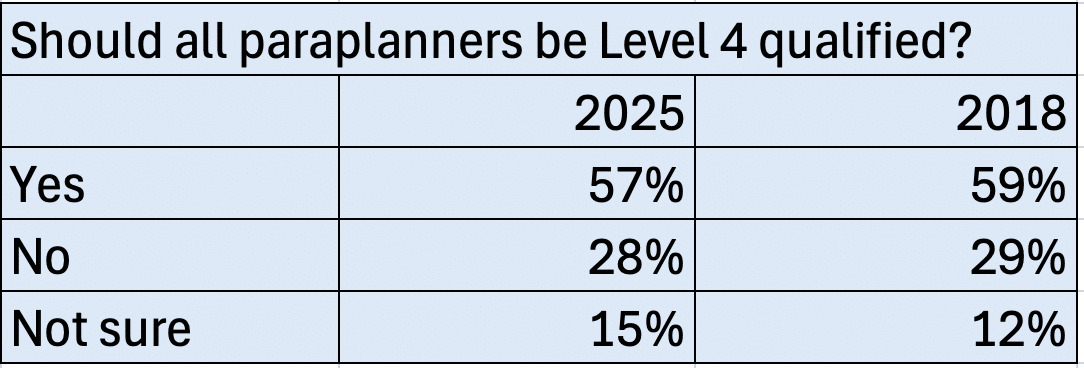
While over half of paraplanners said they thought Level 4 should be mandatory, this was tempered by others who pointed out that having the CII qualification wasn’t necessary to do a good job as a paraplanner – it would depend on the requirements of their individual role.
Paraplanners who felt Level 4 qualification should be the minimum for the role cited a wide range of reasons, largely centred on professionalism, knowledge and the evolving complexity of the job.
For many survey respondents, Level 4 was described as helping to provide the “full-round” technical knowledge required to do the role properly. As paraplanners become increasingly involved in building advice cases, a solid grounding in pensions, investments, tax and protection was seen as essential. Several respondents noted that junior paraplanners would be expected to be on the exam journey, with Level 4 forming a clear and logical milestone in their development.
Others highlighted that while Level 4 may not be a regulatory requirement for paraplanners, it brings clear personal and professional benefits, demonstrating commitment, capability and a willingness to invest in the role, even if not all of the knowledge gained is used day to day. Holding the qualification can also improve marketability and career progression, particularly for those looking to move firms or advance their role.
There was also a strong sense that paraplanning has become too complex to rely solely on experience without formal technical underpinning. As one paraplanner put it, “the role needs to remain relevant and professional, and in some cases paraplanners should arguably be as qualified as – or even more qualified than – advisers”. Exams were seen as supporting deeper understanding, while job experience brings that knowledge to life in practice.
A more nuanced perspective
However, this view was tempered by other responses that stressed the value of experience, role variation and practical knowledge over formal qualifications alone.
Respondents pointed out that some of the most capable paraplanners can have more than a decade of experience but do not hold Level 4 qualifications. In these cases, it was suggested that hands-on experience, technical problem-solving and firm-specific knowledge can make them just as effective as diploma-qualified peers. Much depends on how paraplanners are used within a firm – some operate in highly technical roles, while others work within set templates and processes.
Several respondents cautioned against allowing Level 4 to become a barrier to entry to the role. Knowledge gained through real-world experience, especially for those who have progressed from administration into paraplanning, can offer a depth of understanding that exams alone do not guarantee. There was also criticism of exams being, at times, a test of memory rather than a true reflection of applied technical skill, with some scenarios seen as irrelevant to day-to-day paraplanning.
That said, even among those who did not believe Level 4 should be mandatory, many felt it should remain an aspiration. Paraplanners should be encouraged to study and supported in completing their qualifications, even if they are not excluded from the role without them. The intention to work towards Level 4 was viewed as important, particularly where paraplanners are expected to analyse client information and contribute to advice decisions.
Overall, respondents agreed that paraplanning is not a single, uniform role. Responsibilities can range from producing straightforward review reports to handling complex technical cases. Where paraplanners are expected to make decisions and provide analytical input, Level 4 was seen as far more relevant than in roles where work is carried out strictly under adviser instruction.
Main image: sabri-tuzcu-wunVFNvqhfE-unsplash