
























Anthony Rayner, Fund Manager at Premier Miton Macro Thematic Multi Asset Team says that in the volatile inflationary environment we currently face, it becomes less clear which asset class will best diversify equity risk. However a good place to start is by diversifying equity risk, ensuring the equity exposure itself is diversified.

There are two crucial decisions to make when managing global multi asset portfolios. First, the appropriate degree of equity risk, which tends to be the dominant risk and, second, how best to achieve that balance in terms of asset class breakdown.
History is a good place to start in terms of understanding the dynamic between equity and non-equity and, specifically, what has worked and why.
Digging into the last few decades, especially equity market episodes, where diversifiers earn their crust, what becomes immediately clear is that it’s not always the same asset class that best diversifies equity.
In fact, some asset classes that diversify equity beautifully for extended periods, can actually add to equity risk in different environments.
As a result, a static approach to portfolio construction, a little bit like a broken clock, will be correct sometimes but quite often will be very wrong.
Analysing the economic environment is insightful in understanding what the best diversifiers are.
Obviously, over the last few decades, there are a number of different cross currents but the most consistent determinant of which asset class best diversifies equity is the inflationary environment and, very much related to that, the monetary policy environment.
During periods of low inflation, for example, central banks are more comfortable cutting rates in response to an equity market episode, in order to limit the negative wealth effect, and so bonds tend to rally, diversifying equity.
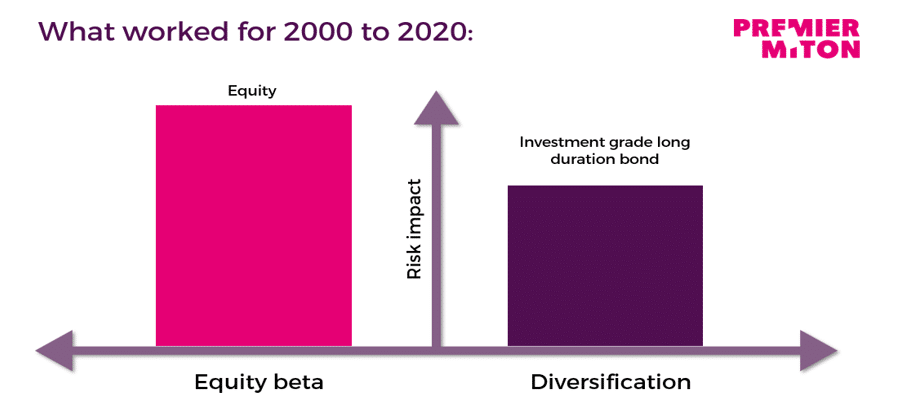
The stylised graphic below illustrates what was a broadly effective portfolio construction for an extended period. With the benefit of hindsight, it was quite a simple approach, effectively achieved through just two asset classes.
This protracted dynamic was one of the key drivers of the growth in the 60/40 equity/bond strategy and it also helped drive the growth in passive investing, as active asset allocation was deemed less necessary.
In reality though, the 20 year period from 2000 to 2020 is not very typical. Economic history is in fact characterised by inflationary spikes, rather than low levels of inflation.
As a result, in more normal times of higher inflation, central banks do not have the luxury of just focusing on preserving economic growth.
If inflation is driving the equity market episode, or is just in the background, central banks are understandably much less keen to cut rates.
As a result, that dynamic of bonds benefiting during equity market episodes is much less likely to happen.
Fortunately, in periods of higher inflation, there are other options: commodities such as oil and gold tend to be a much better diversifier of equity risk.
This makes intuitive sense: oil has been a common driver of inflation in the past, as it plays such a central role in the global economy, and gold tends to be a good diversifier of inflation, as well as of geopolitical risk.
The current inflationary environment is complicated. We have said for some time that we think inflation will remain at levels that are uncomfortable for central banks over the medium term, due to factors like deglobalisation and elevated miliary conflict.
Meanwhile, the market view on inflation is increasingly unclear at the moment, in part due to events in the Middle East.
In the volatile inflationary environment we currently face, it becomes less clear which asset class will best diversify equity risk.
In this situation, a good place to start diversifying equity risk is to ensure that the equity exposure itself is diversified.
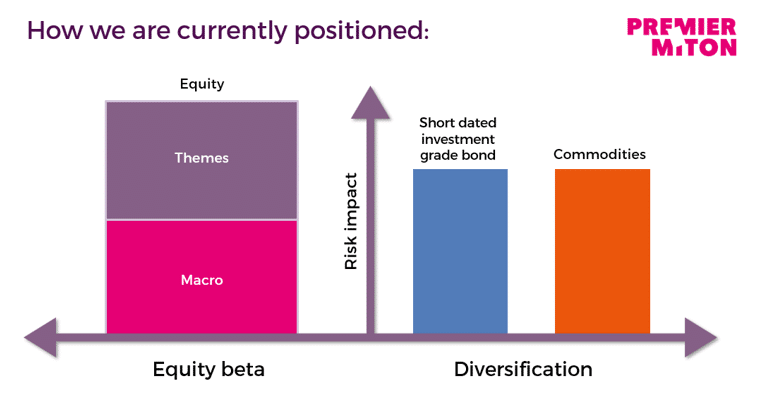
Across the Multi Asset Macro Thematic portfolios, we have been broadening sector and geographic risk materially over the last few months.
In terms of non-equity, we have exposure to short dated investment grade bonds, so limiting both interest rate and credit risk, the former consistent with our higher for longer view on the inflationary environment.
This bond exposure will unlikely diversify equity risk materially but it will dilute it. In addition, we have a commodities basket, which has been providing a good ballast, including oil, gold, industrial metals and agricultural commodities.
This positioning is reflected in the graphic below.
Going forward, we’ll be watching events closely, in particular the inflationary environment, and will act accordingly.
We’re pragmatists and in practice that means we believe in fluid portfolio construction, which is enabled by highly liquid underlying holdings.
Last, but by no means least, as the funds we manage are directly invested, we can be very precise with risk/return exposures.
Past performance is not a reliable guide to future returns. You may not get back the amount originally invested, and tax rules can change over time. The writer’s views are their own and do not constitute financial advice.
This information should not be relied upon by retail clients or investment professionals. Reference to any particular investment does not constitute a recommendation to buy or sell the investment.
Main image: multi, food, cup, cheerios, isabella-fischer-UEX8WkrdQgE-unsplash