























Workload prioritisation is grist-to-the-mill for paraplanners but in an ever more busy environment it doesn’t always go according to plan. Jenny Woods, chartered paraplanner at Wills and Trusts Wealth Management, shares some of the tips she has learned for making sure she stays on track.

As Paraplanners, we’re expected to wear so many hats that when your workload gets to a certain point, and everything seems urgent, it can be hard to effectively prioritise. This can lead to feeling overwhelmed, and decision paralysis and then that can lead to severe procrastination.
So how do you avoid that?
Eat the frog
Mark Twain once said that if you have to eat a live frog, do it first thing in the morning and nothing worse will happen to you for the rest of the day.
He then goes on to say that if you have to eat two frogs that day, you should eat the bigger one first.
The principle is that if you have to do something unpleasant which is usually the most challenging and important thing, not necessarily the most urgent, you should get it done as a priority right at the beginning of the day.
By getting those important things ticked off your to-do list straight away you get a sense of accomplishment early on, which will provide motivation and momentum for the rest of your day. It also takes advantage of your most productive hours, which are usually in the morning.
Put first things first
In Stephen Covey’s book, ‘7 Habits of Highly Effective People’, habit 3 talks about putting first things first.
Covey says that tasks usually fall into one of two categories, urgent tasks and important tasks.
Urgent is something that requires immediate attention and reaction, such as a ringing phone, a crisis, or something with an upcoming deadline. Urgent tasks insist on action, but it doesn’t mean they are always important.
Important is to do with results. If something is important it is usually part of something with a wider impact that will contribute to some form of bigger success. Such as working on a project or making proactive changes. But there is less pressure to act instantly, so you usually have to carve out time to make these things happen.
We typically spend just over 50% of our time dealing with urgent tasks. So, by default, we are spending less than 50% on important tasks for our clients and the business.
Clearly, the effect of constantly reacting to urgency leads to feeling out of control which in turn can result in burnout.
So, what can you do about it?
The Time Management Matrix
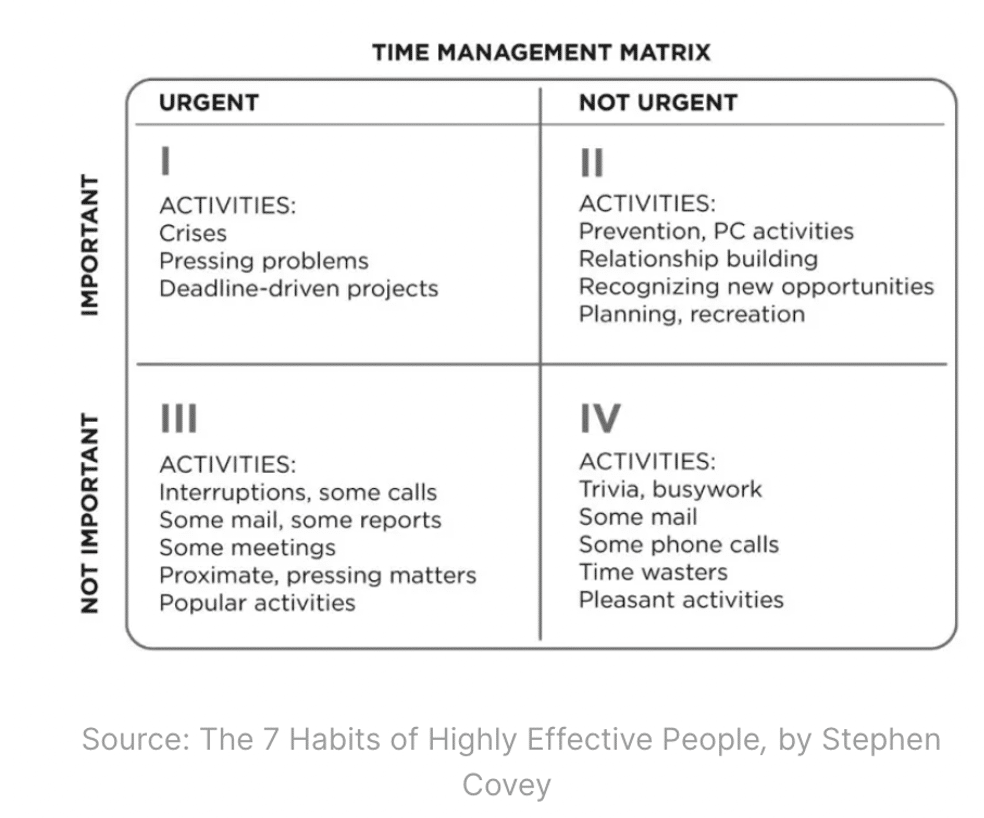
Important not Urgent
Covey suggests that the most important place to be is in the Important and not Urgent quadrant, quadrant 2.
The thinking is that if you are being proactive and dealing mostly with important work, then it will stop a lot of it from becoming urgent.
This quadrant is where all improvement comes from, the other areas keep us busy, but they don’t necessarily make us improve how we are doing things. This means that all long-term success happens here, with all short-term success usually happening in the urgent categories.
Urgent and important
We all have to accept that sometimes the things in quadrant 1, the urgent and important things will happen. This is your crisis, the emergencies, the things that need urgent attention.
These things will always happen, but they shouldn’t be happening all the time otherwise you have a wider problem, in that, too many things are left to become urgent and important instead of being dealt with proactively.
Urgent not important
This is the thief of time from quadrant 4. Just because something is urgent, doesn’t necessarily mean it’s important. The majority of things that people feel are urgent probably aren’t that important.
It’s usually someone else’s issues or agenda that is forced upon you and their timescales that make it feel as though what you need to do is urgent, when in fact you probably have more important priorities to deal with first. We tend to do what and who shouts the loudest.
So, people can spend a lot of time in this quadrant working and thinking they are dealing with important issues when in fact they are perhaps dealing with someone else’s important issues.
The only way to get out of this quadrant is to set boundaries and start saying no. And I don’t mean saying no in a combative way but making it clear to others like your advisers or your team that unless something is both urgent and important in the wider scheme of things, it won’t be getting your attention immediately.
Not Important not Urgent
This is where trivial activities are, it’s things like cleaning your desk or watering the plants around the office, gossiping at the water cooler in classic cliché fashion. Those types of things. If you’re doing a lot of these activities, then you are probably going to end up without a job at the end of it quite honestly.
How to use the time management matrix
It’s fairly simple to implement the matrix, the harder part can be deciding on what is urgent and important. Categorising tasks will become simpler over time, the more the system is used and the more familiar you become with the real-life application.
1. Make a list of all your tasks.
2. Decide on a due date for each task.
3. Determine the urgency and importance of each task.
4. Assign each of your tasks to the relevant quadrant.
5. Plan your day and/or week making sure to prioritise quadrant 2.
Why use a form of time management matrix
Increased productivity
Having everything laid out in terms of priority allows you to get on with things straight away as soon as you start your day, avoiding that decision paralysis.
Good habits
Habits take time to bed in, and using a time management system consistently can ensure that good habits prevail.
Better balance
Highlighting your most important tasks can make sure that your time isn’t filled with insignificant tasks or time-wasting activities. That can mean that your work and life balance can improve when put into perspective.
Better planning capabilities
It’s undeniable that if you’re proactive something you will improve your ability. The same applies to time management. If you implement a system and practice, it consistently then it’s highly likely that you will get better at categorising and prioritising over time.
On track strategies
It can be hard to consistently implement a workload strategy when things get busy, so here are some tips to help keep things on track.
Plan your week.
Set out 30 mins each week to plan the upcoming week (whatever day works for you, but I like to do it on a Sunday night).
Plan your day.
Prioritise each day the night before.
Reprioritise
Halfway through the day, reassess things so you can take account for anything that comes in that is deemed ‘urgent’. Until your reprioritisation time, do not deal with anything new, but keep a note of it for when you reassess things.
So, if something comes in at 4 pm, it waits until you prioritise at the end of the day for the next day. And if it comes in at 10 am then it waits until lunchtime to be added to your priorities.
It’s good to remember that there are very few things that require immediate attention!!!
Say no.
Let the people you work with know when you will be reviewing your tasks for the day, so they can be aware that nothing new will be considered outside these times unless it really is an emergency.
If you feel pressurised, then be realistic with your team. Let them know that if needs be you can do that urgent thing today or now but lay out what tasks will then have to wait.
You are not an infinite resource, you only have so many hours in a day.
Schedule focus time
This is time set aside where you let everyone know you are in ‘focus’ and that means you won’t be reacting to anything; you’ll be switching your phone and emails off and will be focusing on one thing for a set amount of time.
It’s not usually for a whole day, but for a chunk of time that you estimate, it will take you to complete a task.
During that time, you are not to be interrupted unless there really is an emergency. And as I’ve mentioned before, depending on what your job role specifically is, these are usually very rare.
All of the above techniques are proven to work and will be beneficial to managing your workload. However, they do take discipline to implement and to be successfully enforced long term.
Whilst there may be some adjustment for both you and your team, the long-term benefits will far outweigh the short-term struggles. Before you know it, this could be the new ‘normal’ for your way of working and could inspire others to adopt some of the same strategies and get everyone working more efficiently and with hopefully less stress.
If this particular strategy doesn’t work for you, then find one that does. The important thing is to have a system to manage your workload that you can consistently implement and that works for you.