






















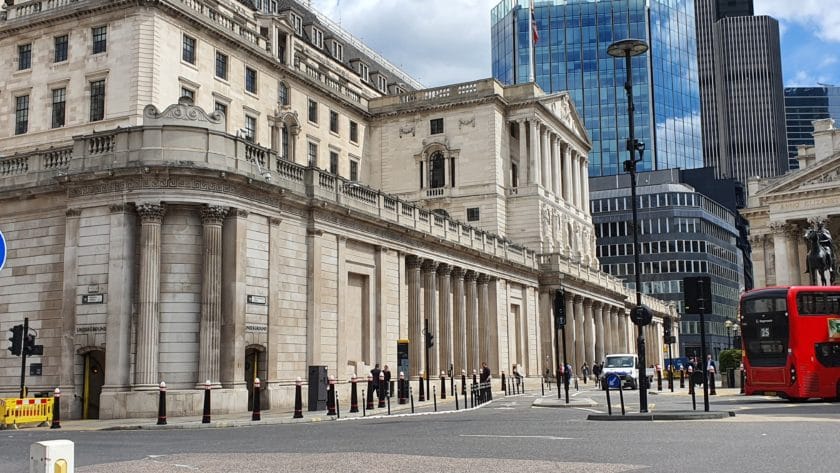
The Bank of England has cut interest rates for the first time since March 2020, as the fall in inflation continues to feed through to the economy, in a finely balanced decision.
After holding rates steady at their highest level since the 2008 financial crisis, the bank’s monetary policy committee voted to cut the rate by 0.25 points to 5% by a narrow majority of five votes to four.
Four members preferred to maintain the rate at 5.25%.
The decision to cut the rate follows inflation reaching the Bank’s 2% target in May and June. CPI inflation is expected to increase to around 2 ¾% in the second half of this year, as declines in energy prices last year fall out of the annual comparison. The committee said it expects the fall in headline inflation to continue to feed through to weaker pay and price-setting dynamics. However, it warned that the risk of inflationary pressures from second-round effects will prove more enduring in the medium term.
Lindsay James, investment strategist at Quilter Investors, said: “The Bank of England has finally spotted its opportunity to cut interest rates and has enacted its first reduction since the onset of the pandemic. This will bring a huge collective sigh of relief to consumers and businesses up and down the country after interest rates reached the highest level in 16 years.
“With the market having been on the fence ahead of the announcement, the decision by the MPC was indeed a very close thing with a 5-4 majority decision. The Bank of England is making it clear to everyone this will not be a speedy journey on the way back down as it does not want to cut too quickly or by too much and risk a fresh inflationary spiral.
“Despite the headwinds that the UK economy has faced, there is an air of optimism that has for some months been desperately lacking, even if further cuts may not necessarily be as speedily forthcoming as some might like.”
Luke Bartholomew, deputy chief economist at abrdn, said: “The Bank’s signalling talks of the risk of cutting too quickly but its own forecasts imply that inflation will come in well below target in a couple of years if interest rates follow the path currently priced into markets. This might be a signal that the majority of policymakers are expecting to cut more than the market currently forecasts.
“We tend to agree with that assessment and expect rates to fall further over the next six months. But ultimately it is the data that will determine how interest rates evolve from here with the Bank hoping its conviction that underlying inflation pressures are fading will be vindicated.”
However, Laith Khalaf, head of investment analysis at AJ Bell, adopted a more cautious approach: “The bad news for Rachel Reeves is the Bank reckons economic growth will remain limp, with GDP growing by just 0.8% over the next year.
“As for where interest rates go from here, there are mixed messages in the Bank’s latest statement. The fact four out of nine members wanted to keep rates on hold shows there is still a considerable amount of hawkishness in the interest rate committee. But according to the Bank’s figures, if it cuts rates in line with market expectations, inflation is forecast to be 1.5% in three years’ time. So that opens up the possibility of more drastic rate cuts than currently pencilled in by the market.”
He added: “Even if more rate cuts are forthcoming, no-one should be under any illusion that rates are going back to near zero. And, as ever when it comes to interest rates, it’s best not to count your chickens until they’re hatched.”