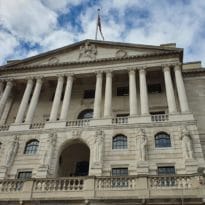























The Bank of England has kept interest rates at a historic low of 0.1%, despite growing speculation of a rate hike.
Policymakers within the Monetary Policy Committee voted 7 – 2 in favour of keeping interest rates unchanged, despite the Bank raising its inflation forecast to 4.5% by the end of the year and 5% in early 2022.
The BoE is expected to keep inflation at around or below 2%.
However, the BoE has signaled it will raise interest rates in the coming months in response to high inflation but is waiting for a clearer picture to emerge about the end of the furlough scheme and unemployment levels.
Ivan Petrella, professor of economic policy and forecasting at Warwick Business School, welcomed the BoE’s decision: “The Bank of England has made the right choice in resisting calls to raise interest rates this time. Inflation has been rising over the recent months and it is clearly heading up but looking beyond the aggregate numbers shows that most of the recent rise in price reflect global supply shortages and bottlenecks.
“This is a classic “cost-push” inflation which will compress spending, in particular for the lower income earner that are more exposed to fuel and energy price increases. As price pressures are temporary and with the economic data already showing a slowdown in aggregate activity, not raising the interest rate at this time is clearly a wise move by the Bank of England.”
David Page, head of macro research at AXA Investment Managers, also agreed the MPC made the right decision to hold off raising interest rates until they had received further clarity around employment figures.
Page explained: “The Bank of England has been observing for months significant uncertainty surrounding the labour market and to tighten policy before the first labour market report covering the post-furlough period, particularly given the significant 1.14m people that remained on the furlough scheme as it ended, would, to our minds, have been a mistake.”
The BoE also lowered its growth forecast in the face of ongoing global supply constraints, rising energy prices and the rate hikes implied by markets. It now forecasts GDP growth of 1.5% and 1% for Q3 and Q4 GDP to deliver annual growth of 7% for 2021, but lowered its 2022 growth projection to 5% and kept its 2023 forecast unchanged at 1.5%.
Page said: “The BoE’s statement that rates would likely need to rise over the coming months suggests a choice between December and Febuary’s meeting. Both provide an opportunity to gauge the evolution of the labour market post-furlough with two labour market reports between now and December. On balance, although waiting until February would provide more time to judge the labour market and a fresh set of medium-term forecasts, we think that the MPC will tighten policy next month – having more than prepared markets for such a move.
“We forecast Bank Rate rising by 0.15% in December to 0.25%, by 0.25% in May to 0.50% and to 0.75% in November 2022. We then expect the BoE to pause, before tightening again later in 2023 November to 1% and expect it to spell out how it will actively unwind its balance sheet, starting in 2024. That said, we acknowledge significant uncertainty over the outlook for energy prices, the labour market and Brexit-related issues.”
Anna Stupnytska, global economist, Fidelity International, also forecasts a December hike.
Stupnytska said: “Contrary to market expectation, the Bank of England did not budge leaving rates unchanged. With supply side shocks and strong post-pandemic demand having pushed inflation above target for a few months in a row, the BOE was expected to become one of the first developed market central banks to hike rates, following the Norges Bank and the RBNZ earlier this autumn.
“The decision might raise concerns about the BOE credibility as an inflation targetter, especially following recent hawkish comments from MPC members including Governor Bailey. But as the inflation narrative should continue dominating markets in the near term, a December hike now seems highly likely. Ultimately, we believe the hiking trajectory will be shallow, with growth challenges and the high debt burden acting as key constraints.”
With experts widely expecting an increase imminently, deVere Group chief executive Nigel Green said investors should review their portfolios to ensure they successfully navigate the changing landscape.
“Crucially, the BoE did leave the door open to the likelihood of raising rates ‘over coming months.’ We believe this is the central bank’s way of prepping investors and households that inflation has become a concern and that growth has become slower due to supply side bottlenecks – and, therefore, to expect an interest rate hike as early as December.
“Should this happen, stock and bond markets could correct sharply. Investors would be well-advised to stay in the market, but they should review their portfolios to ensure that they are properly diversified across asset class, sectors, regions and currencies.
“This will ensure they are best positioned to mitigate the downsides and seize opportunities arising from the likely volatility.”
Green said that while the current scenario might normally drive investors to increase their exposure to fixed-income, it’s “almost universally agreed” that stocks will continue to outperform bonds.