






















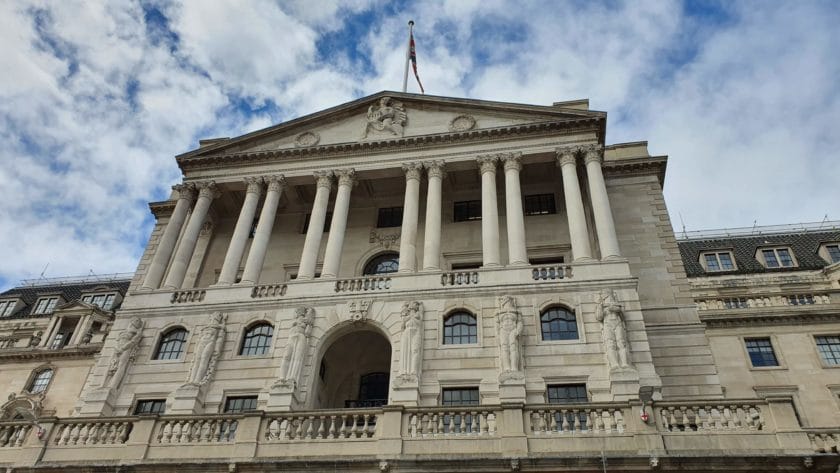
The Bank of England has raised interest rates for a fifth time in a row to tackle soaring inflation, while also balancing against an unsteady UK economy.
In a move that was widely expected by analysts, the Monetary Policy Committee announced a 0.25% increase from 1% to 1.25% on Thursday, taking interest rates to their highest level in 13 years.
The MPC said three members of the nine-strong group had been even more bullish, preferring to increase the bank rate by 0.5% to 1.5%.
It comes as inflation continued to rise steeply to reach a 30% year high of 9% in April, as the surging cost of gas and electricity pushed household energy bills to record levels.
The UK’s rate hike follows the US Federal Reserve’s announcement of a 0.75% rate rise on Wednesday – the largest single rise since 1994.
Hinesh Patel, portfolio manager at Quilter Investors, said: “The Bank had no option but to hike rates in an effort to contain inflation. However, with the outlook of the economy looking increasingly unsteady, the Bank will have been unwilling to hike rates too quickly and thus opted for the safer 0.25% increase. Given the global risks such as the ongoing Russia-Ukraine war alongside decreasing consumer confidence, growth is expected to continue slowing.
“All together it seems the Bank will be tightening into a very weak economic backdrop in the quarters ahead, however there is no choice but to go hard and fast before inflation expectations become structurally unanchored. Given the delicate market environment we could see inflation continue to rise above the Bank’s forecasts – particularly as the goalposts have so often been moved already. Investors will need to continue to watch the data and markets closely and allocate accordingly. Diversification, active management and prudency remain key.”
Martin Lawrence, director of investments at Wesleyan, said: “Faced with runaway inflation, the Bank of England was under immense pressure to act urgently, so the announcement is no real surprise. We expect further interest rate rises tipping towards three percent in the months ahead; however, the MPC’s hands are partially tied in that they can’t raise rates too high or too quickly, or else risk smothering the UK economy.
“Higher interest rates can be good news for those with cash savings, but only when providers pass on the base rate to their customers. For those who are fortunate enough to have money in savings, they should be considering all options to maximise their financial returns, such as investing in Stocks & Shares ISAs and other products that look past short-term volatility with the aim of long-term gains.”
Comparing assets and markets
Investment experts said investors should monitor how different markets and assets are faring in this environment of high inflation and rethink their strategies accordingly.
Jatin Ondhia, CEO of Shojin, said: “Today’s decision is no surprise; the Bank of England’s dovish stance is expected as its battle with runaway inflation is only just beginning. In reality, the question right now is how much higher will interest rates go?
“Diversification and agility could prove key in navigating this testing climate, and it should be expected that most resilient markets, such as real estate, will continue to attract investor demand, particularly among those seeking relatively safe options that stand a chance of keeping pace with inflation.”
Good news for pension deficits
But while the Bank of England provided a downbeat assessment of the UK’s economic prospects, pointing to weaker-than-expected GDP, the interest rate hike may spell good news for pension scheme sponsors.
Liabilities of UK pension schemes have already reduced by £630 billion as a result of gilt yields tracking rising interest rates.
Charlotte Jones, actuary at XPS Pensions Group, commented: “Some pension schemes will have seen a marked improvement in their funding positions over 2022. According to XPS’s DB:UK Funding Watch, UK pension scheme deficits have reduced by nearly £250bn. Schemes in a good position should start to focus on longer term security for their members, whether that be securing a scheme’s liabilities with an insurer or reviewing their investment strategy.”
However, Andrew Megson, executive chairman of My Pension Expert, urged pension savers not to be spooked by the ongoing uncertainty around the UK economy.
He said: “Under ‘normal’ circumstances, raised interest rates would be welcomed by pension planners. But these conditions are far from normal. Unprecedented economic uncertainty, fuelled by soaring inflation, is threatening the retirement prospects of 50% of Britons. This boost in interest rates, therefore, is unlikely to offer any meaningful comfort.
“Remaining calm in the face of volatility is absolutely crucial – panic could result in people making snap decisions and cause permanent damage to their future finances. Reviewing one’s retirement strategy as early as possible would certainly be advisable. So too, would exploring all avenues with the help of an independent financial adviser. Indeed, options such as flexible-access drawdowns and riskier investments offering better returns could help Britons to best protect their hard-saved cash and hold its value against inflation – the key will be to utilise the expertise of an adviser to ensure Britons are choosing the option that best suits their needs.
“Unfortunately, things are expected to worsen before they get better. But action can be taken to limit the potential damage inflicted on Britons’ future finances.”