






















In this article, BlackRock’s Christopher Ellis Thomas – Head of Multi Manager and UK Wealth solutions, and Hugo Thompson – Lead UK Investment Strategist for UK Models within the MASS team talk about government borrowing and how markets are becoming less forgiving of fiscal expansion.

After years of government borrowing, markets are becoming less forgiving of fiscal expansion, particularly where heavy issuance coincides with persistent deficits, inflation uncertainty and increasing competition for capital.
If this trend continues, it could pose challenges for governments, bond markets, and investors.
Debt burdens once considered high have become commonplace across developed economies. Following the Global Financial Crisis, advanced-economy government debt rose rapidly to breach 100% of GDP in 2011.
Such high debt levels have since remained and hasn’t looked back since. Markets, all the while meanwhile, have shown relatively little concern.
Advanced economy government debt has been rising
Debt-to-GDP ratio for advanced economies (%)
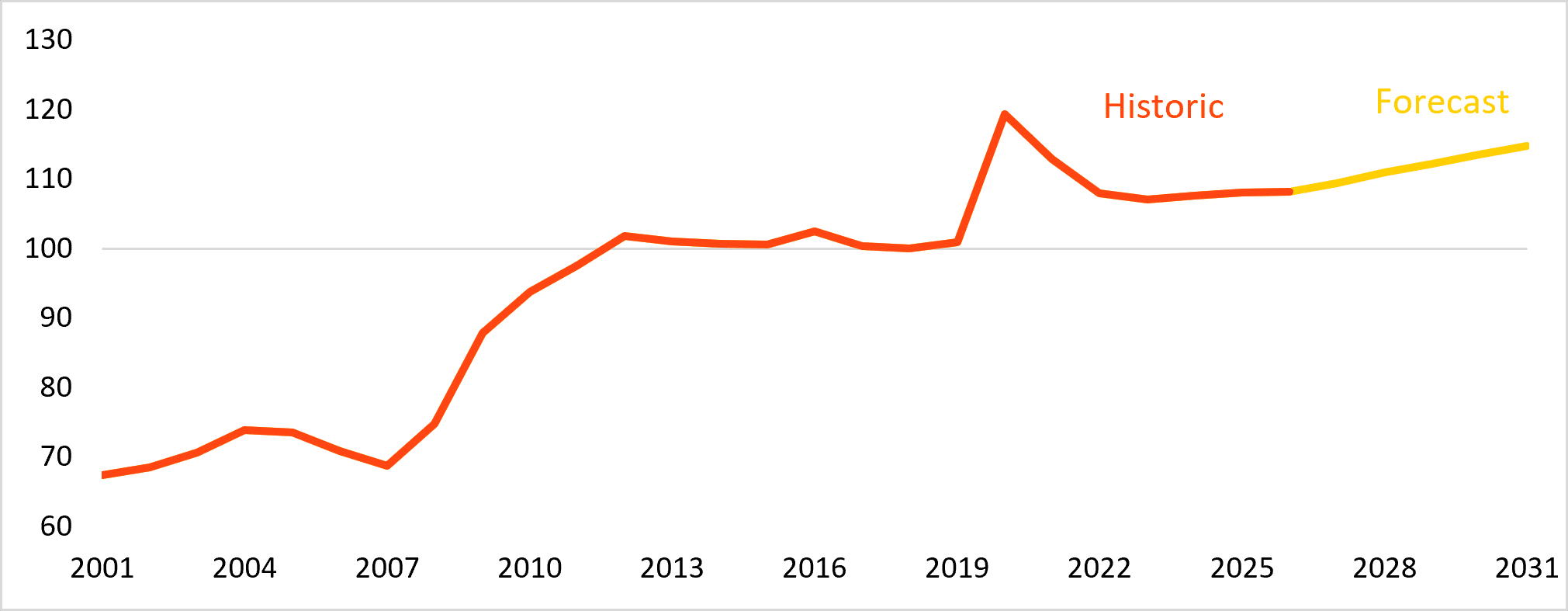
Source: IMF, 30/09/2026
High government borrowing isn’t inherently problematic. If it finances productive investment that raises an economy’s future growth potential, the borrowing can fund itself. That is why the market increasingly focuses on what governments spend money on, rather than how much they borrow.
Today, markets are asking whether government borrowing is too focused on funding current spending (rather than growth-enhancing capital investment). High spending governments from Japan to France have been penalised recently.
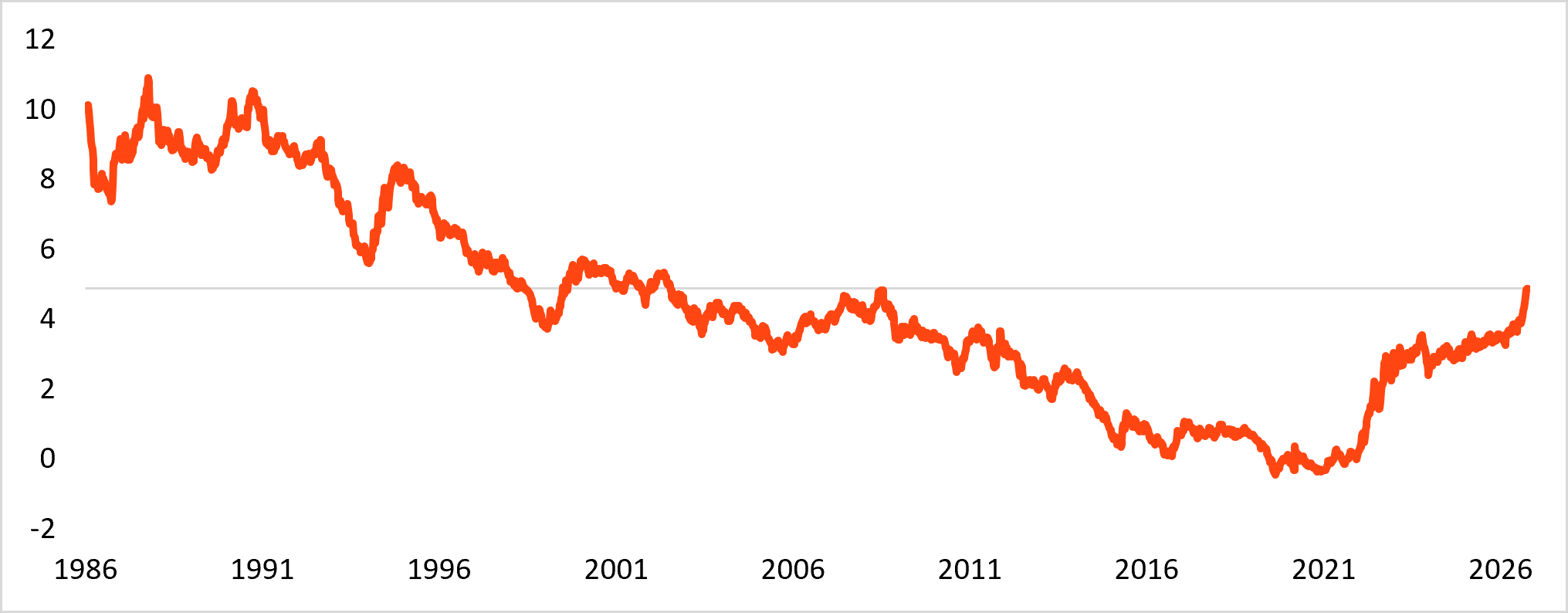
What’s more, these are arguably mere warning shots: France’s borrowing costs have only just reached pre-financial crisis levels and remain well below what they were in the 1980s.
French borrowing costs are in-line with those seen in 2008
French 10-Year Government Bond Yield (%)
The situation could deteriorate further if bondholders start questioning whether they will be paid back. For large, well-established economies like the US, the UK or Japan, which predominantly borrow in their own currencies, outright public debt default is extremely unlikely.
More commonly, governments seek to bring debt down levels by allowing inflation to run above target: eating away at their financial obligations and bondholders’ returns alike. This kind of financial repression has a well-established precedent.
According to the IMF, real interest rates in advanced economies were negative for over half of the period between 1945 and 1980.[1]
While long-dated yields have risen materially, markets have yet to start meaningfully pricing protracted inflationary risks. That could leave portfolios exposed, should persistent fiscal pressure ultimately cause investors to demand greater inflation compensation.
We are therefore talking to our clients about how to shield their portfolios from both rising bond yields and debt debasement.
A good start could be incorporating inflation-linked bonds, which may provide direct protection against persistently high inflation eroding the real value of bond returns.
Adjusting the regional mix within government bond holdings can be another powerful tool. For example, tilting exposure away from countries like Japan and the US, and increasing exposure to markets where the yield adequately compensates for fiscal, inflation and duration risk.
Another approach is to focus on shorter-dated bonds, the price of which tends to be determined by the immediate term economic environment, while remaining reasonably insulated from structural shifts in an individual country’s fiscal position.
Finally, emerging market government bonds can provide diversification because these economies’ fiscal starting points, monetary regimes and debt dynamics differ markedly from those in developed markets.
Furthermore, growing local-currency markets helps to reduce reliance on dollar funding, although currency and country-specific risks remain important considerations. Countries such as China and India are issuing increasing proportions of their debt in their domestic currency, rather than dollars, further buttressing their credibility as debtors.
Rising government debt may well cause markets to demand structurally higher government bond yields. Injecting additional volatility into long-dated government bonds and potentially undermining their role as defensive anchors in portfolios.
Abandoning bonds is unlikely to be the answer, but investors can instead become more selective about duration, inflation protection, geography and valuation.
Past performance is not a reliable guide to future returns. You may not get back the amount originally invested, and tax rules can change over time. The writer’s views are their own at the date of publishing and do not constitute financial advice.
This information should not be relied upon by retail clients or investment professionals. Reference to any particular investment does not constitute a recommendation to buy or sell the investment.
[1] IMF Working Paper, The Liquidation of Government Debt, Carmen, Reinhard and Sbrancia, January 2015
Main image: office, building, blue, dmitry-vechorko-q6Kc9TrKD7M-unsplash