






















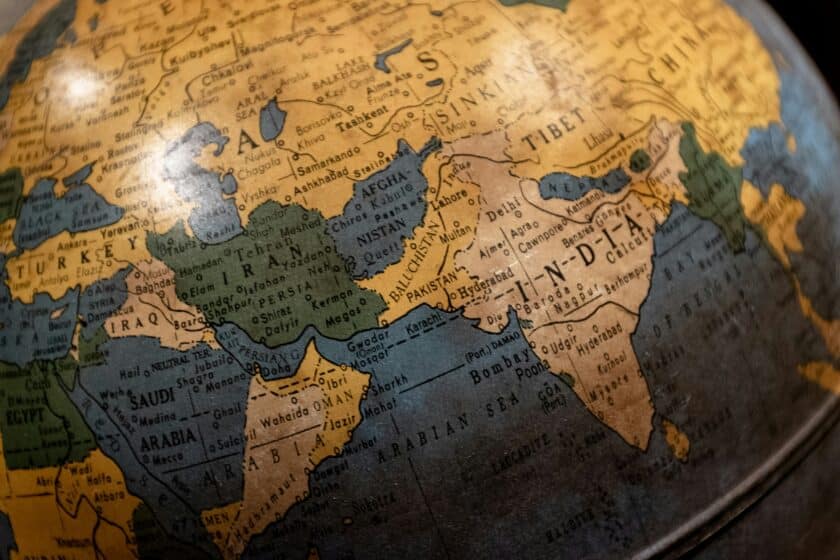
Conflict in the Middle East has thrust geopolitical risk to the forefront of investors’ minds.
On Saturday, the United States and Israel launched a vast and ongoing attack against Iran’s leadership and military. Iran responded by launching retaliatory strikes on Israel, US assets and its allies across the region.
The FTSE 100 fell on Monday morning as markets reacted to the events of the weekend, tumbling 94 points, following falls in Asia markets overnight.
With President Trump stating that the war may last four weeks, what does this mean for markets and investors?
Oil prices surge
Oil prices have surged as a result of the ongoing attacks. Brent crude, the global benchmark for oil prices, jumped by 10% to reach more than $82 a barrel on Monday – its highest level since July 2024 – before easing back slightly.
Iran has warned vessels not to pass through the Strait of Hormuz, through which around 20% of the world’s oil and gas is shipped.
George Lagarias, chief economist at Forvis Mazars, expects the conflict to have a sharp but short-lived impact on prices.
“Presently, we expect energy market turbulence to be sharp but short-lived. Oil prices are now up 30% since last December and year-on-year positive for the first time since December 2024. This has less to do with Iran’s productive capacity and more to do with the effective closing of the Straits of Hormuz.
“Our base case is that the region and energy markets have prepared for the present eventuality, and it is a matter of time before contingency plans become operational that would allow oil to flow beyond Iranian chokepoints,” he said.
However, Lagarias warned any unwelcome surprises could have an impact on US inflation.
“Prolonged energy market volatility could have a very quick effect on US inflation, whose consistently lower-than-expected numbers have, thus far, mitigated some of the more acute consequences of the trade wars. Similarly, higher energy prices could hurt already sluggish GDP growth in Europe and the UK.”
Emma Wall, chief investment strategist at Hargreaves Lansdown, shared a similar sentiment.
“While oil prices may be higher now, consensus is that this disruption is transitory and so too will the impact be on wider asset classes. In the event of an effective transition of power, and an end to the fighting, oil prices are expected to return to $65 a barrel within weeks, and therefore the likelihood of a global growth shock is minimal. However, if in-fighting erupts and conflict drags on, expect equity markets to respond badly,” she said.
Impact on inflation
The conflict brings with it the risk of an inflation spike as higher oil prices feed through to higher energy costs. The latest consumer prices index measure of inflation showed it had dropped to 3% in January, but remains above the Bank of England’s 2% target.
Lindsay James, investment strategist at Quilter, said: “Markets tend to focus on oil prices, which is pertinent in the case of Iran given the importance of the Straits of Hormuz to energy markets. However, volatile European gas prices have already risen over 20% at a time when Europe is trying to wean itself off Russian energy and stockpiles are low.
“With UK retail customers protected in the short term due to the April energy price cap having already been set, businesses do not enjoy this lagged effect and may face sharply higher energy prices very quickly, potentially challenging the inflation outlook and the expectation for a couple of further rate cuts this year by the Bank of England.”
Gold as a safe haven
Gold has risen by 1.9%, reaching above $5,400 in earlier trading. While this is still below the all time high of $5,589, it comes off the back of a near 20% rally year to date.
Wall said: “While at these elevated prices investors should be wary of piling in, we do think the perceived safe haven appeal of gold in times of uncertainty remains and gold has an important role to play in portfolios this year.”
Chris Beauchamp, chief market analyst at IG, expects events to send gold to new highs.
“War in the Middle East and the disruption to shipping in the vital Hormuz waterway means that the momentum trade that dominated markets at the end of 2025 is back with a vengeance. A move to new highs had been likely given the recovery over the last few weeks, but the timetable has now been sped up significantly.”
However, James warned that gold may not hold the same appeal as previously.
“Asset owners are sitting on significant gains and will be wary of adding to holdings at this level, and when many investors already have some exposure. When Russia invaded Ukraine in February 2022, it was at $1908 per ounce, less than half of today’s level. Whilst it is likely to offer some protection, it’s unlikely to be the shelter it once was.”
What should investors do?
Industry commentators said investors should keep calm amid the growing uncertainty.
According to Wall: “The most sensible thing for most investors to do is nothing. Heightened market volatility was a feature of 2025, and our house view was that unpredictable markets were likely to continue this year.
“The events of the weekend are deeply troubling from a humanitarian point of view, and present global leaders with difficult choices to make. But they are sadly not isolated incidents; global markets continue to trade through wars, pandemics and natural disasters.”
Wall said investors should be mindful of valuations and volatility and the temptation to try and time trades.
“Those looking for investment ideas as we approach tax year end should remember that a well-diversified and tactical investment approach is increasingly important. We think that fixed income funds and emerging markets offer opportunities as does the much-beleaguered quality-style of investing, which has been overlooked and undervalued.
“Quality stocks, listed globally, but with stable and predictable cashflows and little to no debt, have characteristics which should do well regardless of economic backdrop – needed in a time of uncertainty. As well as a diversified portfolio, investors should also arm themselves with a long-term view, and keep focus on their goals, rather than daily market movements,” she added.
James also urged investors not to react in response to unfolding events: “Ultimately, calm should prevail in markets before too long, even if a period of volatility may now be in store. For investors, this is the time to hold your nerve.
“Events such as this can be unsettling, but remembering the reasons why you invested in the first place, and staying the course over the long term will continue to be the best strategy, even if we get a period of volatility while events in the Middle East play out.”
Past performance is not a reliable guide to future returns. You may not get back the amount originally invested, and tax rules can change over time. The writer’s views are their own and do not constitute financial advice.
This information should not be relied upon by retail clients or investment professionals. Reference to any particular investment does not constitute a recommendation to buy or sell the investment.
Main image: joshua-olsen-zR3wTk9End8-unsplash