




















What happens in Chinese factories and boardrooms matters for global investors says Adam Hamilton – economist at Sarasin & Partners.
China accounts for around 20% of global GDP in purchasing power parity terms, and 27% of global manufacturing. It is automating fast, having installed 59% of the world’s new industrial robots in 2025. China shapes the prices we pay, the supply chains firms rely on, and the speed at which new technology spreads.
This year, we made two trips to China, meeting 30 companies in robotics, autos, batteries, semiconductors, and software across seven cities.
The bigger opportunity is AI that makes standard robots more flexible. Price competition at home is structural and is pushing firms abroad, and politics increasingly decides where Chinese technology can be sold.
Robots do not need to look like us
‘Physical AI’ has become one of the technology industry’s favourite phrases. Behind the buzzword is a simple idea. A physical AI system combines three things: sensors that read the world around it; an AI model that decides what to do; and a machine that carries out the action.
Humanoids get most of the attention. But companies on both trips made the same point: a familiar shape is not the same as a useful one. Factories reward precision, accuracy, and low variability, qualities that are not traditionally associated with the human form. Humanoids are also far harder to build.
The bigger opportunity lies elsewhere. Much factory work is still done by hand even though it happens at a fixed station and is repetitive.
Robot arms lacked the dexterity to handle awkward or varied parts, and needed costly reprogramming whenever a task changed. Now physical AI is tackling both problems, as cameras and AI models let an arm adjust its grip and switch tasks without an engineer rewriting its code.
Of roughly 500 million manufacturing workers worldwide, an estimated quarter do fixed, repetitive work that AI-enabled robot arms can take on now.
A further third or so do skilled manual work at a fixed station, such as sewing, welding or woodworking, which better robotic hands could reach over time. Mobile work, where humanoids fit best, accounts for just over a tenth. In factories, the larger slice of the pie looks like smarter robots at fixed stations.
Built for scale rather than returns
Western companies are judged on returns. Many Chinese ones put market share, jobs and resilience ahead of profit, and policy and local government incentives encourage this.
The result is that competition does not end when it should. In autos, subsidies have gone and margins are shrinking, yet weak carmakers are kept alive by local backing. Hardware is copied and cheapened quickly. Margin pressure is a lasting structural feature.
With consumer spending weak outside the big cities, companies go abroad. BYD is the clearest case: it reportedly told analysts it made about RMB 20,000, roughly £2,200, per car sold overseas in the first half of 2026, against analyst estimates of under RMB 3,000 (£330) at home.
Politics determines business models
Politics now shapes how Chinese firms are built. Sunwoda, a battery maker, keeps its best technology at home and sends older versions abroad, in line with Beijing’s export controls. Alibaba deliberately avoids the American market.
Tariffs are only one barrier. Local-content rules, safety regulations, and licensing requirements push production closer to the customer, which is why BYD is building a factory in Brazil, and Sunwoda one in Hungary.
Data security and national security concerns are harder to get around. The US has banned Chinese driving software from connected cars from the 2027 model year, and a bipartisan bill introduced in March would bar federal agencies from buying Chinese robots.
Politics also sets the pace at home. Beijing is slowing the rollout of driverless taxis to protect the jobs of drivers. Worries about jobs decide how fast technology spreads as much as engineering does.
What this means for investors
In automation, the nearer-term opportunity lies in making existing robots smarter: the vision systems, sensors, software and precision components that let a standard arm take on more varied work.
These businesses sell into a large installed base and do not need humanoids to succeed. Among exporters, those relying on software and data in sensitive markets face real limits, while those selling plain hardware, or building close to their customers, should be better placed.
With price pressure set to persist, it is key to find companies whose competitive advantages cannot be priced away: strong brands, products deeply embedded in a customer’s operations, and manufacturing know-how built up over decades.
China also shows that how fast automation spreads is ultimately a social and political choice. Where governments are slow to set guardrails, we believe long-term owners have a role to play, pressing the companies building and deploying AI to put safety, transparency and human oversight at the core of the investment case.
Past performance is not a reliable guide to future returns. You may not get back the amount originally invested, and tax rules can change over time. The writer’s views are their own at the date of publishing and do not constitute financial advice.
This information should not be relied upon by retail clients or investment professionals. Reference to any particular investment does not constitute a recommendation to buy or sell the investment.
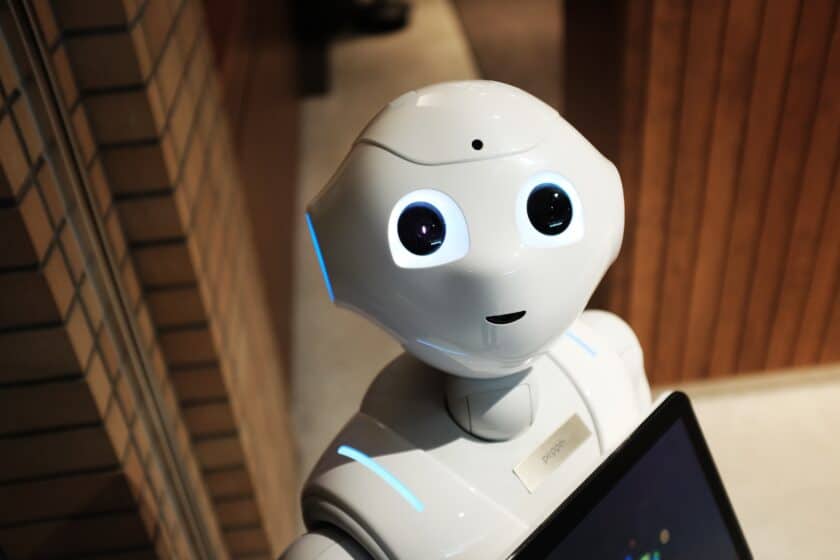
Main image: robot, AI, tech, alex-knight-2EJCSULRwC8-unsplash