























In this month’s article, Juliet Schooling Latter, research director at FundCalibre, looks at the T. Rowe Price Asian Opportunities and how the fund is positioning in respect of China as well as other markets in the region.

Perhaps the most important decision facing any Asian or emerging markets manager is their outlook on China and the wider influence this will have on the region in which they invest.
That has made the past three or so years particularly challenging. Emerging economies, especially Asian countries and commodity exporters, are the most vulnerable to the structural slowdown in Chinese growth, due to their high degree of trade and financial dependence on China.
We’ve seen a regulatory crackdown, a rigid Covid-zero policy and never-ending geopolitical concerns force the world’s second-largest economy into reverse. Chinese equities are down 40% since February 2021*, yet still account for a third of the MSCI Asia ex-Japan index – China is too big to ignore**.
But was the last week of September 2024 the change in direction of China’s policy mix many had hoped for? China’s Politburo held an unscheduled meeting on economic policies, signalling a shift in monetary and housing policy stances. The change opened the door to further rate cuts and stabilising the troubled property market. The market rallied hard, but there are still questions about whether this is an actual long-term pivot.
Most managers would agree China is more complicated than the majority of regimes and economies. A fund management decision has to be made based on your reading of the government’s intention – rather than what has actually been announced – which is not easy.
“It’s a clear message and a 180 degree U-turn from what we have previously seen. The key thing is we talk about the structural issues of China (declining population and the leverage of the household sector being a lot higher than it used to be); those structural factors will not turn around soon, but the main point is people with means to spend are holding back because they are unclear on the future. A big part of that is the fall in property of 20-30% and also a small percentage of the population investing in equities.”
That’s the view of T. Rowe Price Asian Opportunities manager Jihong Min, who believes that the statements from the government about not wanting property prices to fall further, coupled with the use of the People’s Bank of China to help companies’ buyback shares and also lend through Repo to get asset managers and insurance companies to buy equities, are incredibly significant.
Having seen the market initially rally some 30% before pulling back, Jihong says the move has prompted him to move from a 3% underweight to a neutral position in China, with the intention to buy further dips from this point. He has been adding to names like online property agency Beike, insurance business Ping An and mall management company Mixc – all of which have a property element to their business.
The fund itself is style agnostic as Jihong, alongside the huge research team at T. Rowe Price, target high-quality businesses that will reliably compound earnings and sustain strong cash flow over time. These tend to be established companies, with leading market positions and good management teams who prioritise shareholder returns. He looks for returns-focused capital allocation and prudent balance sheet management.
Once these high-quality compounders have been identified, valuation is assessed. The final portfolio typically has 40-70 holdings. Turnover has been around 45-55%.
Jihong will happily admit he has made both good and bad calls during his tenure. He admits he got the China story wrong post reopening, as he felt there would be a recovery. India has also seen a lag on performance, but this is more due to the fund’s focus on high-quality, low-beta plays. Jihong says these low-beta holdings have compounded 15-20%, which is “not bad unless the market is up even more”, with a strong domestic play into higher beta small and mid-cap holdings helping the Indian market to keep firing on all cylinders.
However, following a recent trip to India, Jihong says he came back worried about some companies starting to miss expectations. He says India is now 4-5% underweight – the largest in the portfolio – citing concerns that barring financials, the country is trading at two standard deviations above its historical average. Although he does not see a sharp slowdown, he feels it won’t take much for the market to correct.
Other moves have brought stronger returns. This includes a 10% allocation to Asean markets, which Jihong views as long-term positions driven by demographic and consumption trends. This has meant a focus on high-quality banks and consumer companies. A good example is BCA Indonesia – Jihong says it is a conservatively managed bank with very little cyclicality – adding that it is extremely profitable and offers a 4% return on equity (most banks in Asia would give you around 2%).
Technology is another sector the portfolio has taken advantage of, however, Jihong is less clear on the outlook from here. He says it is not so easy to make a call on the sustainability of AI demand, but says non-AI focused tech stocks look “soft” with no obvious sign of pick up. TSMC is one stock he has confidence in because of its monopoly in the AI chip-making world.
It has been a challenging time for managers in this region, given the important calls which have needed to be made on both China and India. Being on the wrong side of that trade to any degree will hurt – but the focus on high-quality companies run by high-quality people, and holding them for the long term, has proven fruitful. Jihong also has the backing of a strong analyst team on the ground, which is very beneficial. We are confident that Jihong can deliver good performance in the future and the fund is one we are watching closely.
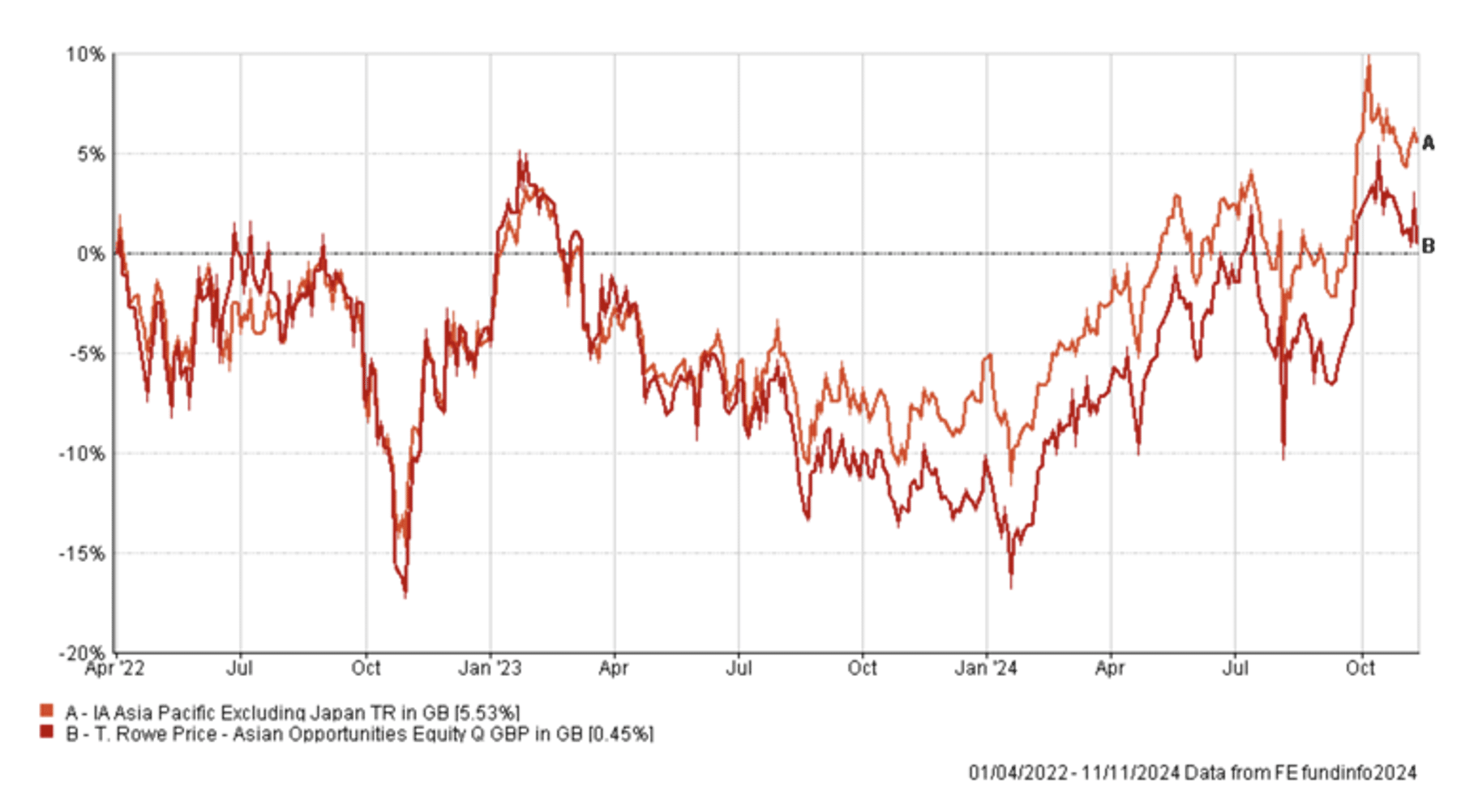
*Source: FE Analytics, figures in pounds sterling for MSCI China, 17 February 2021 to 11 November 2024
**Source: MSCI figures to October 2024
Past performance is not a reliable guide to future returns. You may not get back the amount originally invested, and tax rules can change over time. Juliet’s views are her own and do not constitute financial advice.
Main image: chuttersnap-aku7Zlj_x_o-unsplash