
























For this month’s three year track record analysis, Juliet Schooling Latter, research director at FundCalibre, looks at the Europe ex-UK sector and in particular, the CT European Select fund, a high conviction portfolio of 50 companies, with a bias towards large-caps.
While the technology giants have continued to dominate the headlines in the first four months of 2024, in the background Europe’s largest stocks are delivering for investors.
Year-to-date the STOXX Europe 50 Index has risen 8.5 per cent* (having risen 20 per cent in 2023**), outperforming the home of the AI darlings, the S&P 500 (7.8 per cent)*. The kicker for supporters of Europe is the breadth of performance, with names from various sectors producing earnings ahead of expectations.
A recent market update from Lazard cites the potential for incremental improvements in the macroeconomic picture, helped in part by lower energy costs feeding through to lower manufacturing input prices, and the near-term prospect of a start to the rate-cutting cycle. This, they suggest, means European equities could extend their gains***. Buybacks are also on the rise – indicating company management are seeing the appeal of their shares.
But your mind is always cast back to the challenges of the past 15 years – as one fund manager I spoke to a couple of years ago aptly put it – “there is always something wrong in Europe”. Earnings divergence could be a concern as Europe continues to adapt to the new regime of higher interest rates. In addition, while rate cuts will benefit equities – the uncertainty around when, is putting the economy in a reactive position. In short, I believe this is when active managers should really thrive.
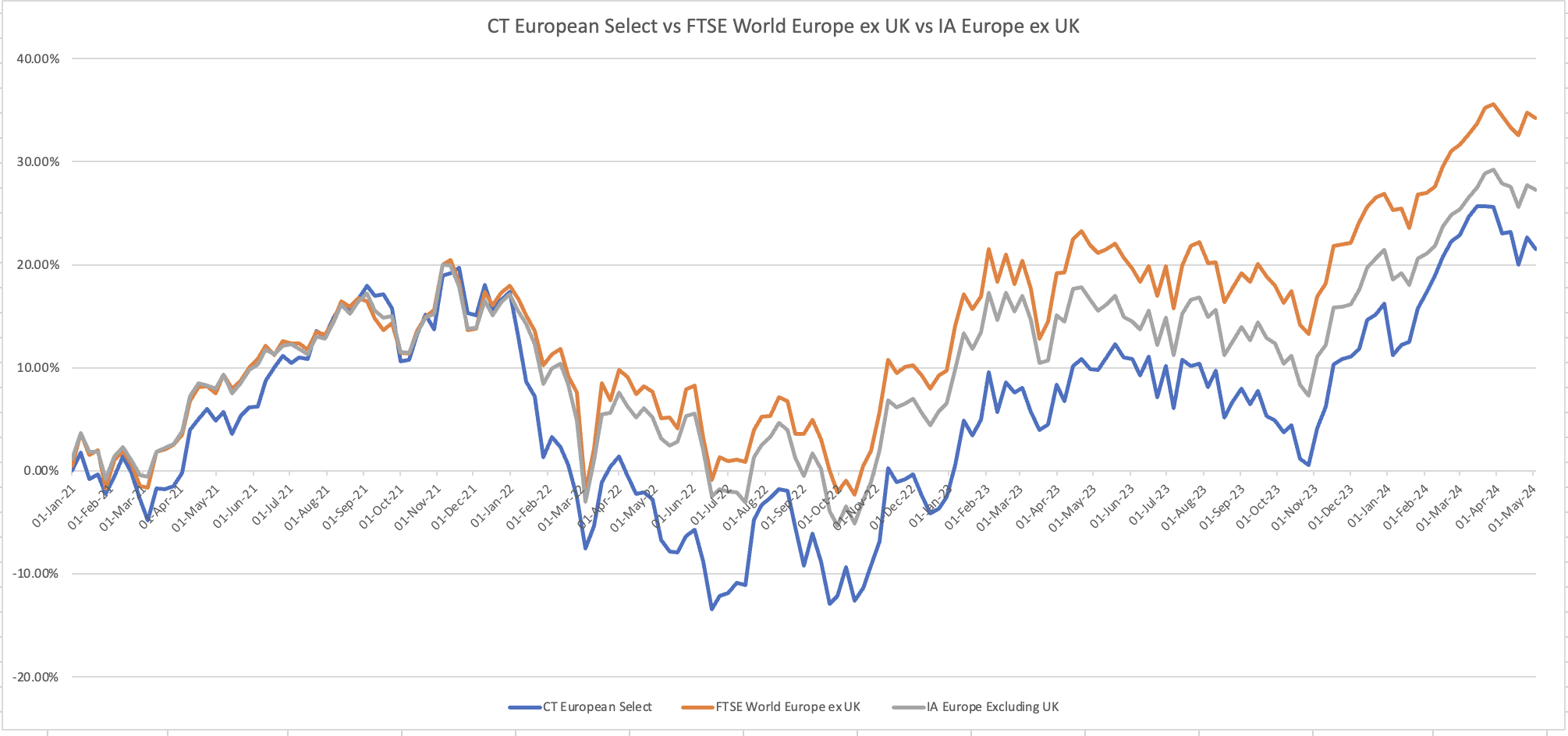
“We are investors not traders – our added value is spending lots of time and energy on analysing and buying good companies and letting those companies develop in the way we think they will do – in a stable and predictable manner. It’s not about saying this is cheap today so let’s grab a bit.” That’s the view of Ben Moore, manager of the CT European Select fund, a high conviction portfolio of 50 companies, with a bias towards large-caps. Ben became lead manager in January 2021, having been co-manager since April 2019. Since his involvement, the fund has returned 67.2 per cent, versus an average of 56.2 per cent for the IA Europe ex-UK sector****.
The investment philosophy is based on the premise that a company’s intrinsic value is determined by its growth, returns on capital, sustainable competitive advantage and pricing power. This approach aims to develop a thorough understanding of the industry in which a firm operates, the competitive landscape that the firm is facing and the actions it is taking to improve its positioning.
Companies likely to show the most promise will exhibit some or all of the following characteristics: there has been a material corporate event; the company is under-researched; consensus forecasts appear inaccurate; or the company fits the team’s current economic, thematic or credit views.
The desire for companies with the ability to defend margins, and industries with barriers to entry, means Ben tends to avoids sectors with regulatory uncertainty, such as banks or telecom companies, but will sometimes invest in stocks without pricing power – but only if the firm is the lowest-cost producer in the industry. By contrast, there is a bias towards higher quality companies in the likes of the consumer and tech space.
The strategy leans towards secular and defensive growth names. But it can suffer should the growth style fall out of favour. This was the case in 2022, when some of the areas Ben tends to avoid performed well.
“Our strategy means we are inversely correlated to rates as our focus is on stability through secular/defensive growth names. It means we can have tough years, like 2022, where you have to grit your teeth to some extent, but we’ve had many more good years than bad,” Ben says.
The past year or so has been kinder. Ben points to certain secular trends offsetting some of the cyclical influences in markets. For example, Novo Nordisk rolling out GLP-1 weight-loss drugs or software company SAP’s migration to the cloud driving above trend growth.
The fund has had recent success in the insurance space, courtesy of Munich RE and Hannover. Ben cites the rare combination of underwriting profits improving, in tandem with the money these companies are making from the float they generate from investing insurers’ premiums. Other strong performers include the likes of ASM International – which provides tools and technologies to support semiconductor manufacturers – as well as SAP and clothing company Inditex.
When you ask Ben for an outlook, he will bring you back to his focus on companies, but he does acknowledge the re-rating we’ve seen in his part of the market in 2024.
“The re-rating has been broad, but it is not at nosebleed levels. Some have been left behind, like most consumer names in general,” he says.
With typically 3-5 names joining or leaving the portfolio each year, Ben does see opportunities but admits he is fussy, despite wanting competition for capital. It tells you he is very happy with the current positioning of the fund.
It is hard to argue against this fund being a strong core consideration for investors wanting exposure to Europe – given the predictable returns and strong focus on managing volatility. Ben and his team pride themselves on every stock sitting in the portfolio on its own merit (the GRANOLAs don’t go into the portfolio simply because they’re GRANOLA, so only some are held selectively). We feel it is well positioned to keep delivering consistent returns for investors.
*Source: FE Analytics, total returns in sterling, from 29 December 2023 to 30 April 2024
**Source: FE Analytics, total returns in sterling, from 30 December 2022 to 29 December 2023
***Source: Lazard Asset Management, Outlook for European Equities Q2, 2024
****Source: FE Analytics, total returns in sterling, from 1 April 2019 to 7 May 2024
Past performance is not a reliable guide to future returns. You may not get back the amount originally invested, and tax rules can change over time. Juliet’s views are her own and do not constitute financial advice.
Main image: christian-lue-7dEyTJ7-8os-unsplash