























Considering ownership, flexibility, changing circumstances and potential vulnerabilities alongside cost can support informed decisions that continue to meet clients’ needs over time. Shelley Read, Senior Protection Technical Manager at Royal London, shows us a case for both joint and single life set-up.

When supporting clients who are considering life insurance or critical illness cover, one of the early decisions advisers help make is whether to put cover in place on a joint or single-life basis.
While cost is often the primary driver, and there is usually only a minimal difference, the choice can have implications far beyond the monthly premium.
The example below illustrates the difference in monthly costs between the two approaches.
Mark and Jayne, both aged 34, non-smokers, level term policy, sum assured £150,000 over 25 years (Royal London quote June 2026):
- Joint life first event policy: £13.80 + £2.60 plan fee = £16.40
- Two single life policies (individually owned): £7.07 + £7.07 + £2.60 plan fee = £16.74
- Understanding the advantages and disadvantages of each approach is essential to ensuring recommendations remain suitable not only today, but throughout a client’s lifetime.
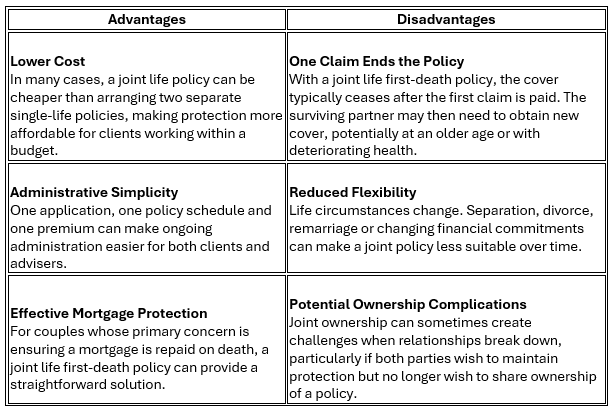
The case for joint life policies
Joint life policies have long been popular among couples, particularly those seeking protection for a mortgage or shared financial commitments.
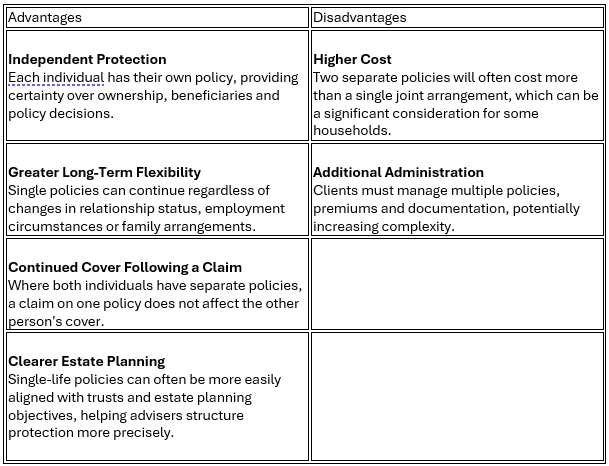
The case for single life policies
Single life policies cover one individual and are increasingly viewed as a more flexible solution, despite their potentially higher overall cost.
While cost and protection needs remain central, advice professionals should also consider broader factors. If one partner has a significantly different health profile, separate policies may offer greater flexibility in structuring cover and managing underwriting outcomes.
The FCA’s Consumer Duty places increased emphasis on delivering good client outcomes. It’s important to consider how policy structure and ownership may affect clients if circumstances change unexpectedly.
Some clients value individual ownership of financial products. Separate policies can offer greater autonomy and control, particularly where one partner manages most household finances.
While not the primary driver in most cases, economic abuse is a relevant consideration. In relationships where financial control or coercion is present, independently owned policies may provide greater protection and resilience.
Advisers do not need to investigate personal relationships, but awareness of potential vulnerabilities helps ensure recommendations remain appropriate and inclusive.
For clients seeking affordability and simplicity, particularly for mortgage protection, a joint life policy may be appropriate. For those prioritising flexibility, independence and long-term resilience, separate single-life policies may offer greater value despite a higher premium.
The adviser’s role is not simply to identify the cheapest solution, but to help clients understand the long-term implications of each option.
By considering ownership, flexibility, changing circumstances and potential vulnerabilities alongside cost, advice professionals can support informed decisions that continue to meet clients’ needs over time.
Main image: cost, calculator, money, sasun-bughdaryan-5AmcgCr8N1Y-unsplash