





















Example 2b – PETs and death within 7 years
8 years before she dies, Amy gifts £500,000 to Alicia
7 years later, Amy gifts £500,000 to Michael.
The following year, Amy dies
IHT Position
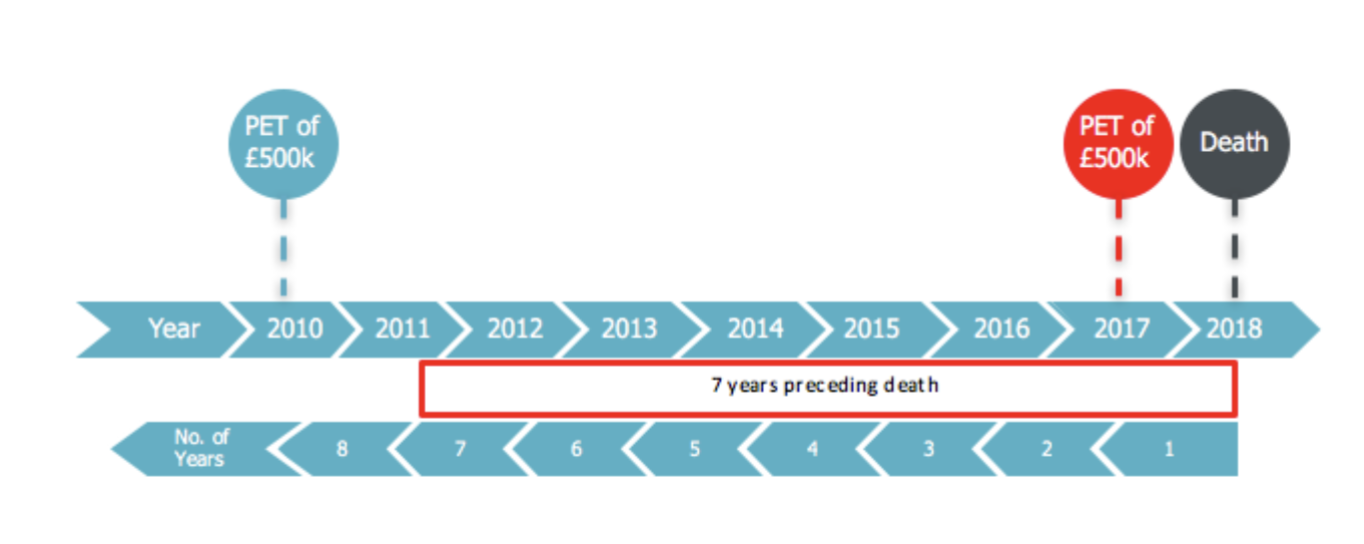
The timeline above shows that the first PET has dropped out as Amy has survived for 7 years after making it.
Only the second PET is within the 7 years preceding death, therefore only this PET will “fail” and become chargeable. This will use all of the £325,000 nil rate band leaving £175,000 of this PET chargeable to IHT at 40%.
Chargeable Lifetime Transfer (CLT)
Gifts such as transfers into discretionary trusts are Chargeable Lifetime Transfers (CLT).
A CLT is a gift made during an individual’s lifetime which is immediately chargeable to IHT. This does not necessarily mean that there will be IHT to pay but it does have to be assessed to see if a charge to IHT will arise. If the amount gifted is within the available nil rate band, then there will be no IHT due immediately.
CLTs are cumulative and CLTs made in the previous 7 years prior to the current CLT will reduce the amount of nil rate band available.
* If the sum of CLTs in the 7 year period is below the nil rate band, there will be no IHT due immediately.
* If the sum of CLTs in the 7 year period exceeds the nil rate band, then there will be a charge to IHT on the excess. The charge is at the lifetime rate of 20% (half of the death rate).
Either the trustees or the transferor can pay any IHT due. Where the tax is paid by the transferor, that is also a loss to the estate and is a transfer of value. A ‘net’ transfer therefore has to be grossed up to arrive at the chargeable transfer amount.
Consider a CLT of £8,000 when there is no available NRB and the transferor pays the tax. The value for IHT purposes will be £8,000 x 100/80 = £10,000 with IHT due of £2,000.
If an individual dies within 7 years of making a CLT, it will be brought into the IHT calculation and tax will be recalculated at the full rate.
Example 3a – Two CLTs in a 7 year period
Amy gifts £162,500 to a discretionary trust
The following year, Amy gifts £200,000 to another discretionary trust Position whilst alive:
Total gifts equal £362,500
* The gifts are CLTs, so if the accumulation of CLTs in the 7 years exceeds the nil rate band, there will be an entry charge of 20% (half the death rate)
* The gifts were made a year apart.

* When each trust is created, it needs to be assessed to see if an entry charge applies.
* For Amy’s first trust , any entry charge would be determined by checking for CLTs in the preceding 7 years. The timeline shows that there are none.
* This means that there is no entry charge and that there is a full nil rate band available to the trust at the 10 year point.
* For Amy’s second trust , again check for CLTs in the preceding 7 years. The timeline shows that there was a CLT in the previous year and this used £162,500 of the nil rate band
* This means that only £162,500 of the nil rate band is available to the second trust (full nil rate band of £325,000 less previous CLT of £162,500 = £162,500). As this CLT is £200,000, the surplus over the £162,500 (£37,500) will be subject to an entry charge of 20%. If Amy pays the tax due, then a ‘grossing up’ exercise is required in recognition of the fact that her estate is also diminishing by the tax paid. This would be as follows £37,500/0.8 = £46,875 x 20% = tax due of £9,375.
* This trust will also be subject to charges at the 10 year point and an exit charge when monies are distributed to beneficiaries. The nil rate band at the point the charge applies will be reduced by £162,500 to determine the nil rate band available to the trust. For example, at the 10 year point, if the nil rate band is £450,000, then the nil rate band available to the trust will be £450,000 – £162,500 = £287,500
Example 3b – CLTs and death within 7 years
[continued on next page]