























With AI dominating the global equity market narrative right now, sky-high expectations and a healthy dose of ‘FOMO’ are boosting tech stocks towards record valuations, says Richard Aston – Portfolio Manager of CC Japan Income & Growth Trust and the Chikara Japan Income & Growth Fund.

And this, along with an unnerving disregard for less positive macro issues like rising debt and rising energy costs, is driving a powerful run not just across US indices but also semiconductor-heavy markets like Taiwan and Korea.
Over in Japan, the latest earnings season has been broadly positive. AI and tech have helped underpin performance of course, but it’s the ripple effect from years of corporate governance reform which remains the key driver of growth.
Recent results indicate that companies are becoming increasingly disciplined in their approach to capital allocation and shareholder returns, and investors are rewarding these changes with higher valuations.
The distinction matters.
Markets driven overwhelmingly by AI can keep rising. But as they do, vulnerability and valuations become stretched and performance concentrated, leaving investors exposed to potential breaking points.
Investors can gain exposure to the AI theme in Japan, but the market’s longer-term investment appeal is underpinned by deeper structural changes that are likely to prove more durable and supportive over time.
Reduced concentration risk
Concentration risk is a concern across global markets with a relatively small number of large technology or semiconductor companies accounting for a significant share of market performance. Japan offers a notably wider spread.
Japan’s recent rally isn’t simply being driven by a small number of AI winners. The market’s strength runs the gamut of sectors and companies.
Longer-term, this breadth and depth also expands the opportunity set for investors seeking exposure to corporate governance reform. The benefits extend well beyond the largest index constituents and AI-related businesses, reaching more traditional sectors where strong balance sheets, reasonable valuations and pressure to improve shareholder returns continue to create value.
From reform to results
AI and semiconductors, along with defence and financials, were the primary drivers of earnings momentum this earnings season. But the most interesting data comes from capital allocation.
Japanese companies across the TOPIX are delivering more to shareholders over the earnings period.
And while buyback announcements were slightly lower than last year’s run rate, they remain elevated by historical standards, still in the double-digit range. Dividend hikes also rose sharply, with many companies increasing payouts beyond earlier expectations.
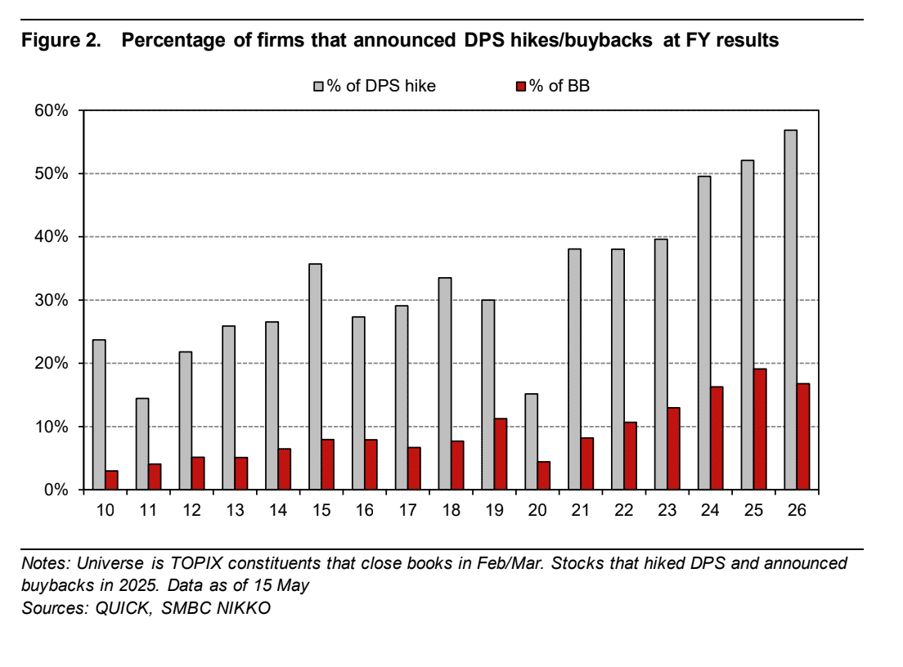
This is exactly the kind of behaviour Japan’s reform programme, driven both by the government and the Tokyo Stock Exchange, is trying to encourage.
It’s important because dividend upgrades are not usually made lightly. When companies raise payouts above previous expectations, it suggests greater confidence in earnings, cash flow and future capital discipline.
Looking long-term
The governance shift is also showing up beyond dividends and buybacks.
There has also been a rise in management buyouts, suggesting more companies are recognising that public market valuations need to be justified. Where they cannot be, pressure is building for alternative solutions.
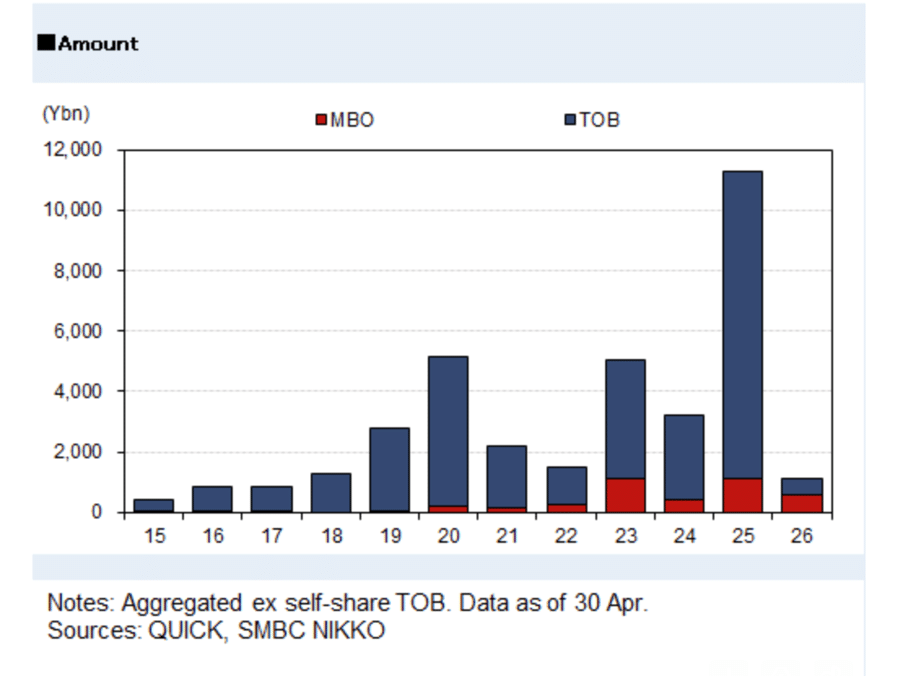
More governance proposals are also being put to annual general meetings.
That matters because it shows shareholders are becoming more active, and boards are having to engage more seriously with questions around balance sheets, capital allocation and corporate value.
Even if global market attention remains fixed on AI, we expect governance to remain near the top of boardroom agendas. Not least because Japan’s corporate governance code is due to be revised, keeping the pressure on companies to move from formal compliance toward even more meaningful governance reform.
Market recognition
Encouragingly, this comes just as the first phase of TSE reform is starting to show up in shareholder returns and valuations.
TOPIX price-to-book has risen markedly YTD, no reaching close to 1.9x (Source: Bloomberg as of 22 June 2026). At the same time, the proportion of Japanese companies trading below book value has fallen sharply, reaching its lowest level since the TSE reforms began in March 2023.
That is a clear sign that investors are starting to reward better capital discipline. It also suggests Japan’s valuation improvement is not only about higher earnings or AI-related excitement. It is also about a changing perception of corporate behaviour.
If higher valuations are supported by improving returns on equity, stronger shareholder distributions and better capital allocation, the market’s advance has a firmer longer-term foundation than one based purely on expanding AI multiples.
A durable foundation
AI will remain an important market theme, and Japan will continue to benefit from it. But governance reforms in Japan are not a cyclical play. They represent long-term structural market change that will see companies raising dividends, buying back shares, engaging more seriously with shareholder pressure and responding to the TSE’s capital efficiency agenda.
The latest results season suggests management teams are no longer treating this as a box-ticking exercise. They are responding with real actions.
And while Japan is not immune to global market risk and it will still be affected by swings in AI sentiment, it is not dependent on AI alone to gather momentum.
Main image: japan, alex-knight-Ys-DBJeX0nE-unsplash